You come back to a 2023 Model 3 after a long Fontana warehouse shift. The screen is black and the handles stay flush. The app shows the car offline. On a newer Model 3 or Y, that silence is often a lithium 12V shutdown. It followed a long inland sit. It isn’t always an empty drive pack.
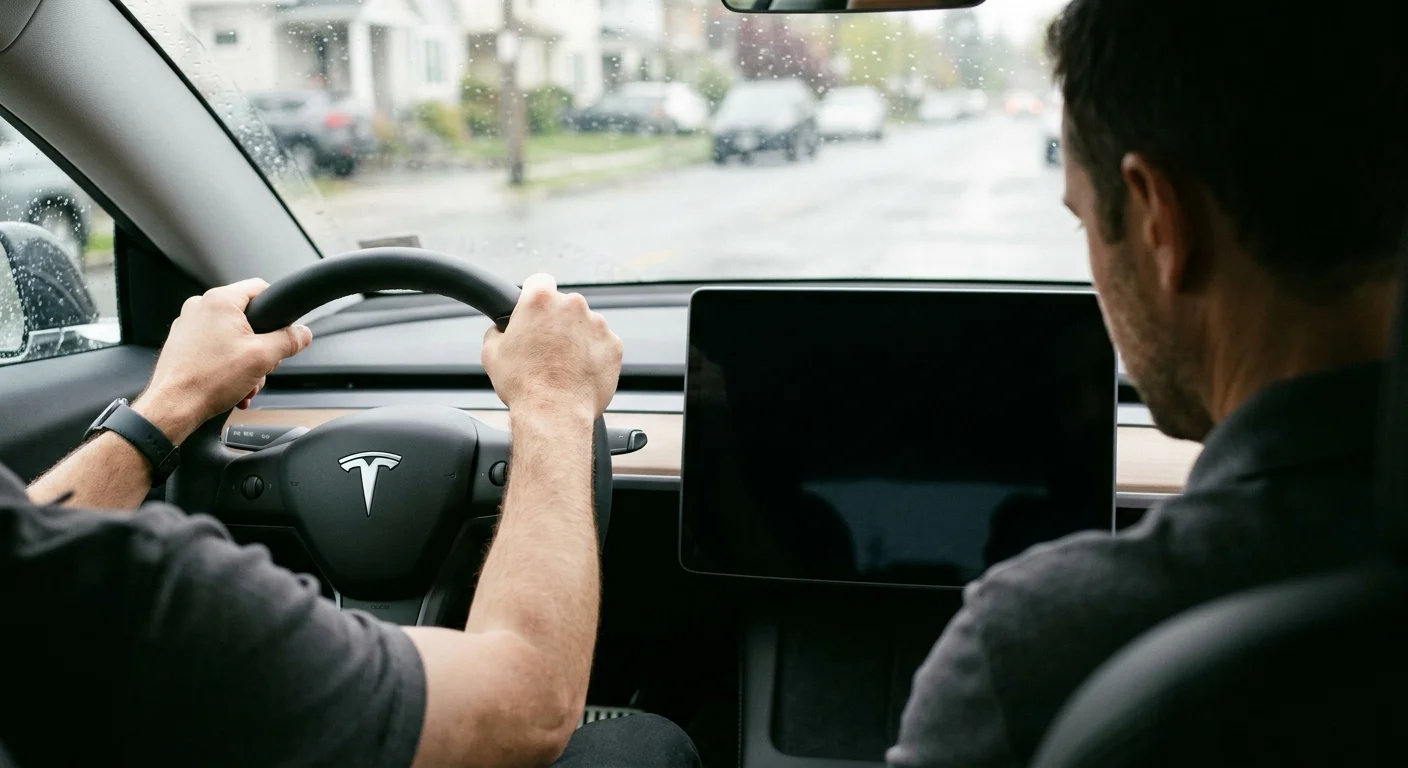
A lead-acid 12V used to fade in a familiar way. Many 2023 and later Model 3 and Y cars use a lithium 12V instead. Check your build in software or on the window sticker. The chemistry change alters the wake. It also changes what a hard jump can damage.
Why a lithium 12V still dies after inland sits
The 12V doesn’t drive the wheels. It powers locks, the screen, and the contactors. Those contactors connect the high-voltage pack. If the small battery is dark, the big pack can still hold range. The car just can’t use it.
Lithium 12V packs include a battery management system. When voltage falls too far, that system can shut the unit down. The cutoff protects the cells. After that, a typical gas-car jump often does nothing. A high-amp pack can also stress the car’s low-voltage electronics. You’re not spinning a starter. You’re feeding modest voltage so the car can wake. Then the DC-DC converter can draw from the drive pack and recharge the 12V.
Long inland sits set that cutoff up. A Model Y can sit all day in an Ontario airport lot or warehouse row. A Model 3 can sit through a night on a Fontana logistics row. Bloomington and Rialto feed that same warehouse belt. Eastvale and French Valley are full of newer streets. ACS 2019-2023 figures put Eastvale’s pre-1980 housing share at 2.2 percent. French Valley sits at 2.3 percent. The garages are new. The cars still sit for hours. Valley heat and High Desert heat do the rest. A weekend in Big Bear Lake adds a cold overnight.
Ontario’s housing stock is older. ACS 2019-2023 puts its pre-1980 share at 50.7 percent. San Bernardino is 60.9 percent. Riverside city is 56.4 percent. Those neighborhoods look nothing like an Eastvale tract. The 12V failure still looks the same. The car sat, and the lithium pack went into protection.
A silent Tesla in a busy lot is still a 12V problem. It isn’t a statement about plugs on that street.
Every current Tesla still has a 12V. For the layout by model, read whether Teslas have a 12V battery.
Dead 12V versus a dead drive pack
From the sidewalk, both failures look like a brick. They’re different jobs.
A dead drive pack is a range problem. You used the miles. The app may still open. Locks may still work for a while. You need energy put back in the pack.
A dead lithium 12V is a low-voltage outage. The screen stays dark, and the phone key fails. The charge port door may not move. A Supercharger can’t handshake with a car that has no 12V power. Destination plugs have the same limit. For a clean split, use how to tell 12V failure from a dead pack.
If you still had range this morning, start with the 12V. That holds on I-15 after the Cajon climb toward Victorville. It holds on I-10 through Colton and Redlands. It holds on SR-60 in Jurupa Valley. It holds on I-215 through Moreno Valley and Perris. An empty pack feels different. You watched the percentage fall.
Highland sits at the foot of the mountain climb. Yucaipa and Beaumont sit on the way up. A Model Y that won’t wake after a parked lunch is often the 12V. It isn’t the grade by itself. The grade matters when the drive pack was already low. Don’t mix those two stories.
Clues a 2023 Model 3 lithium 12V is going
The lithium unit often nags before it goes fully silent. The nags are easy to miss on a Corona to Ontario commute.
The screen may blank, freeze, or flash odd artifacts. Menus that used to snap open now lag. The car that woke as you walked up now pauses. A “12V Battery Service Required” alert is the direct warning. A low-voltage notice in the car or the app is next. Charging that stalls at the handshake can also trace to a weak 12V. That last one is less common.
Older Teslas with lead-acid packs showed dimmer analog signs. These newer cars mostly show software glitches. If two or three clues stack, get the 12V inspected before a full shutdown. Early tells also show up in Tesla 12V clues you can catch before a stranding.
A car that woke fine in Temecula can be mute by evening. A Moreno Valley work lot is a common place for that. Moreno Valley splits electric service. Southern California Edison covers much of the city. Moreno Valley Utility covers a newer pocket and publishes an address lookup. That split doesn’t kill a 12V. The hours of sitting do.
Riverside is different again. Riverside Public Utilities has served the city since 1895. Colton owns the electric system inside city limits. Banning runs a city electric utility. Rancho Cucamonga has a municipal pocket around Victoria Gardens and The Enclave. Day Creek Square and The Resort sit in that same pocket. SCE covers the rest of that city. Bear Valley Electric Service covers Big Bear Lake and Big Bear City. A dark home charger in those places is a power or panel issue. It’s separate from a 12V that died in a stall. Victorville’s municipal utility serves only the Southern California Logistics Airport and Foxborough Industrial Park. It doesn’t serve residential streets. A dark Tesla in a Victorville driveway is still SCE at the meter.
Get the door open, then the frunk
Access is the first wall. Phone key and key card both need 12V. Your owner’s manual covers the mechanical driver’s door. The physical key hides in the key card. Some builds also take a 9V battery on a contact on the lower front fascia. That can power the locks for a moment. Follow Tesla’s steps for your year. Don’t pry on the handles.
The frunk cable
Once you’re in, the screen still won’t pop the frunk. The electronic release is dead. You need the mechanical cable.
On many Model 3 and Y cars, the cable sits in the front passenger wheel well. Peel back part of the liner. Look for a loop or handle. Pull it firmly until the latches click, then lift the hood.
Jump posts usually sit under a plastic cover toward the windshield, near the wipers. Positive and negative are marked. Leave the cover on until you’re ready to clip.
The charge port
The charge port waits. A dead 12V typically leaves the port door and lock unresponsive. Wake the 12V first. Only then can the car take a plug, or release one. That’s why a Supercharger stall doesn’t help yet. The car can’t talk to the post.
Wake the 12V with a gentle feed
This is a wake, not a crank. Skip the running gas SUV in the next stall. Skip a large engine jump pack on full output. Those dumps can hurt a lithium 12V in protective shutdown.
Better sources, if you have them, are modest. A small 12V pack with a lithium recovery or boost mode. Another charged 12V auxiliary battery with proper clips. A smart maintainer, if you’re home with an outlet.
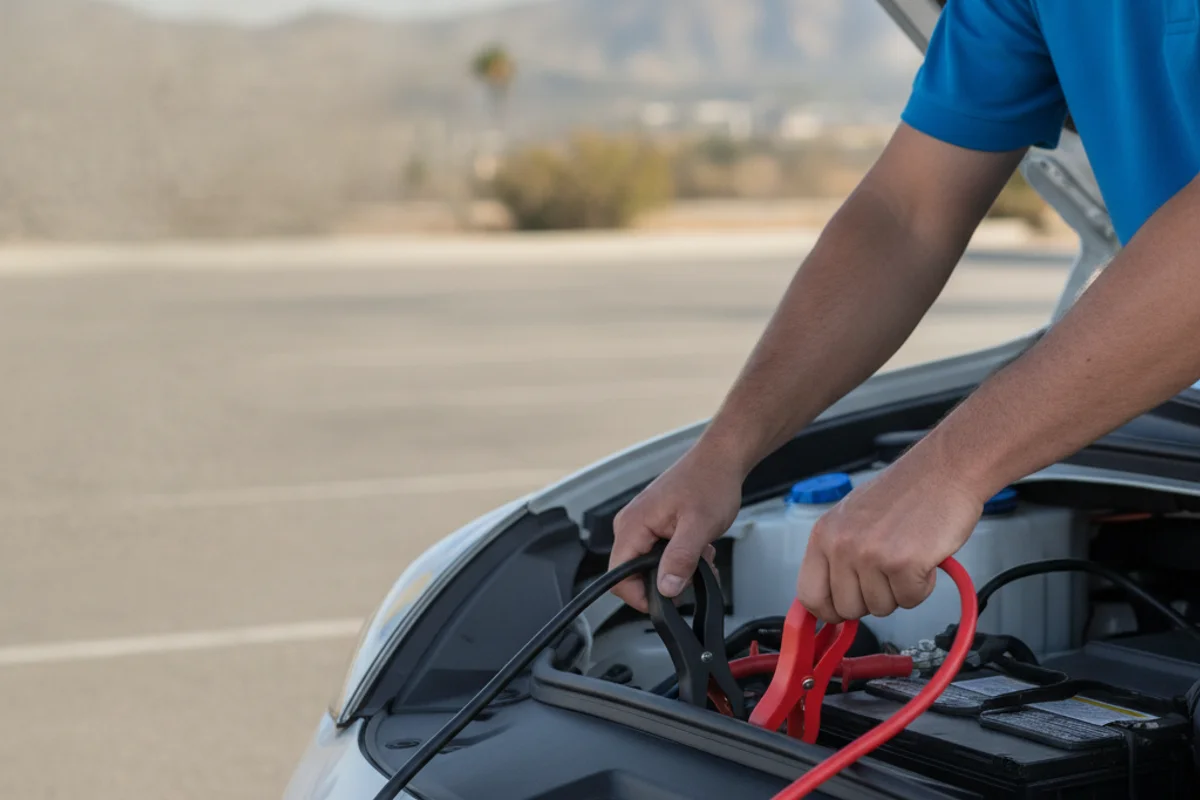
Clip the red lead to the Tesla’s positive jump post. Clip the black lead to the negative post, or to a clean chassis ground Tesla specifies. Keep the clamps off other metal, then wait. Give it a few minutes of steady, modest voltage. You may hear faint clicks as modules come up. Interior lights, a flickering screen, or a lock response means the low-voltage side is stirring.
Once it’s awake, the DC-DC converter should feed the 12V from the drive pack. Leave the donor source on a bit longer if the car still feels fragile. If you can then plug in at home or at a Supercharger, do it. That lets the system keep the 12V topped up.
If any of that feels wrong, stop. Reversed polarity or a huge current spike can turn a sit into a bigger mess. For clip order, see how to jump a Tesla Model 3, Y, S, or X.
Shoulder work has extra risk. I-15 through Cajon is a bad place to fight a wheel liner. So is the 91 in Corona. Ortega Highway near Wildomar isn’t better. Get out of the lane first. Then decide if you can reach the cable safely. A Chino work lot or an Eastvale cul-de-sac is a calmer place to try. A dark freeway shoulder isn’t.
A wake isn’t a repair
If the car returns, treat it as a ride to a charge. Get the 12V inspected after. A lithium 12V that hit hard shutdown once can do it again. Heat or a parasitic drain can put you back in the same lot. A worn 12V can too.
If it dies again after a jump, that isn’t a fluke. It usually means a failing 12V or an ongoing drain. What a 12V that dies again after a jump usually means covers that loop.
Replacement is a shop job. Charge Pro IE doesn’t replace parts. It doesn’t run a service bay. Local operators can wake the car. You can then roll to Tesla service or an independent shop. The operator quotes you before starting. The operator bills you directly.
Same pattern after a long destination sit. A day at Pechanga can leave a 2023 Model 3 dark. A Glen Helen show or a Cabazon lot visit can do the same. The drive pack may still show range. Mountain overnights in Lake Arrowhead, Crestline, or Running Springs add cold drain. High Desert sits in Victorville, Hesperia, Apple Valley, Adelanto, and Phelan add heat soak. The 12V doesn’t care that you parked at a busy place.
Chino Hills hillside homes see the same failure after a hot sit. Hemet and San Jacinto lots fail after a long errand. The map changes, but the lithium cutoff doesn’t.
When to hand it to a local operator
Stop DIY if the car stays dark after a careful wake. Stop if you don’t have a lithium-safe pack. Stop if you can’t reach the wheel-well cable without standing in a lane. Stop if this is the second death this month.
A mobile operator who works Teslas can jump the 12V on site. That’s the Tesla 12V battery jump path. If the drive pack is also low, they can bring a 240V Level 2 source. Teslas take a native NACS plug. Other EVs use a CCS or J1772 adapter. Operators typically add 10 to 20 miles of range. That takes 15 to 30 minutes of charging. That’s charging time, not an arrival time. Charge Pro IE owns no trucks and employs no technicians. It’s a referral line. It matches stranded EV drivers with independent local mobile rescue operators across the Inland Empire.
That includes valley cities, the 91 through Corona, and High Desert miles around Victorville. Operators handle Tesla and every major EV brand. They can also jump or replace a dead 12V on site.
A Model Y that won’t wake after a Yucaipa climb follows the same fork. Beaumont is the same call. So does a 3 that’s silent in a Rancho Cucamonga garage. A Menifee driveway after an Ortega day trip matches it. Confirm 12V versus pack. Then get a person with the right leads.
Call (909) 250-2881 when you want that match. Tell the operator where you are. They quote before they start.