A Tesla that won’t wake on the Cajon climb isn’t a flat tire. You’re on I-15 toward Victorville, or on I-10 through Colton. Two numbers sit in the phone, and they aren’t equals. AAA is a membership roadside club. A local Tesla rescue is a quoted visit from an independent operator. They don’t send the same truck. They don’t treat a dead pack and a dead 12V the same way. That’s the AAA vs Tesla roadside rescue question here. You want to know what actually shows up.
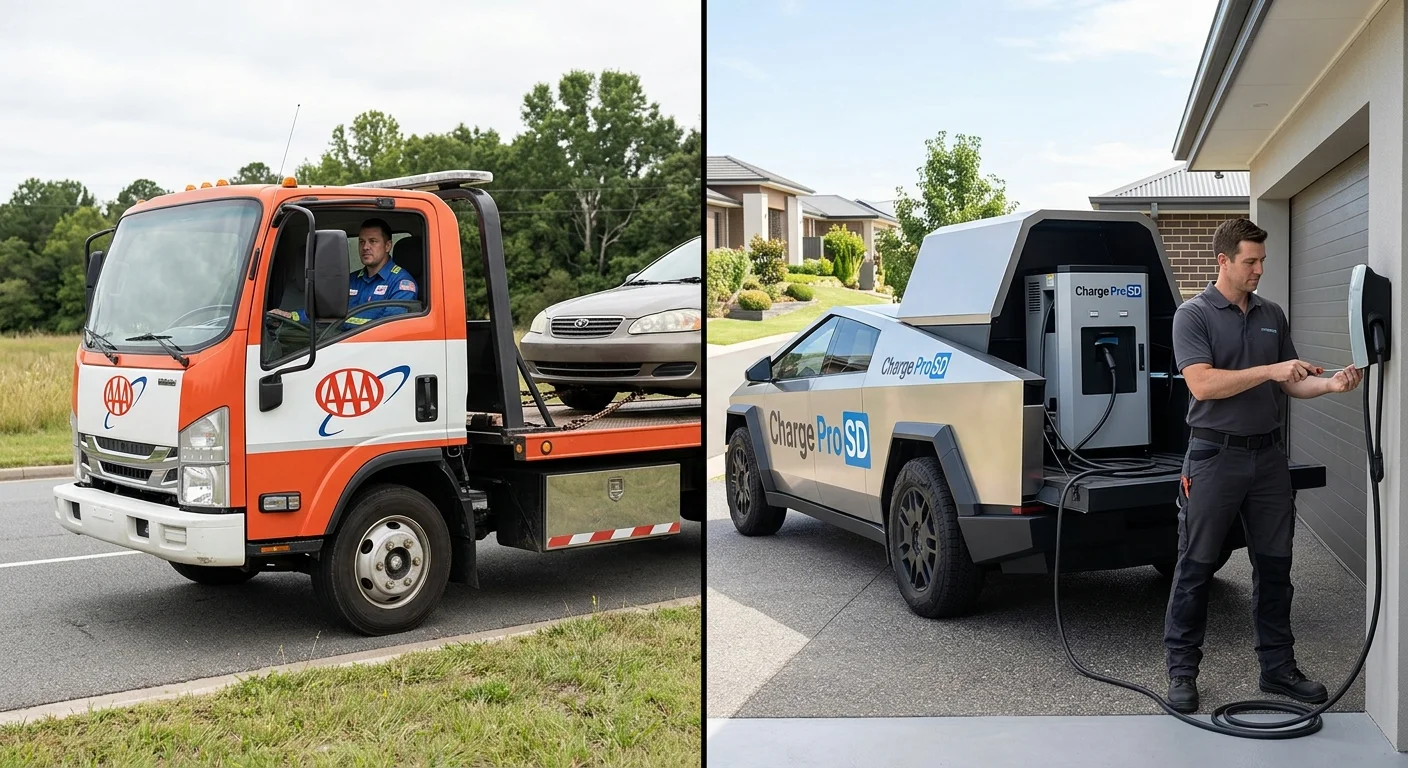
The logo on the door isn’t the job. The job is a boost, a tow, or a 240-volt top-up on site.
Membership club versus a quoted local visit
AAA sells a membership that covers many vehicle types. You pay whether you use the club or not. This page doesn’t publish AAA’s fees, call limits, or tier names. You have to confirm those details with AAA. When you request help, their dispatch sends whatever their network has. Ask them, before you wait, what they’re sending. Ask if it’s a 12V boost or a tow. Ask if anyone they send can add range on site.
Charge Pro IE doesn’t run a club. We don’t own trucks, a yard, or charging gear. We match stranded EV drivers with independent local operators. The operator quotes you before they start, then bills you directly. You’re buying that one visit, not a year of coverage.
That split matters in a market this large. Riverside County’s ACS 2019-2023 population is 2,478,600. San Bernardino County’s ACS 2019-2023 population is 2,197,104. A stall in a Fontana warehouse row isn’t a stall in Big Bear Lake. A stall on SR-91 in Corona isn’t a stall after Cajon into Hesperia. The person who quotes the job is the operator who works those roads.
Empty pack versus a 12V that took the car with it
Teslas still run a low-voltage 12V alongside the traction pack. When that 12V dies, the car can look fully dead. Screens stay dark, and handles may not act right. The traction pack can still hold miles. A generalist truck that only hears a dead car may default to a tow. A Tesla-aware operator checks the 12V first.
If the pack is actually empty, you have two honest paths. One is a tow to a working charger. The other is a mobile Level 2 hookup at the bumper. Operators we connect you with bring a 240-volt Level 2 source to the car. Teslas take a native NACS plug on that visit. Other EVs use a CCS or J1772 adapter. It typically adds 10 to 20 miles of range. That’s 15 to 30 minutes of charging, not travel time.
Ten to twenty miles is often enough to reach a Supercharger or home. For the 12V path, start with Tesla roadside rescue. For how the mobile visit works, read what a mobile EV charging visit actually is.
Inland roads change the job even when the car is the same
This isn’t one climate or one grade. The Inland Empire runs from Chino Hills ridgelines to High Desert flats. Then it climbs to Crestline, Lake Arrowhead, and Big Bear.
The Cajon climb on I-15 toward Victorville burns range on the way up. If the car already won’t wake, the descent doesn’t save you. I-215 through Moreno Valley and Perris is a long valley run. SR-60 through Jurupa Valley pins a dead Tesla against freight. SR-91 through Corona does the same in stop-and-go. The Ortega near Wildomar is a two-lane grade. High Desert miles near Adelanto, Phelan, and Apple Valley are long and exposed.
Mountain towns sit on different electric utilities than the valley. Big Bear Lake and Big Bear City sit on Bear Valley Electric Service. The City of Riverside is on Riverside Public Utilities. Colton and Banning each own a city electric utility. Rancho Cucamonga and Moreno Valley are split. SCE serves most of each city, with a municipal pocket on top. RCMU covers a southeast Rancho Cucamonga area around Victoria Gardens. MVU covers parts of newer Moreno Valley.
None of that sets a roadside price. It does show why a local operator is a different dispatch. Eastvale’s pre-1980 share is 2.2 percent on ACS 2019-2023. San Bernardino’s pre-1980 share is 60.9 percent on the same vintage. Temecula sits at 6.5 percent, and Crestline at 77.7 percent. New Eastvale and French Valley streets fail differently than older Upland or Redlands panels. On the shoulder, that home story doesn’t matter. You still need a 12V recovery or enough Level 2 range to move.
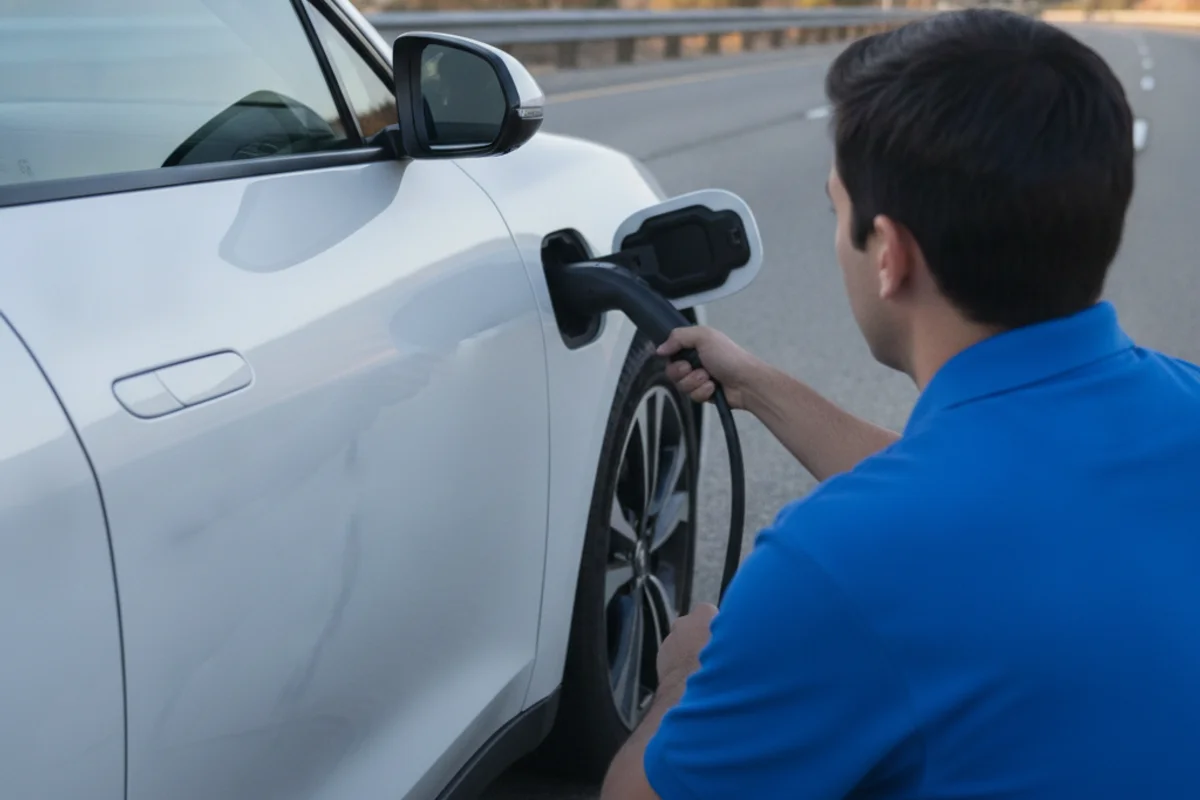
What to ask a club dispatcher
A membership roadside club is built for volume. Tesla’s own roadside channel is a third lane. Confirm with Tesla what your coverage still includes. Then compare the three options in Tesla, AAA, or local mobile rescue. For the local picture, read who actually helps a stranded Tesla in the Inland Empire.
Ask AAA these questions when you call. Ask if they’ll jump a Tesla 12V on site or only tow. Ask if they send anyone with a Level 2 source. Ask what your membership covers when the pack has no miles left. This page can’t confirm their answers, so get them from AAA. AAA sets those rules, and they change.
If the club’s plan is a tow, that’s a real outcome. You still need a method that protects the drive unit. You still need a charger at the other end that actually works. You stay with the car, take a quoted top-up, and drive it yourself.
For the club versus charge choice, see AAA or mobile EV charging when you’re out. On the Cajon shoulder, start with out of charge on I-15 at the Cajon climb.
What the local operator quotes before they start
Charge Pro IE is a referral line, not a licensed contractor. We don’t employ technicians, and we don’t set the price. The independent operator who accepts the job quotes you first. They quote before they plug in or clamp on. If you don’t want the quote, you don’t start.
They handle Tesla and every major EV brand. A 12V jump or replacement happens on site. A Level 2 session happens on site. You’re buying that visit, not a membership.
That’s the cost comparison you can actually use. AAA’s annual fee is a prepaid club product. Confirm the current price with AAA. A local rescue is a one-time quote for the car in front of them. Neither figure belongs here as a guessed average. The operator’s quote is the number that matters for that stall.
Match the call to the failure
Call AAA if you already pay them and their answer matches what you need. A tire, a lockout, or a tow they’ll cover is a club job. Call Tesla’s own roadside line if that coverage still applies. A Level 2 top-up where you sit is a local rescue call. A Tesla-aware 12V recovery is the same kind of call.
Fontana warehouse lots and Ontario airport rows are in the service area. So are downtown Riverside and the I-10 climb at Banning. We serve every city in the Inland Empire. The match is still to an independent operator, not to a brand-owned truck.
Make the call with the car in front of you
Don’t wait on a logo, and name the failure. Name whether it’s an empty pack or a 12V that killed the screens. Name Cajon, the 91, I-10 through Redlands, or SR-60 in Jurupa Valley. Ask what is coming: a tow, a boost, or a 240-volt source. Ask for the quote before anyone starts.
Charge Pro IE will match you with a local operator who does that. Call (909) 250-2881 when you want that match. The operator quotes, you decide, and they bill you directly.