The Cajon climb on northbound I-15 toward Victorville eats EV range. Estimated miles fall faster than real ones the whole way up. If you’re already on the shoulder, stay put, stay visible, and call. If you can still roll, make Victorville the stop, not a pass-through.
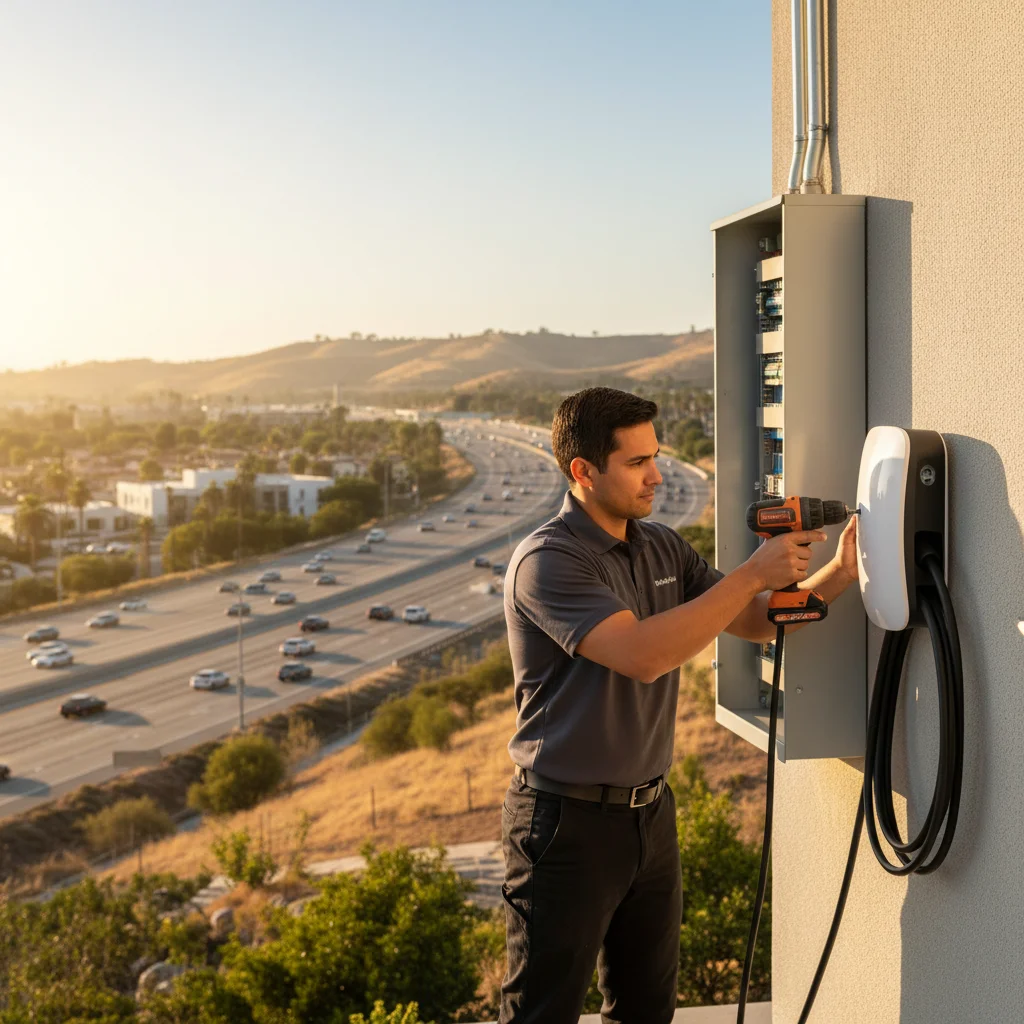
The climb has two names, and they are not the same
People treat Cajon Pass as one crest. It isn’t. USGS lists Cajon Pass and Cajon Summit as separate gaps. The named pass sits at about 3,779 feet. Cajon Summit is higher, about 4,261 feet. The I-15 high point is Cajon Summit, north of the pass proper. A 4,190-foot freeway summit figure shows up in casual talk. It could not be confirmed against Caltrans or USGS. A published grade percentage could not be confirmed either. If you need a number, use the USGS elevations. If you don’t, skip the number.
The road is much lower when the climb starts. At the Devore junction of I-15 and I-215, you’re around 2,030 feet. Victorville, the largest High Desert city, sits around 2,878 feet. You climb through those named gaps, then drop into the Victor Valley. Southbound, regeneration on the descent gives some of that energy back. Northbound, you pay for every foot in the pack.
The range number that ticks down while you climb
Drivers describe the same moment on this corridor. The estimated range falls far faster than the miles. The number drops every few seconds while you’re still climbing. That’s the most consistently described EV complaint in this region. It isn’t a software glitch. The motor is working against elevation. Cabin cooling is often already on. The car’s guess was built on flatter, cooler miles behind you.
Southbound is the reverse. Regeneration on the drop can make the estimate look generous. Then the grade eases and the number corrects. Either way, don’t spend the last buffer on a guess.
Victorville is not a hotter Riverside. It’s a different climate zone. The city averages roughly 42 days a year at or above 100 degrees. That’s about twice as many as Riverside. Summer air conditioning runs from morning into the night. The town also sits nearly three thousand feet up. Winter nights freeze in a way the valley does not.
Cold cuts pack range more than heat does. Heat is harder on the 12-volt battery than most owners expect. A car that felt fine in San Bernardino can look empty after the climb. After a long stop in a hot lot, it may not wake at all. If the dash is dark and the handles don’t pop, think 12-volt first. An empty traction pack and a dead 12-volt are different jobs.
Victorville is the staging city for a reason
Victorville is the largest city in the High Desert. ACS 2019-2023 puts the population at 137,627. The 2024 estimate is 140,721. I-15, US-395, and SR-18 all meet this town. SR-18 runs through as Palmdale Road and D Street. Bear Valley Road, Hesperia Road, Mojave Drive, and Air Expressway come up on calls. Neighbors are Hesperia, Apple Valley, Adelanto, Oak Hills, Spring Valley Lake, and Phelan.
Public charging exists here. Two Tesla Supercharger sites in Victorville have 16 stalls each. Electrify America, ChargePoint, and EVgo locations are in town as well. The problem on this page is not a missing plug in the city. The problem is the climb you already paid for. Heat and the long I-15 run north add to it.
North of Victorville, I-15 continues toward Barstow, Baker, and Las Vegas. Drivers stage here or in Barstow before that trip. A misjudge in the Victor Valley still leaves you near town and near help. A misjudge after you’ve left the valley is a longer night. If the estimate is collapsing on the Cajon climb, get into Victorville and stop. That’s what this city is for on an EV trip.
Once you’re off the freeway, EV roadside assistance in Victorville covers getting moving in town. The Victorville charging page is the planning version of the same place.
What to do if you’re already on the shoulder
Pull as far right as the pavement allows. Turn the hazards on right away. Exit on the passenger side if you can. Don’t stand in the gap between your car and traffic. Stay with the vehicle. Walking the Cajon shoulder in heat or dark is a worse plan. Waiting with the car is safer.
Report the stop to CHP. A mile marker is best. The last exit you passed works. Nav coordinates work. Somewhere by Cajon does not. This is a fast freeway with limited sight lines in cuts and curves.
If the car still wakes, a mobile charge can add range on the shoulder. That’s out-of-charge recovery. If it won’t wake, say that. A 12-volt jump or replacement is a different visit from a pack top-off. A tow is the tool when the car cannot take a charge. It’s also the tool when the car cannot sit safely where it is.
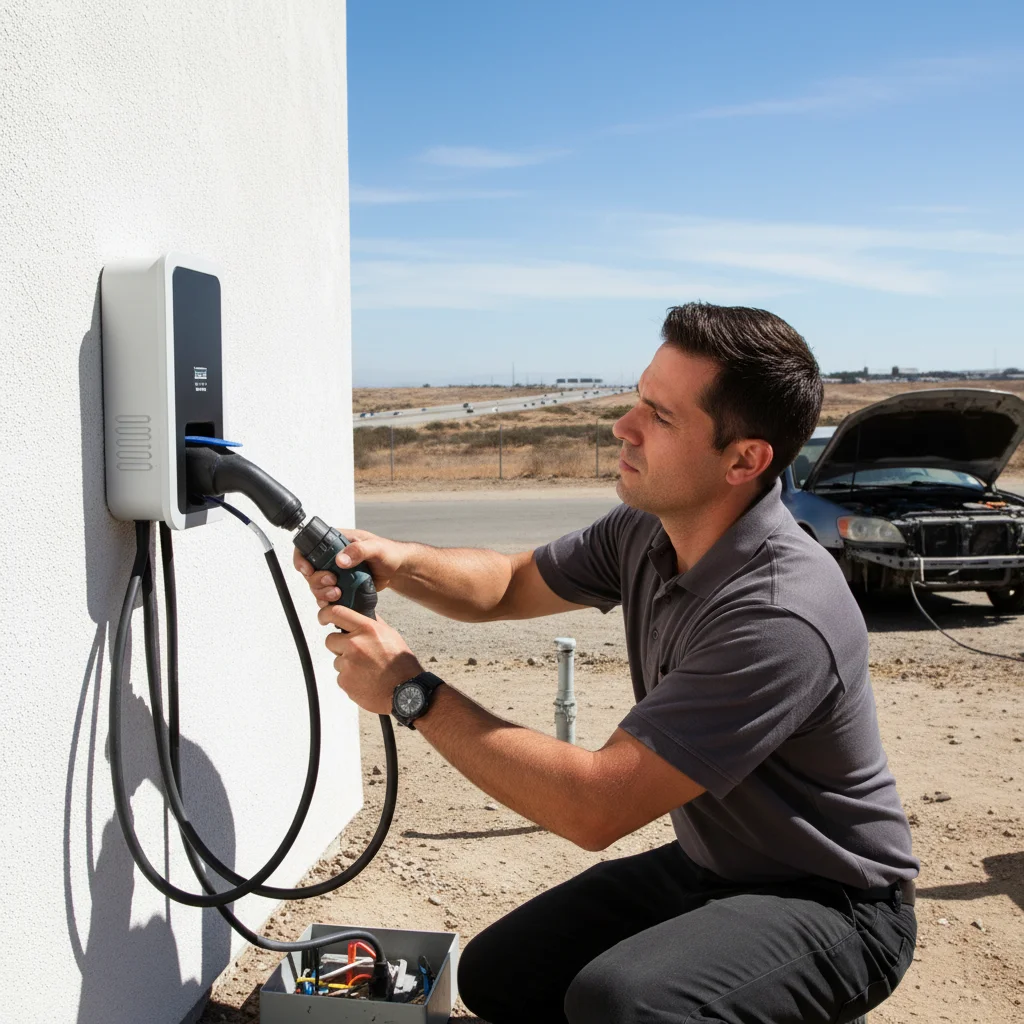
What a mobile charge on this corridor actually does
Charge Pro IE is a referral line for the Inland Empire. We don’t own trucks. We don’t employ technicians. We don’t set prices. We match stranded EV drivers with independent local operators. The operator quotes you before work starts. The operator bills you directly.
The typical visit is a 240-volt Level 2 hookup at the car. Teslas use a native NACS plug. Other EVs use a CCS or J1772 adapter. Charging time is usually 15 to 30 minutes. That’s not travel time. A visit like this often adds about 10 to 20 miles. That’s usually enough to leave I-15 and reach a stall in Victorville or Hesperia. It’s not a full charge. It’s not a scheduled arrival.
Mobile EV charging is the service name for that visit. What a mobile EV charging visit actually is walks through the same job. Operators in the network handle Tesla and every major EV brand. They can also jump or replace a dead 12-volt on site. That’s the call when the pack still has energy. The car still won’t wake.
What to say so the operator brings the right gear
Give a hard location. Northbound or southbound. Cajon climb or already in the Victor Valley. Right shoulder. Last exit, mile marker, or coordinates. Near Victorville wastes a round of questions.
Give year, make, model, and color. Plug type follows from that. A Model 3 and a Mach-E are not the same setup.
Give the car’s state. Still in gear at a low percent is one case. Fully shut down is another. Mention a 12-volt warning if you had one. Mention a patrol unit if one is already with you.
If you’re still moving, don’t wait for a narrow shoulder. What to do before you strand is for that earlier window. Once you’re stopped, you’re in recovery.
Edison at the house, a city utility at the airport
Residential Victorville is Southern California Edison. Victorville Municipal Utility Services is real, and it is easy to mix up. VMUS serves only the Southern California Logistics Airport and Foxborough Industrial Park. The city utility states it doesn’t serve residential areas at this time. That split matters for a home charger in Eagle Ranch or Old Town. It doesn’t change the I-15 call. It also explains the warehouse and fleet EVs around the former George Air Force Base.
A van that left the logistics airport already low can stall on Air Expressway. It can also die on the ramp to I-15. That’s the same referral and the same Level 2 visit. The operator still quotes before starting.
Old Town, Spring Valley Lake, Eagle Ranch, and Brentwood share this climate. So do Mojave Heights and the Hesperia Road corridor. The Mall of Victor Valley and Victor Valley College are easy pins. So are the California Route 66 Museum and Mojave Narrows Regional Park. The Mojave River and its narrows sit just east of the old alignment.
Use the valley, then stop
The Cajon climb and the long High Desert miles are the problem. This page is for that mix. Not because Victorville lacks stalls. Elevation, heat, and the next stretch of I-15 ask more of the pack. A valley commute doesn’t. If you burned the buffer on the way up, take the recovery in town. Out of charge on High Desert miles near Adelanto is the next version. That’s what happens when people skip this stop.
When the pack is gone on I-15, call Charge Pro IE at (909) 250-2881. We’ll connect you with a local operator who quotes the job before it starts. This page doesn’t publish an arrival time. Traffic, the pass, and the operator set that, not the referral line.