You parked at Ontario International Airport, flew out, and came back to a silent EV. Handles stay flush, and the app won’t connect. Lights stay dark on a car that still has a pack. That stall is usually a dead 12-volt, not an empty pack. Warehouse vans south of Mission Boulevard hit the other Ontario pattern. The route ran long, and the traction battery is sitting on empty.
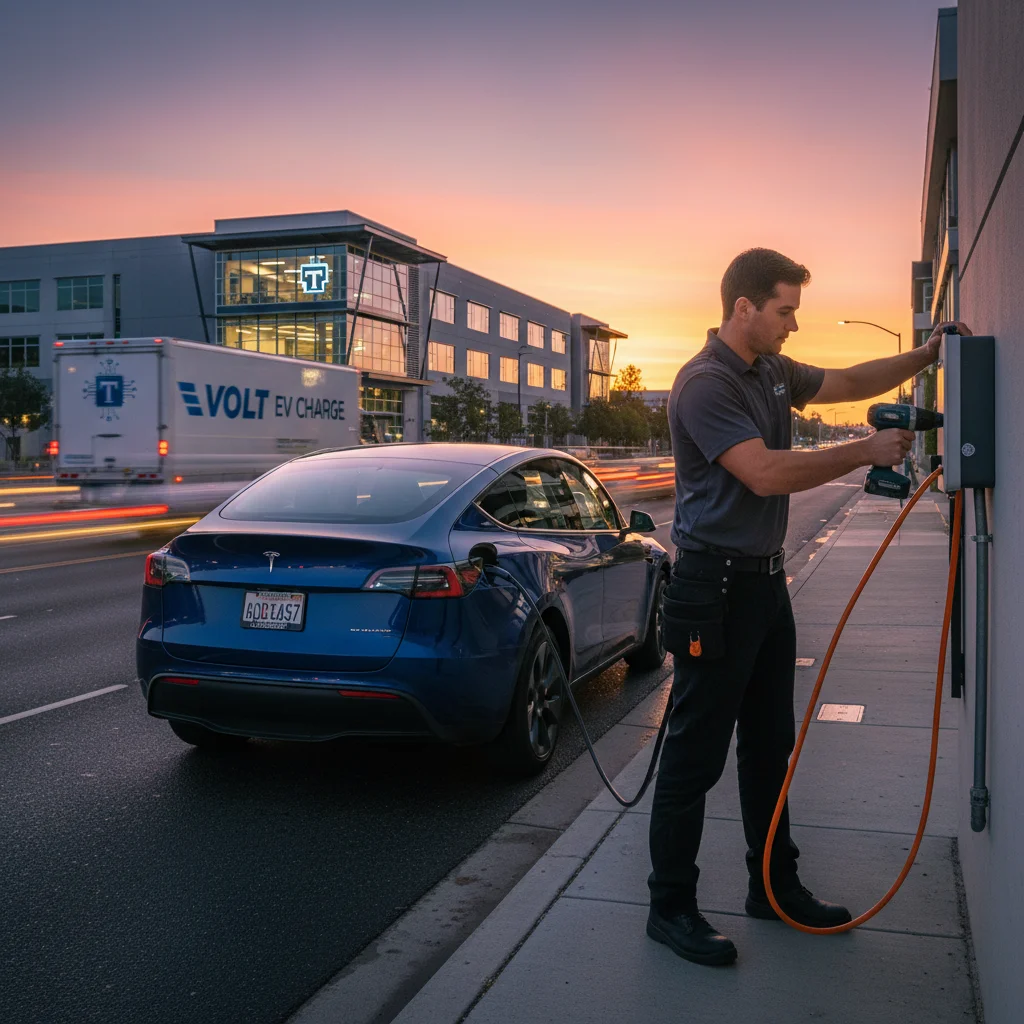
A week in ONT parking often kills the 12-volt
Ontario is boxed by two interstates, a state route, and an international airport. I-10, SR-60, and I-15 to the east wrap the field. In 2025 the Ontario International Airport Authority reported 7,116,735 passengers. Cargo hit 835,129 tons the same year. A lot of those trips leave an EV in a surface stall for days.
The small 12-volt battery keeps computers, locks, and the wake circuit alive. Heat soaks that 12-volt battery while you’re gone. The main pack can still hold plenty of miles. The car looks fully dead from the curb. A dark Tesla isn’t always an empty pack. Start with Dead Tesla: how to tell 12V failure from a dead pack.
Ontario sits on the valley floor, with no marine breeze. There’s no elevation here to cool a lot. Cabin heat here builds from May through October. A parked EV still takes that heat soak. Accessory drain plus heat is how a 12-volt fails in long-term parking.
A flatbed is the rescue most travelers picture, and it’s often wrong. A jump or an on-site 12-volt swap is what usually wakes the car. The operators we connect you with handle that on Tesla and other brands. The Tesla 12V jump path is the usual first move.
Lots 2 and 4 publish the free chargers
ONT publishes free EV charging on the south side of Lots 2 and 4. Those lots sit in front of the terminals. Parking fees still apply when you use those stalls. Port counts and plug types couldn’t be confirmed from a clean page read. Check the airport FAQ before you count on a stall.
Long trips usually land in the surface economy lots, not at the terminal curb. ONT lists Lot 5 and Lot 6 as economy parking with a shuttle. Confirm names, shuttle points, and the live charging map on flyontario.com. Lot labels change, and this article isn’t ONT’s map.
All ONT lots are surface lots today, with no parking garage. A garage is proposed under ONT BOLD, and it isn’t in service. The Cell Phone Waiting Lot on John Bangs Drive is for pickups, not overnight storage. Valet sits at the Terminal 2 or Terminal 4 center curb.
A week of valley-floor sun can flatten a 12-volt in any lot. If you’re in economy parking and the app is mute, start with the 12-volt. Don’t assume the traction pack is empty yet.
Warehouse rows, shift changes, and empty vans
Ontario’s second stranded-EV call is a work van, not a suitcase. The warehouse belt south of Mission Boulevard runs last-mile and logistics routes all day. Drivers often finish a route already low on charge. A late gate or an extra stop can strand the van after dark. Stop-and-go on Milliken and Haven at shift change eats the rest. Range dies on clock time here, not on highway miles.
That’s an empty pack, not a 12-volt. The operator who shows up brings a 240-volt Level 2 source to the stall. Tesla gets a native NACS plug on that visit. Other EVs use a CCS or J1772 adapter. A typical session adds 10 to 20 miles in 15 to 30 minutes of charging. That clock is plug time, never an arrival time.
Mobile EV charging is the visit for an empty van. Fontana’s warehouse lots see the same van stall. Ontario’s grid is tighter than a single industrial park. Airport traffic, Ontario Mills, and the warehouse belt share the same surface streets. Fontana’s sibling write-up is A dead EV by a Fontana warehouse.
I-10, SR-60, and Holt apartments
Some drivers were only crossing on I-10 or SR-60. The remaining miles didn’t match the next stop they had in mind. Euclid, Vineyard, Archibald, Haven, and Fourth Street catch those exits.
Holt Boulevard is a different slice of the same city. Older apartments along Holt and in central Ontario often have no home plug. About 50.7 percent of Ontario housing was built before 1980, per ACS 2019-2023. Those households live on public charging, with less margin when a stall is down.
If the pack is empty on the shoulder, you need miles. If the car is dark in a lot, you likely need the 12-volt. Mixing those two is how a simple stall becomes a tow you didn’t need. Call for EV roadside assistance once you know which failure you have.
Southern California Edison serves Ontario, which matters for home rates. It doesn’t power a dead van in a warehouse row. The operator’s truck is the source on site. The city page at EV charging in Ontario covers the broader map.
What Charge Pro IE actually is in these lots
Charge Pro IE is a referral line for the Inland Empire. We connect stranded drivers with independent local mobile rescue operators. We own no trucks, employ no technicians, and set no prices. The operator quotes you before work starts and bills you directly.
That still helps at ONT and in the industrial belt because the pavement is open. There’s no garage ramp for an operator to negotiate. An operator can pull beside the car in a surface stall. You don’t push the EV to a marked charger.
Operators typically jump or replace a dead 12-volt on site. They can also add Level 2 range so you can drive out. They handle Tesla and every major EV brand. They don’t rebuild a failed traction pack on the lot. They don’t tow unless you hire a tow separately.
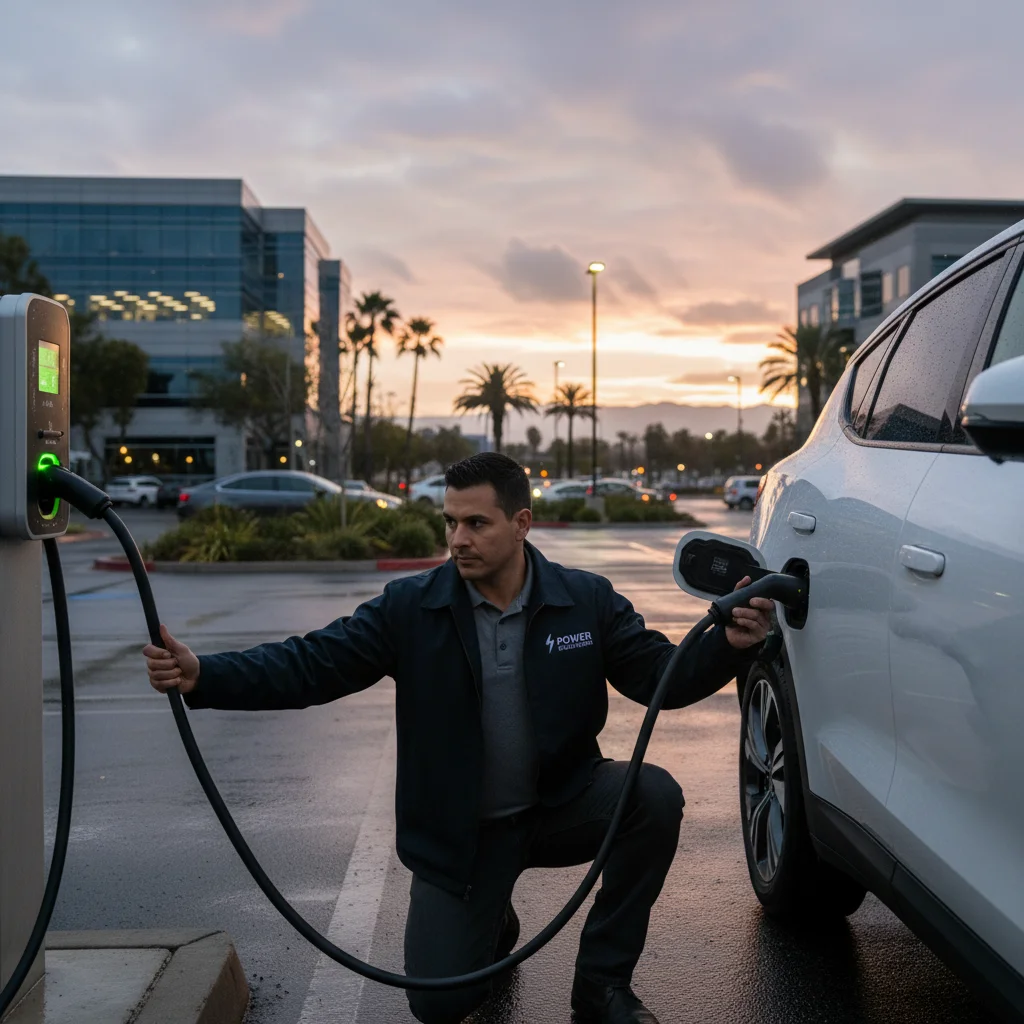
Read What a mobile EV charging visit actually is, and isn’t for the limits.
A tow through airport parking is a longer night
A silent EV in economy parking looks like a tow job you don’t need. A flatbed through a shuttle lot stretches a late landing. Loading a low car adds handling you don’t need. Skip that if the 12-volt was the only fault.
If the main pack is empty, a mobile charge keeps the car in the stall. You drive it out once the display shows miles. Warehouse driveways south of Mission follow the same logic. A bed in a gated row at shift change is a bigger production. A Level 2 hookup beside the van is the smaller move.
This page can’t quote a fee or an arrival time. Ask the operator on the phone for both. Tesla roadside is a separate choice from a local operator. Some owners call Tesla roadside before anyone local. They still need a local operator when the 12-volt is the real fault.
Ontario isn’t one stall pattern
Montclair, Chino, Upland, Rancho Cucamonga, Fontana, and Eastvale sit on the city’s edges. Downtown Ontario and the airport district don’t fail the same way. Ontario Ranch, Guasti, Creekside, and the Mills area each have their own stall pattern. Newer Ranch streets are more likely to have a home plug. Holt and the older central blocks usually don’t. Toyota Arena and the Ontario Convention Center dump event traffic onto warehouse streets.
This post is for the airport lot and the Mission warehouse row.
Call when the car won’t wake, or the van won’t roll
Open the app one more time before you assume the pack is dead. If it stays silent, treat it as a 12-volt. Stop cycling the handles once the app stays mute.
Confirm the lot on flyontario.com before you guess which field you’re in. Lots 2 and 4 are the premium lots in front of the terminals. ONT publishes the free chargers on the south side of those lots. Economy parking is a different surface field from those terminal lots.
If you’re in a warehouse row, note the gate and the building. Also note whether the van still has propulsion. Empty pack and dead 12-volt need different tools.
Then call Charge Pro IE for a local roadside operator. They can jump the 12-volt or bring Level 2. Call (909) 250-2881 when you’re ready for an operator quote. The operator quotes the job before they start, and we don’t promise when they arrive.