A dark Tesla on Inland Empire pavement isn’t one failure. It’s two electrical systems, and Tesla’s own manual links them. When the high-voltage pack hits empty, it stops supporting the 12-volt battery. The 12V then drops, and the car goes fully silent. That’s the tesla battery dead stall people describe from the curb. You still need to know which layer failed first. The next step isn’t the same.
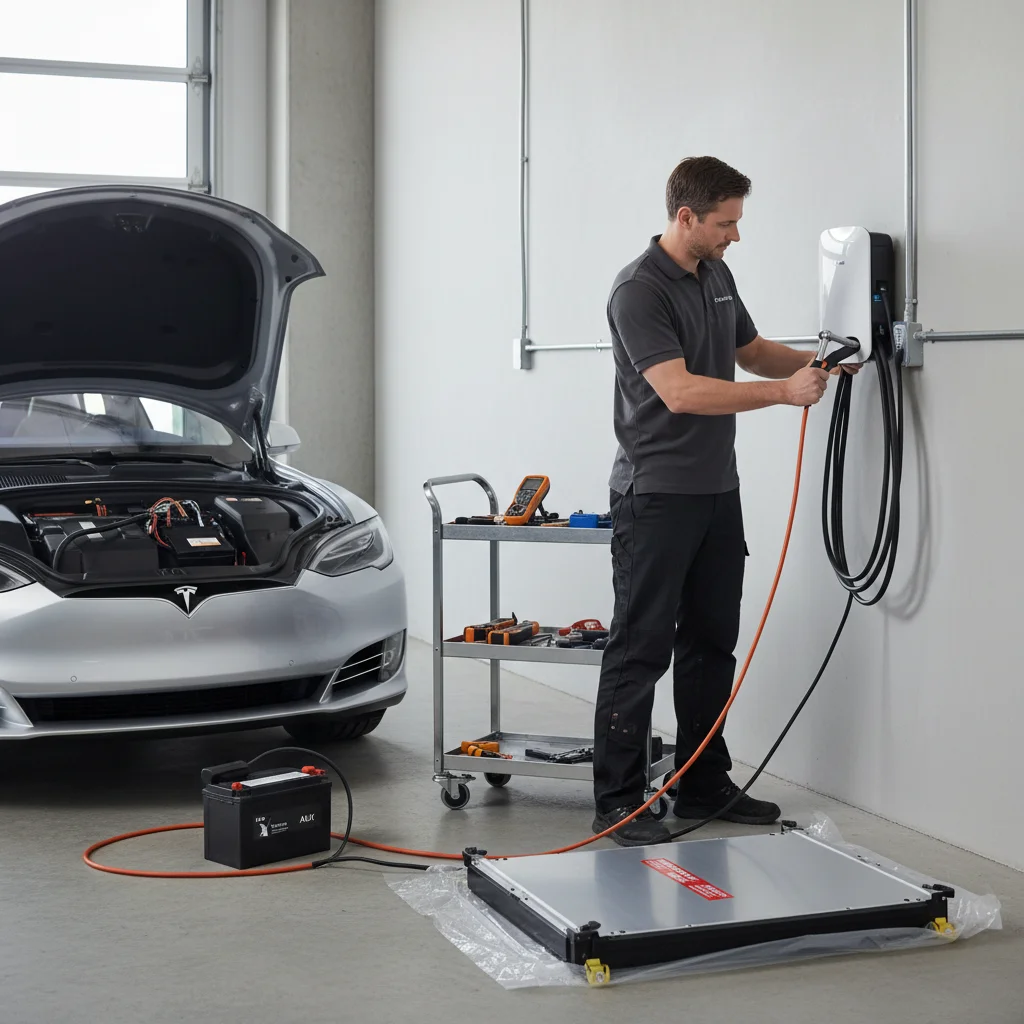
Tesla’s manual: empty pack, then 12V support stops
Tesla doesn’t treat these batteries as unrelated. In normal use the traction pack keeps the 12V charged. That small battery runs the computers, locks, and lights. It also runs the contactors that close the high-voltage circuit. If the 12V is dead, the pack can’t connect. A full pack still leaves you stranded.
The reverse is the warning owners skip. Tesla’s published guidance is plain. A traction pack that’s too discharged can’t keep the 12V alive. Roll to empty, then sit, and you inherit a second failure. The app goes quiet, handles stay flush, and the cabin stays dark. You now have a dead 12V sitting on an empty pack.
That sequence shows up on inland routes all the time. A Tesla that reaches the Cajon climb already low can empty the pack before Victorville. Then the car sits, and the 12V follows. The same stack happens after a long sit in a Fontana warehouse row. It happens after a mountain day toward Lake Arrowhead too. The scenery changes, but the electrical chain doesn’t.
A pack that’s only empty needs energy. A 12V that’s already gone needs a jump before the car will even listen. Tesla’s own jump-start pages describe that order. If you want the curb checklist, use the diagnose and jump steps. For the empty-pack side, that’s out-of-charge recovery.
Start with the last thing the car told you
Before you call anyone, rebuild the last known state. That history is the diagnosis.
If the last app glance showed comfortable range, and the car sat overnight, start here. The pack almost certainly didn’t drain to zero by itself. A 12V that failed on its own is the lead suspect. That pattern shows up in Ontario driveways, Riverside curbs, and Moreno Valley apartment lots. Last night’s rated miles are the clue.
The car slowed as the miles fell, then it stopped. That’s pack empty until you prove otherwise. Accessory mode can do the same. So can a charge session that never started. Inland Empire homes aren’t on one utility. Southern California Edison serves most cities in this market. Riverside Public Utilities serves the city of Riverside. Colton owns the electric system inside its limits. Banning runs a municipal electric utility. Bear Valley Electric Service covers Big Bear Lake and Big Bear City. Moreno Valley and Rancho Cucamonga are split. If you plugged in at home and woke to a brick, confirm the session ran. The utility name doesn’t diagnose the battery. It does tell you who to ask about an overnight outage.
If you drove to empty, then sat, assume both. Tesla already told you the 12V would lose support. For the Cajon shoulder specifically, out of charge on I-15 walks the next move.
Signs the 12V failed by itself
Work this list against what you see.
The car doesn’t wake at all. Model 3 and Model Y handles stay flush. Model S and Model X handles may be there, but nothing unlocks. The touchscreen stays off, not dim, even after the brake and the app. The Tesla app can’t reach the car, and wake commands do nothing. This isn’t a weak phone signal. The car just isn’t answering.
You hear no chime, no fan, and no click from the door hardware. Quiet is a 12V tell. Phone key and key card both fail. Those readers run on the 12V system. You parked with range on the screen. You didn’t drive it to a stop. That history points at the small battery, not the pack.
Teslas do have a 12V, even when people swear they don’t. The layout varies by model. The model-by-model 12V guide maps where it sits. Newer Model 3 and Y cars may use a lithium 12V, not lead-acid. The symptoms from the curb still rhyme.
Signs the pack is empty while the 12V is still up
A depleted traction pack looks different while the 12V is still alive and talking. The screen boots, and you may see a low-charge warning or a charge-now alert. The car has enough low-voltage power to complain. The app reports a very low state of charge, sometimes single digits or zero. Doors unlock, handles present, and lights work. You can sit in a quiet cabin that won’t roll.
You drove until traction cut, or you parked low and never charged. The car may creep a few feet, then refuse. That’s pack empty with a living 12V, and infotainment still on.
A 12V jump doesn’t put miles in the pack. You need energy in the high-voltage battery. The operators we connect you with bring a 240V Level 2 source. Teslas take a native NACS plug. Typical charging time is 15 to 30 minutes. That usually adds about 10 to 20 miles of range. That’s charging time, not a promise of when someone arrives. It’s enough to roll toward a Supercharger you can confirm in the Tesla app. The Department of Energy’s AFDC map is a second way to confirm public stalls.
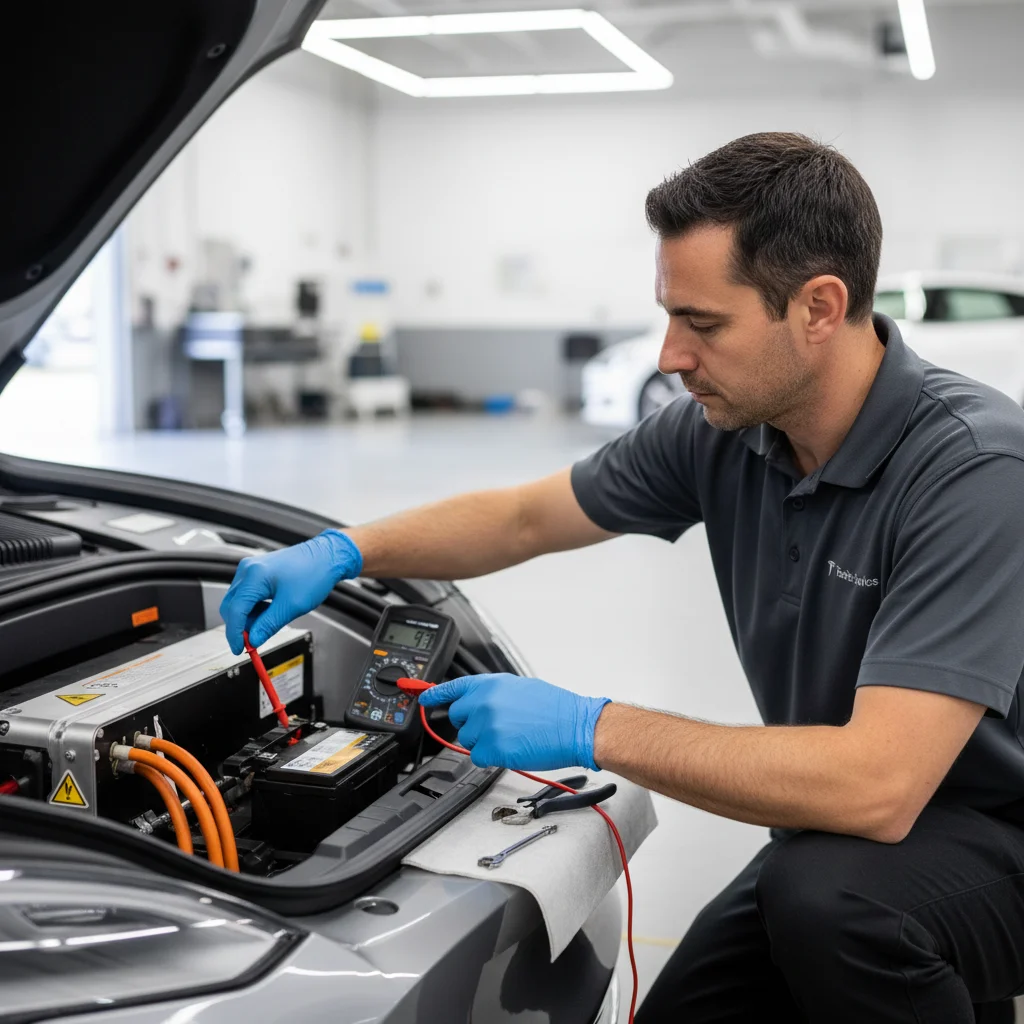
When both have already stacked
This is the inland case Tesla’s warning is about. You emptied the pack. Then you sat, and the 12V died on top of it. Now the app and screen are dead, and your last miles were already gone. Treat it as two jobs. Wake the 12V first, so the contactors can close. Then put energy in the pack. A 12V jump alone can wake a screen on a car that still won’t drive. Charging only the pack can’t start if the car can’t wake.
An Ontario airport employee lot is a classic sit. So is a warehouse row off I-10 in Colton. Time parked is what lets the 12V follow the pack down.
Operators in this network handle Tesla and the other major EV brands. They can jump or replace a 12V on site. They can also bring that Level 2 source. Charge Pro IE doesn’t own the trucks. We match you with independent local operators. The operator quotes you before work starts, and bills you directly.
What you can try from the bumper
Tesla publishes jump points in the owner’s manual and on its support site. On most Model 3 and Y cars, a manual frunk release sits behind the front bumper. The positive post is usually under a red cover in the frunk. Negative goes to a chassis ground Tesla specifies. Use a known-good 12V source. Follow Tesla’s polarity, and don’t guess.
A jump only helps if the 12V is discharged, not internally failed. If the car dies again the moment you pull the clamps, that battery is done. Replacement, not another jump, is the next step. Use the Model 3, Y, S, and X jump walkthrough if you have the gear. Stand somewhere safe before you clip on.
Don’t try to refill an empty pack from a household outlet on a live shoulder. A Level 1 cord is a home tool, not a freeway tool. If the pack is critically low, the car may need Tesla’s wake sequence first. You can’t improvise that from memory on I-10 through Colton.
If you see crash damage, flood water, or a non-battery fault, stop. Don’t jump it, and don’t charge it. That’s Tesla Service territory, not a roadside top-off. A tow is a different job when jump and charge both fail. Towing with the drive unit loaded the wrong way can damage it. Follow Tesla’s published transport steps, or wait for an operator who already knows them. For a 12V wake, not a pack fill, ask for a Tesla 12V battery jump.
Who to call once you know the layer
If the screen is on and the app shows empty, ask for out-of-charge recovery. If the car is silent and last night’s range looked fine, ask for the 12V jump. If you drove to zero and then sat, say that out loud. The operator needs both jobs on the ticket.
Someone with a gas-car jump pack who can’t find Tesla’s posts is a common miss. Model 3 and Model Y hide the frunk release. Model S jump points aren’t a Honda layout. Tell the person who shows up which model you have.
Charge Pro IE serves the Inland Empire. That includes I-215, the 91 and 60, and the High Desert. The mountain communities are in the service area too. We don’t hold a contractor license, and we don’t perform the work. The pros we connect you with are licensed and insured. They quote before they start any work.
If you’re locked out of a dark Tesla anywhere in this market, call (909) 250-2881. Tell the operator the last range you saw and whether the app still pings. Also say if the cabin screen boots. That’s enough to match you with an independent operator who has the right gear.