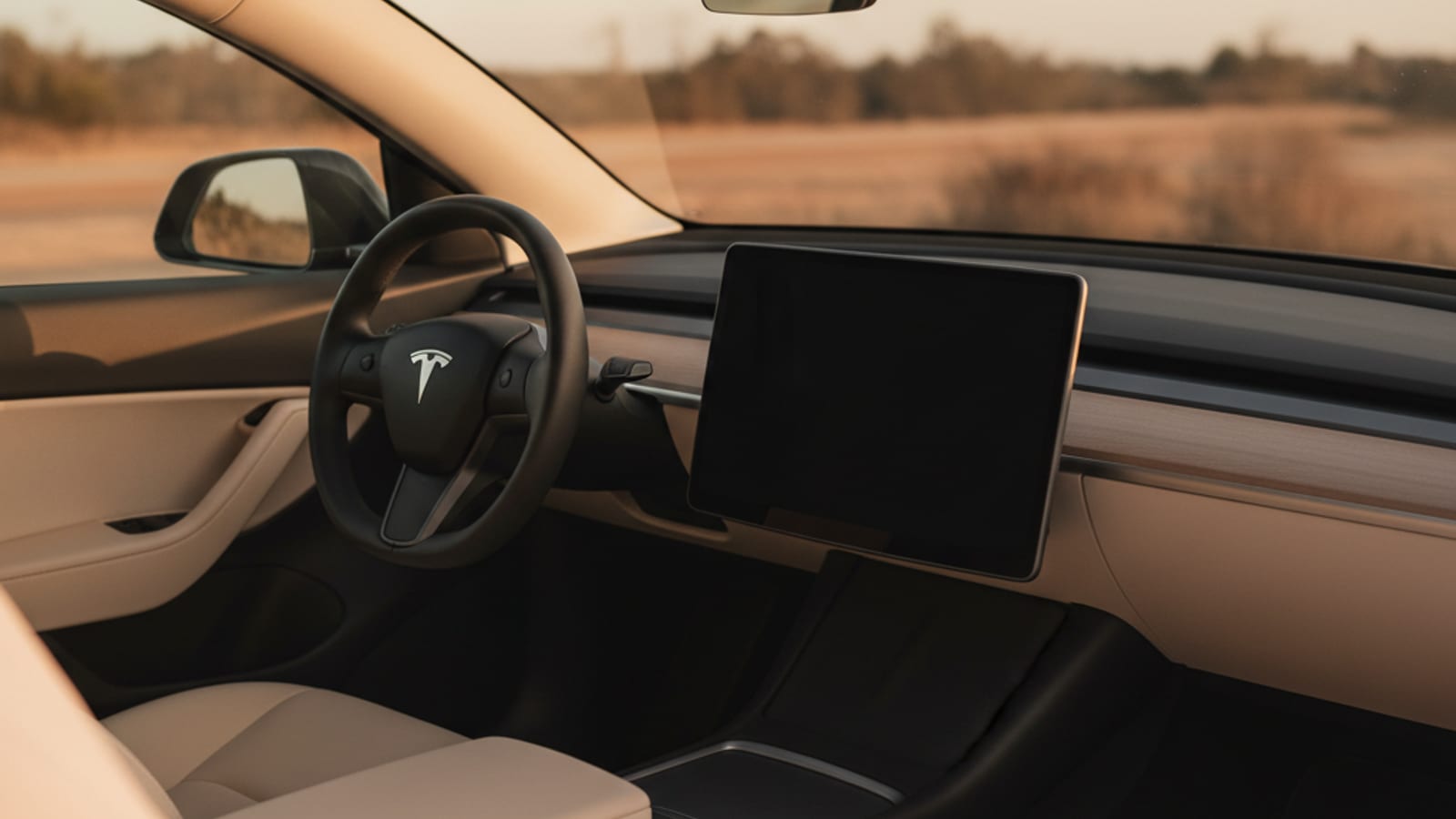
A Tesla with a black screen and flush handles is usually a dead 12V. That’s not a ruined traction pack. Inland Empire owners hit this after a Fontana warehouse shift, in Ontario airport lots, and on hot valley driveways. The little 12V that wakes the car is the one that quit.
Charge Pro IE is a referral line. We match stranded Tesla drivers with independent local operators. Those operators jump or replace a dead 12V on site. We don’t own trucks, and we don’t set prices. The operator quotes you before work starts and bills you directly.
The stall that looks worse than it is
You walk up to a Model 3 or Y and nothing presents. The center display is dark through the glass. The Tesla app shows the car offline, and the frunk release does nothing. The charge port door won’t open.
That cluster is the 12V signature, not a single door module. A door module usually fails on one handle. If the driver’s handle works and the rest don’t, start there instead. A low pack still lets the car talk a little. A dead 12V takes the whole low-voltage bus with it. See Dead Tesla: how to tell 12V failure from a dead pack for that split.
Why Teslas keep a 12V at all
Every production EV still carries a small 12V battery beside the traction pack. Teslas follow the same design. That 12V runs handles, screens, locks, lights, and the contactors. Contactors are the switches that connect the main pack to the car. The pack can’t power those contactors by itself. The 12V has to close them first. A healthy pack at 90 percent does you no good if the 12V is flat. You’re locked out of your own energy.
Why it dies on Inland Empire days
Valley heat cooks a 12V that sits in a closed frunk or underbody bay. Riverside County and San Bernardino County both bake parked cars through long afternoons. A Tesla left in Sentry outside a Fontana distribution building draws on that 12V all shift. Cabin overheat protection does the same in a Corona or Riverside lot. Both draw from the 12V and ask the pack to refill it. If the pack is already low, that refill stops.
The Cajon climb on I-15 toward Victorville is a pack problem when you leave empty. It can also be a 12V problem after a High Desert job with Sentry left on. The car was fine when you parked. It won’t wake when you return.
Older Model S and Model X cars shipped with a lead-acid AGM 12V. Newer Model 3, Y, S, and X cars use a lithium 12V. Lithium usually lasts longer, but it still fails. A weak cell can look fine at rest, then collapse when a handle tries to present. Near-empty packs add a quiet drain. The car can lose the ability to keep the 12V topped off. Then the screen goes black even though the pack started the trouble. For heat and grade habits, see How to care for an EV battery in Inland Empire heat.
Confirm the cluster, then pick the access point
If that full cluster matches, you can jump. If only half of it is true, pause. A working screen with a stubborn handle is usually not the 12V. A car that still pings the app is probably not a flat 12V either. The access point depends on the model.
Jump a Model 3 or Model Y from the bumper
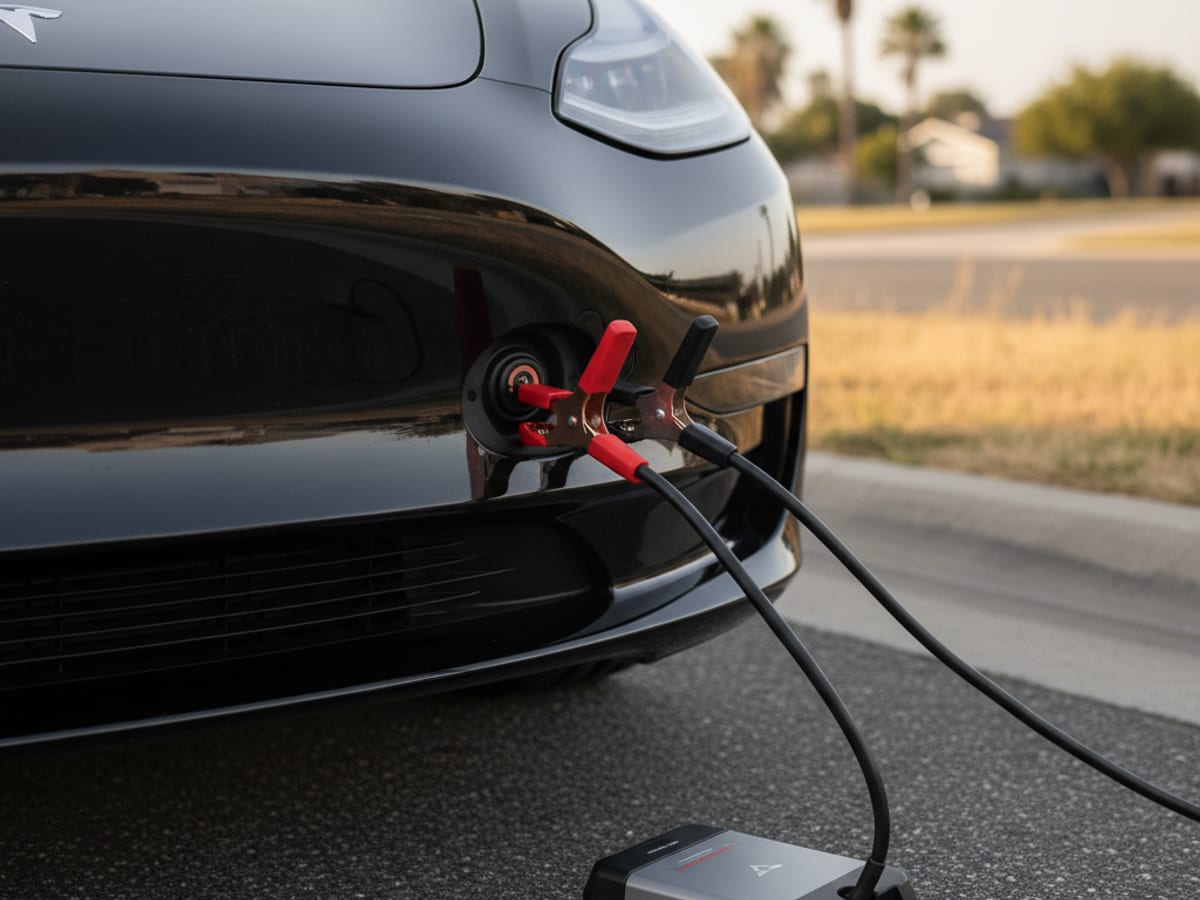
Tesla put emergency jump terminals behind a small cover on the front fascia, driver’s side. That’s the intended path when the frunk is locked. Press the rectangular tow-hook insert until it pops. If it fights you, a thin card under the top edge usually frees it. Inside you’ll see a red positive and a black ground. Clip a dedicated 12V lithium jump pack there. Don’t clip a running gas truck.
Wait about thirty seconds. The frunk latch should release. Pull the interior frunk release and open the hood. The model-by-model jump steps walk through each car.
Jump a Model S or Model X without that bumper point
Refreshed Model S and Model X cars from 2021 on moved the 12V rearward. The front fascia doesn’t give you the same tow-eye jump. Use the mechanical door release instead. On those cars it sits near the window switch on the front doors. Once you’re inside, find the manual frunk release under the carpet or in the footwell. Open the frunk and jump on the terminals Tesla put there. Pre-2021 Model S and Model X still keep the 12V in the frunk. They also have the front fascia jump points, so treat those like a Model 3.
Don’t jump from another car
A running gas engine pushes more voltage and amperage than this circuit was built for. Jumper cables from a running truck can damage the DC-DC converter. Use a dedicated lithium jump pack set for 12V. That’s the tool the operators we connect you with bring to the curb. If you can’t get the cover off, stop. If the latch never releases, stop too. Forcing panels is how people crack a fascia on a warehouse apron in Ontario. Call for a Tesla 12V battery jump and let an operator take the next step.
After the car wakes
Two checks matter more than the relief of a live screen. First, check the 12V’s age and whether a low-battery service message already appeared. Tesla can flag a weak 12V in the service menu before it dies. If that warning has been sitting there, the jump is temporary. Operators in this network can replace a dead 12V on site. Confirm the chemistry and the part with the operator before they start.
Second, check whether the traction pack drained too. A car that sat for weeks at 2 percent may have shut systems down on purpose. The 12V might have been the victim, not the cause. Plug into Level 2 at home if you can. A roadside Level 2 hookup from an operator typically adds 10 to 20 miles of range. That takes 15 to 30 minutes of charging. That window is charging time, not a promise of when someone arrives.
Home plug-in isn’t the same in every Inland Empire city. Riverside homes sit on Riverside Public Utilities, not Southern California Edison. Colton runs its own electric utility inside city limits. If the panel is dark, the outage is a separate problem from the 12V. Older housing makes a home plug-in less of a given. ACS 2019-2023 figures put pre-1980 housing at 60.9 percent in San Bernardino and 2.2 percent in Eastvale.
AGM or lithium, once you’re moving
If the car is an older S or X, the original 12V was an AGM lead-acid unit. Tesla later moved new cars to a lithium 12V. Aftermarket lithium drop-ins exist for older cars. We could not confirm current part prices, installer fees, or a published life rating that belongs on this page. Ask Tesla Service or the shop doing the swap for today’s figure. Confirm what’s in the car before anyone installs a replacement, because the two chemistries don’t charge the same way. If the 12V dies again within a day, the jump didn’t fix the cause. Get it replaced rather than jumping it every morning on a Menifee or Hemet driveway.
When to call instead of clipping it yourself
Call if the fascia cover won’t come off, or the frunk never unlatches. Call if you jumped it and it died again. Call if the car wakes with service warnings you can’t clear. Call if you have no jump pack and the car is blocking a Bloomington work row or a Jurupa Valley street.
Charge Pro IE matches you with a local mobile rescue operator. The operator can jump the 12V or replace it on site. They can add a Level 2 top-off if the pack is empty too. They handle Tesla and every major EV brand.
For a broader Tesla stall, see Tesla roadside rescue. If you’re already on the I-10 shoulder through Colton or Redlands, stay with the car. Keep your lights if they still work, and call. The number is (909) 250-2881. That’s a referral line, not a promise of when a truck shows up.