Yes. Every Tesla has a 12V-class battery besides the traction pack. That small battery is what wakes the car. Inland Empire drivers still get stranded by it. They don’t always run the pack to empty. The last range reading can look fine. The screens and handles stay dead anyway.
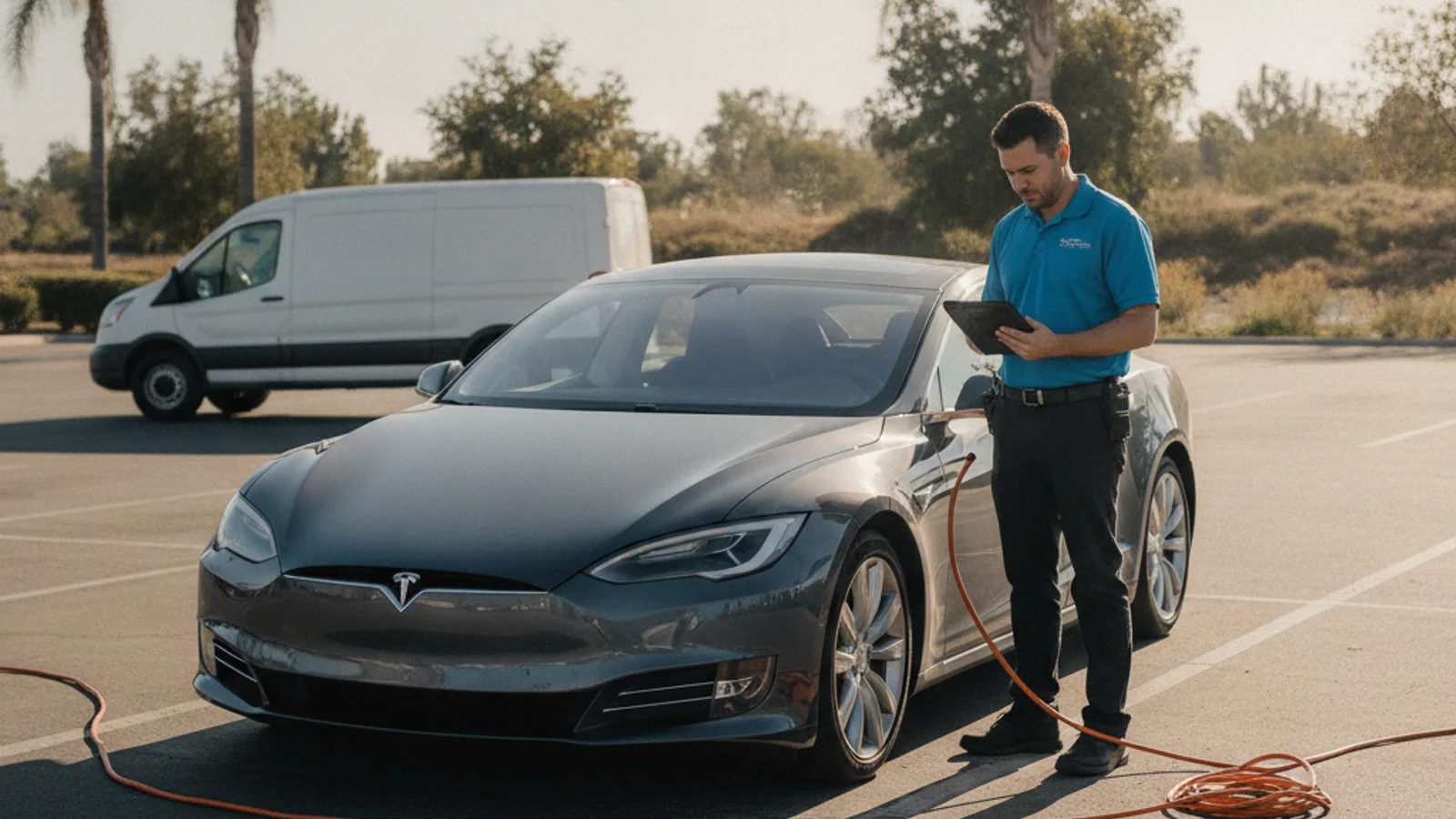
Two power systems, two different failures
A Tesla isn’t a one-battery machine. The traction pack drives the motors and stores the miles. A second, much smaller battery runs what has to boot first. That list includes the touchscreen, door handles, cameras, and computers. It also includes the contactors that connect the pack.
If the 12V-class battery drops too far, the car goes dark. It can sit silent with miles still in the pack. People say it went to sleep and never woke. An empty pack usually looks different. The car still wakes, and the screen still comes on. You see a range warning, not a black cabin.
That split is the first check before you request help. Dark and silent points at low voltage. Awake but low on miles points at the pack. Our guide on how to tell a dead 12V from a dead pack walks that fork in more detail.
Why Tesla still uses a 12V-class system
The traction pack runs at several hundred volts. That voltage is for the drive motors. Cabin electronics, locks, and safety modules use ordinary automotive low voltage. Pack voltage doesn’t belong on those circuits.
Tesla isolates the high-voltage side behind contactors. Contactors are large relays. They need low-voltage power to open and close. Without that supply, the pack stays disconnected. The motors never get power, even with a full pack.
While you drive, a DC-DC converter steps pack voltage down. The same thing happens while the car’s plugged in. That converter keeps the 12V battery charged. After the car sleeps, the converter stops. Background loads then run on the small battery alone. The phone app, Sentry Mode, and always-on monitors all draw from it.
A Tesla can fail to wake after a full shift. That happens in Ontario warehouse rows. The same stall shows up in Fontana work lots. The pack may still show miles. The U.S. Department of Energy explains this two-system layout. Its overview of how electric vehicles work stays at a general level. It isn’t Tesla-specific. It also doesn’t name a replacement interval.
What changes from one Tesla to another
Chemistry, location, and access aren’t uniform across the lineup. Tesla has used a conventional lead-acid 12V on some cars. Others use a lithium-based 12V. The two don’t age the same way. A jump that helps one type isn’t automatic on the other. Location also moves around the models. On some cars a technician can reach the battery with little teardown. On others the work is under trim, or from below.
This guide won’t print a model-year chemistry chart. Tesla has made running changes in the middle of a production year. A neat table is often already wrong. Wrong info sends you toward the wrong part. Your owner’s manual for that car is the first reference. Tesla’s current service documentation is the second. Both beat a blog post, including this one.
Model 3 and Model Y
These two share a lot of design. They don’t share every 12V detail. Some cars in this pair use a lithium 12V. If that matches your car, read the lithium 12V steps for Model 3 and Model Y. For physical layout on a Model 3, use the Model 3 12V and pack location guide. Don’t copy a clip made for a different year.
Model S and Model X
The larger Teslas still carry a separate 12V-class battery. Access isn’t a Model 3 job with extra room. If the cabin won’t wake, treat it as low voltage first. Tell the operator you have an S or an X. Do that before anyone opens a panel.
Cybertruck
The Cybertruck keeps a low-voltage battery besides the traction pack too. Its layout is its own. A Model Y jump video is the wrong map. Start with the Cybertruck 12V checks instead of improvising from another model.
How this shows up on Inland Empire roads
The electrical question is the same in every city. The setting isn’t. A Tesla that won’t wake in a San Bernardino driveway is one scene. One on the I-10 shoulder through Colton is another. The Cajon climb on I-15 toward Victorville is a third. So is a dark cabin after a long park by the Ontario airport lots.
I-215 through Moreno Valley and Perris is the same 12V failure in traffic. SR-60 in Jurupa Valley is too. So is the Ortega near Wildomar if the cabin has already gone dark. Highland sits at the foot of the mountain climb. Lake Arrowhead and Big Bear Lake add a parked overnight in the trees. High Desert towns around Adelanto, Hesperia, and Apple Valley sit in open lots. Cars bake there for hours.
Heat and grades are part of daily driving here. They wear the pack you already watch. They also keep the 12V working while the car sleeps in a hot lot. ACS 2019-2023 data shows 60.9% of San Bernardino housing was built before 1980. In the city of Riverside the share is 56.4%. Ontario is 50.7% on the same vintage. Eastvale is 2.2%, and Temecula is 6.5%. An older home doesn’t cause a 12V failure by itself. The car may have sat unplugged if the house circuit was already a problem. Overnight, that small battery is on its own.
Power at the wall isn’t one utility either. Riverside Public Utilities serves the city of Riverside. The City of Colton Electric Utility owns the electrical infrastructure inside Colton. Banning has its own electric utility. Bear Valley Electric Service covers Big Bear Lake and Big Bear City. Lake Arrowhead and Crestline are on Southern California Edison, not Bear Valley. Most of the valley runs on Southern California Edison. That includes Fontana, Ontario, Corona, and Temecula. Rancho Cucamonga has an SCE area plus a Rancho Cucamonga Municipal Utility pocket. Moreno Valley is split between SCE and Moreno Valley Utility. None of those utilities designed Tesla’s 12V. They do decide whether the car was charging at home last night.
If you were driving and the car went silent, don’t assume the pack hit empty. Check the last range you remember. Then decide which problem you’re looking at. A Tesla 12V jump from a matched operator is the on-site path when the car won’t wake.
What to confirm before anyone works on it
Have the model, year, and trim ready. That’s what tells an operator the chemistry and the access path. If you aren’t sure, say so. Guessing a procedure from a different Tesla is how trim gets damaged.
Don’t let a driveway video talk you into a shortcut. The safe jump sequence is specific. Our steps to tell a Tesla 12V is dead, then jump it stay at the checks a driver can run. Anything under the car is for someone who does this work.
The operators Charge Pro IE connects you with can jump or replace a dead 12V on site. They also handle Tesla and every major EV brand. If the pack is empty rather than the 12V, they bring a 240V Level 2 source to the car. That typically adds 10 to 20 miles of range in 15 to 30 minutes of charging. That’s charging time, never an arrival time. Native NACS for Tesla, with CCS or J1772 adapters for other EVs.
Charge Pro IE is a referral line. It matches you with independent local mobile rescue operators. The pros we connect you with are licensed and insured. Charge Pro IE doesn’t perform the work. It owns no trucks and employs no technicians. The operator quotes you before starting. The operator bills you directly. For a Tesla that won’t wake, ask for Tesla roadside rescue and name the 12V symptom. The matched pro confirms your car’s low-voltage setup before touching it.
When the cabin won’t wake
Call when the Tesla has gone dark and unresponsive. Call even if the last range figure looked healthy. That mismatch usually points at the 12V, not the pack. Call (909) 250-2881 and we’ll connect you with a local EV rescue operator.