The dash lit after the first jump, then went black again. That second death is the one that counts. A battery dying after jump start usually means the 12V needs more than a boost. That pattern shows up on Fontana warehouse rows and Ontario airport lots. The first wake only proved the computers can boot. The second blackout says they won’t stay up on their own.
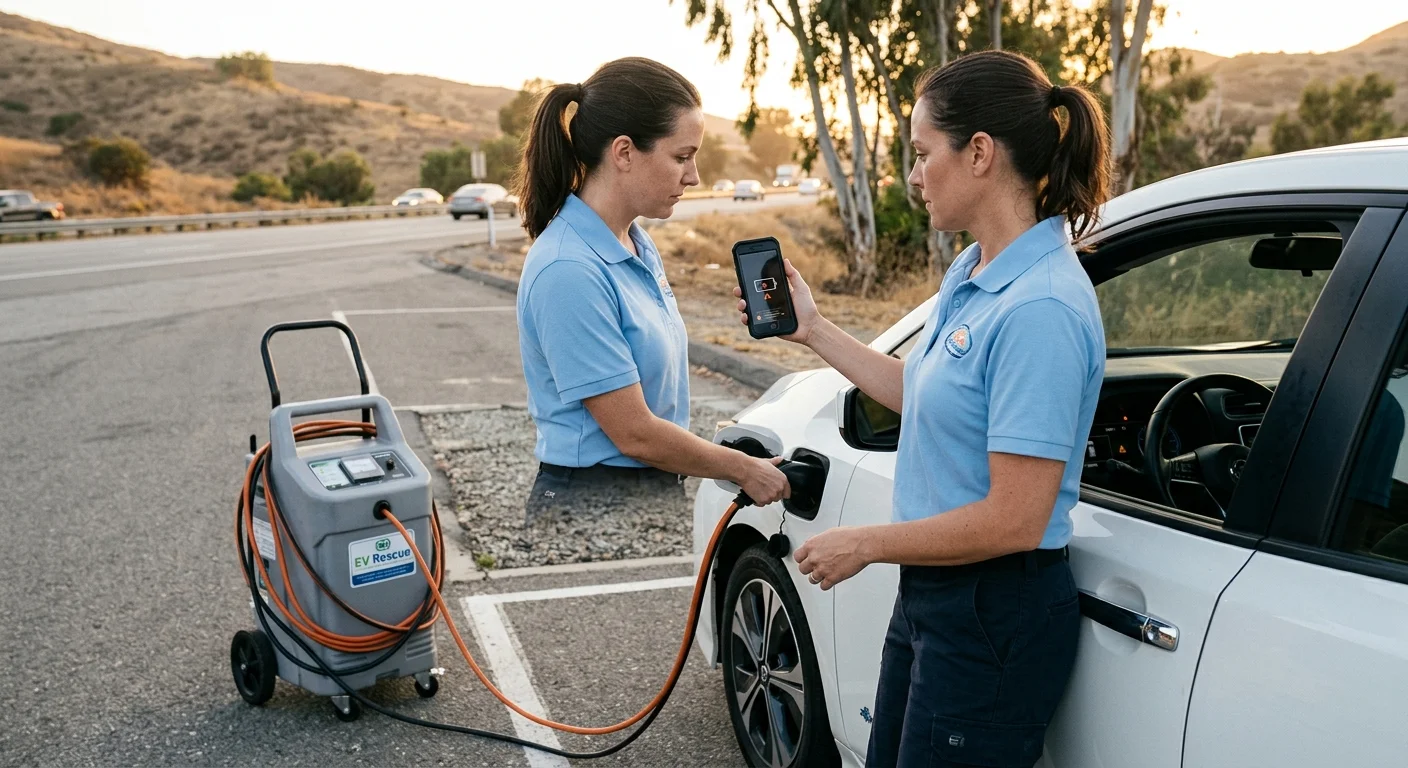
A wake-up is not a repair
Your EV runs two electrical systems at once. The high-voltage pack moves the car. The small 12V battery wakes the computers, locks, lights, and contactors.
When that small battery sags, the whole car can look dead. Handles, the app, and the center screen may all stay dark. The traction pack can still hold a usable charge. You’d never know that from a black dash.
A jump only feeds the 12V for a short window. It doesn’t prove the battery can hold voltage. It doesn’t prove the car is recharging that 12V from the main pack. It only shows the computers will boot if they get a burst of current. If the car dies again after that, you’re past a simple boost.
To separate a dead 12V from an empty pack, see when the 12-volt dies, why the EV looks completely dead. Your owner’s manual still controls the wording for your model year.
What a second 12V death usually points to
Don’t treat “dead battery” as the whole story. Copy the exact text from the dash, the center display, or the official app. Look for 12V, low voltage, electrical system, propulsion, or charging. Leave those words alone, and don’t translate them into a cause.
A second collapse after a warehouse-lot jump often matches one of these patterns. Treat them as observations, not a diagnosis.
The 12V took a boost, then dropped again while the car sat. That often means the battery can’t hold a charge. Cabin overheat protection, cameras, and always-on modules all draw from that small pack.
The car woke, you moved it a short stretch, and it died after you parked. The 12V may have been too tired to recover once the contactors opened. Or the system that should top it up from the traction pack didn’t keep up. That second possibility belongs in a service bay.
The screens came back, but the car still wouldn’t shift or take a charge. A lit display is not ready-to-drive. Write down what returned and what stayed dead.
Don’t jump from that list to a parts order. Replacement is a conversation, not an automatic swap. Our EV 12V battery replacement signs page covers what to ask before anyone pulls the unit. Model year, warning history, and current behavior should lead that talk.
If a coworker did the first jump, ask what they used and where they clipped. Write that answer down for the next operator. Don’t restage the job to check their work.
Inland lots make a weak 12V fail in public
The Inland Empire isn’t one parking pattern. A delivery van on a Fontana warehouse row sits through a long shift with accessories still drawing. A Tesla in a Rancho Cucamonga driveway may have sat in heat with cabin protection on. A car in a Crestline carport sees cooler nights. A car in a Victorville lot sits in High Desert sun. It’s the same 12V job under different stress.
Warehouse rows around Ontario airport lots add access problems on top of the electrical ones. You may be behind a gate or between trailers. It’s a hard place to leave a weak 12V sitting.
Fontana warehouse lots see the same second-death pattern after parked hours. West-valley heat and San Bernardino Valley heat are rough on a small battery that was already marginal. No verified temperature threshold turned up in our source list. If the car died twice in that heat, treat the 12V as suspect until a tech says otherwise.
If you’re on a shoulder instead of a lot, say so. Give route, direction, and a nearby exit. Name I-10 through Colton or Redlands, I-15 toward Cajon, or I-215 through Moreno Valley. “Inland Empire” is not an address.
Write the timeline while you still have it
Vague calls turn into guessing sessions. Start with make, model, model year, and the exact stall point. Then capture a short sequence while it’s fresh.
- What you were doing before the first blackout
- Every warning, in the order it appeared
- Who performed the first jump, and with what gear
- Whether they used the official connection points for your model year
- Which functions came back after that jump
- Whether the car moved, charged, or stayed parked
- What happened right before it died again
Photograph the full dash and the full center screen if they still light. Don’t crop to one banner, and capture each pass if messages cycle. Don’t clear warnings to make the display look tidy.
If the dash is dark, a screenshot from the official app can still help. Note whether the app connected after the first jump, and whether it dropped again. Don’t call it a bad cell, a converter, or a wiring fault from the asphalt. Those labels need a scan tool and model notes that a lot jump doesn’t provide.
A third jump is not the default next move
Read the official procedure for your exact make, model, and model year before anyone hooks up again. Connection points and allowed tools differ by model. Some low-voltage packs aren’t the old flooded battery people picture from gas cars.
This page doesn’t walk you through a repeat jump. Procedures weren’t confirmed here for every EV on a warehouse row. Generic steps can miss your access panel, your warning, or the tool your maker allows.
If the manual says to stop, stop. If nobody on site has the right procedure, don’t improvise. Share the second-death timeline with a qualified operator or the manufacturer’s support line.
Tell them power already returned once and failed again. That sentence changes the job. You’re no longer asking for a simple wake-up. You’re asking whether the 12V still belongs in the car.
Ask whether they handle your exact model and a repeat low-voltage failure before any work starts. For Tesla 12V work in the field, see Tesla 12V battery jump. For the line between a field visit and a repair bay, see EV rescue versus EV repair.
If you see smoke, smell burning, or spot damaged cables, stop and call emergency services. Don’t let someone untrained keep probing around the vehicle.
Choose roadside help or a shop from the car’s current state
Pick the next call from what the car is doing now. Don’t pick it from what you hoped the first jump would fix.
Roadside help fits when the car won’t wake, won’t shift, or can’t leave that lot or shoulder. Ask whether the operator supports your model and a repeat 12V failure. Charge Pro IE is a referral line. We match you with an independent local operator. That operator does the physical work, quotes you before starting, and bills you directly. We don’t own trucks, set the price, or promise an arrival window.
A service center fits when you need diagnosis, testing, or a lasting repair after the second death. Tell the advisor the car lost power again after a jump, and send the same timeline and photos.
Sometimes you need both. An operator may get the car moving, or replace a failed 12V in the lot. A dealer or independent EV shop then traces why it wouldn’t stay charged. Confirm that plan before anyone starts. If a tow comes up, follow your maker’s current instructions for that model.
Operators we connect you with can jump or replace a dead 12V on site. They cover Tesla and every major EV brand. They can also bring a 240V Level 2 source if the traction pack is the real problem. That roadside charge typically adds 10 to 20 miles of range. Plan on 15 to 30 minutes of charging time. That’s charging time, never an arrival time.
Don’t choose the next step from the range figure you remember from before the blackout. Report that number as one observation, with the warning text and what still works.
In a gated Ontario cargo lot, a Fontana warehouse row, or a Riverside driveway, say how someone reaches the car. Gate code, dock number, and garage level save a trip to the wrong entrance.
Before you approve anything, ask who is doing the work and what they propose. You contract with that independent pro, and you pay that pro.
A first jump, if the manual still allows one, is in how to jump start an electric car without frying the 12V. Don’t treat it as a green light to try again after a second death.
If low-voltage power fails again and the car stays dark, a mobile EV rescue operator is a practical first call. Share the model, model year, exact warnings, the stall point, and what followed the first jump. Call (909) 250-2881 and we’ll connect you with a local operator.