Your EV can sit dead in a Fontana warehouse row and still have range. The same stall happens on the I-10 shoulder through Colton. The traction pack isn’t always empty: the 12-volt battery is what usually failed. That small battery runs the screens, the locks, and the contactors. When the 12V is flat, nothing on the car wakes. A careful jump of that 12V is the curb fix this search is about.
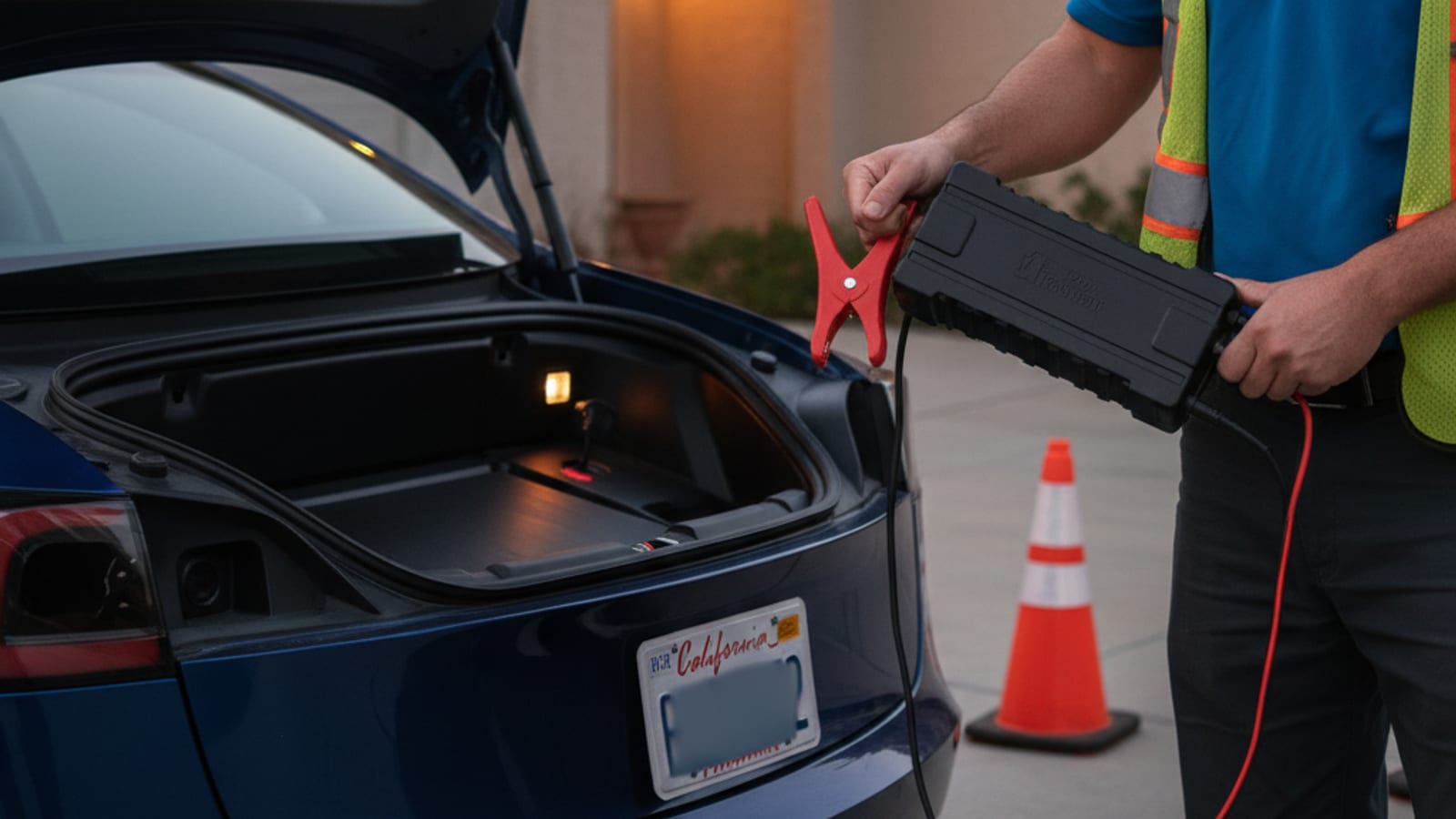
What a dead dash usually means on inland streets
People search how to jump start an electric car after the dash stays black. The car can show no life with miles still in the pack. The computers never came up, so the contactors never closed. That’s a 12V problem at the bumper, not an empty pack. It matches a dark Tesla in an Ontario airport row. It matches a Bolt that sat through a Moreno Valley afternoon. When the 12-volt dies, why the EV looks completely dead walks through that split.
How to tell a 12V stall from an empty pack
An empty pack still talks if the 12V is alive. You’ll get a low-range warning or a charge-now prompt. A dead 12V is quieter, and handles feel inert. The phone app may not connect, and screens stay dark. Doors may skip the usual unlatch. On a Tesla, that feels like a total death. Teslas still have a 12V battery. So do Rivian, Ford, Hyundai, Kia, Chevy, and the rest.
Valley heat soaks a car that sat in Corona or Riverside. The same dark dash shows up after a long sit in Victorville or Adelanto. None of that proves the pack is empty. Start with the 12V before you blame the grade. A Cajon climb toward Victorville can use pack miles. A black dash still points at the 12V first.
Don’t borrow jumper cables from the diesel next to you
A running gas truck in a Fontana yard puts out a hot 12-volt system. An alternator sits above rest voltage and can spike for a moment. An EV’s 12V circuit feeds a DC-DC converter, body computers, and battery management. A spike or a reversed clamp can damage those parts.
Tesla tells owners not to jump from another vehicle. Other makers send you to a dedicated jump pack. Use that pack in a warehouse lane or on the 91 in Corona. The same rule holds on SR-60 in Jurupa Valley.
What a lithium jump pack actually does
A jump pack is a small battery with leads attached. It feeds a controlled 12 volts into the low-voltage circuit. That’s enough to wake the computers without an alternator surge. Pick a pack with reverse-polarity protection. If the clamps are backwards, a decent pack won’t send current. Store it in the frunk or cargo area, and top it up on a calendar.
The jump sequence that keeps the electronics intact
The steps stay the same on Tesla and on a CCS hatchback. Only the posts move.
- Confirm the jump pack itself has charge. The pack’s lights should show it.
- Find the marked 12V posts for your brand. They’re listed below.
- Clip red to the positive post first.
- Clip black to the marked ground, not a random painted bolt.
- Pause and let the two sides settle.
- Wake the car with a handle, the app, or the driver’s door.
- Once it wakes, leave the pack connected a little longer. That gives the DC-DC converter time to take over from the traction pack.
- Disconnect black first, then red.
Stay off orange high-voltage cables, because those aren’t the 12V.
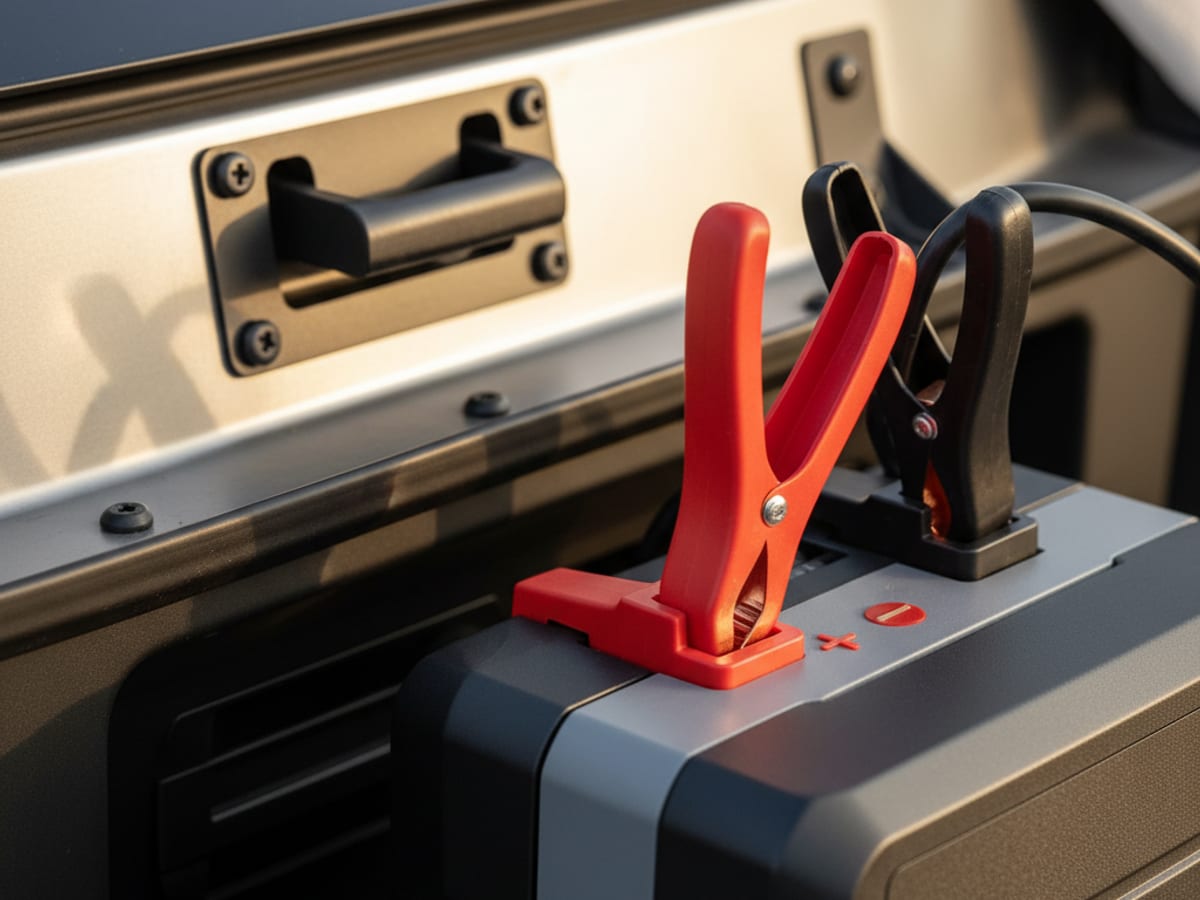
Polarity is the whole job: red to positive, black to the labeled ground. Reverse that and you can damage the DC-DC converter. A modern pack often blocks a reverse hookup.
Where the posts are on inland cars
Fontana Teslas and Ontario Lightnings don’t share jump posts. An Ioniq 5 in Eastvale uses another set.
Tesla Model 3 and Model Y
Pop the tow-eye cover on the front bumper, driver’s side. You’ll see a red positive pigtail and a black ground. Clip the jump pack there. When the frunk releases, open it and feed the real 12V a bit longer. Tesla Model 3, Y, S, and X jump steps stay on that path.
Tesla Model S and Model X
On S and X cars from 2021 on, use the front-door manual releases. Pull the frunk release under the carpet, then jump the 12V terminals in the frunk. Older S and X cars use the tow-eye pigtails, like a 3 or Y.
Rivian R1T and R1S
The fob’s powered frunk needs 12V, so a dead battery leaves the button inert. There’s a manual pull behind the grille. You remove a small cover, often with a Phillips screwdriver, then pull the cord. The 12V sits under a passenger-side panel in the frunk. Jump the positive post and the marked ground stud.
Ford F-150 Lightning
The powered frunk also stays shut on a dead 12V. The mechanical release is a pull loop under the front bumper. Once you’re in, the 12V is on the driver’s side with standard posts.
Hyundai Ioniq 5, Kia EV6, Kia EV9, and the Chevrolet Bolt
The 12V lives under the rear cargo floor, but you still jump from the front. Look in the under-hood bay for a red positive post and a marked ground. Don’t empty the trunk first if those front posts are there.
Polestar 2 and Ford Mustang Mach-E
Polestar 2 keeps the 12V in the frunk. A manual cable sits behind the driver-side headlight if the lid is stuck. The Mach-E jumps from labeled frunk posts. If the app can’t open the frunk, use the driver’s-floor kick-plate cable.
After the car wakes on an Inland Empire street
Once the screens return, the DC-DC converter has to keep the 12V healthy. Driving does that, and plugging in at home does too. Give it some road time or a Level 2 session.
Home power isn’t one utility across this market. Riverside homes sit on Riverside Public Utilities. Fontana, Ontario, and San Bernardino homes sit on Southern California Edison. Colton runs a city electric utility, and so does Banning. Big Bear Lake and Big Bear City sit on Bear Valley Electric Service. Rancho Cucamonga is mostly Edison, with a municipal pocket in the southeast. Moreno Valley is split between Edison and Moreno Valley Utility. None of that changes the jump. It only changes whose meter you plug into when you get home.
If the traction pack is low too, a 12V jump won’t add range. Independent operators can jump the 12V on site. They can also add a mobile EV charge. They typically add 10 to 20 miles of range. Charge time is 15 to 30 minutes, never an arrival time.
When the 12V fails again after a jump
A jump is a wake-up, not a new battery. If the car goes dark again soon, the 12V is done. Watch for a 12V service message, a slow wake, or random screen resets. Those signs can show up before a stall on I-215 through Perris. EV 12V battery replacement: signs it’s going, and next steps covers that sequence. Independent operators can replace a 12V on site.
If you can’t get the leads on
Some stalls aren’t a DIY clip. A Rivian or Lightning with a stuck frunk is one. So is a car on the Ortega near Wildomar with no jump pack. A dead 12V plus an empty traction pack is another.
Charge Pro IE is a referral line. It matches stranded EV drivers with independent local mobile rescue operators. It doesn’t run its own trucks or set prices. The operator brings a 240-volt Level 2 source with a native NACS plug. They also carry CCS or J1772 adapters for non-Tesla EVs. They handle Tesla and every major EV brand. For Tesla-only 12V help, start with Tesla 12V battery jump. For CCS and J1772 cars, use non-Tesla EV rescue.
If you need that match, call (909) 250-2881. Name the spot: Ontario airport, a Fontana warehouse lane, or Temecula. The operator quotes before any work starts.