Your Porsche Taycan won’t start, and yesterday’s range still looked fine. In the Inland Empire that’s usually the 12V battery, not a high-voltage pack failure. The dash stays black. Handles don’t pull. The frunk won’t pop. The drive battery can sit at a healthy percent and still do nothing. The Taycan needs that small battery to wake its computers and close the contactors.
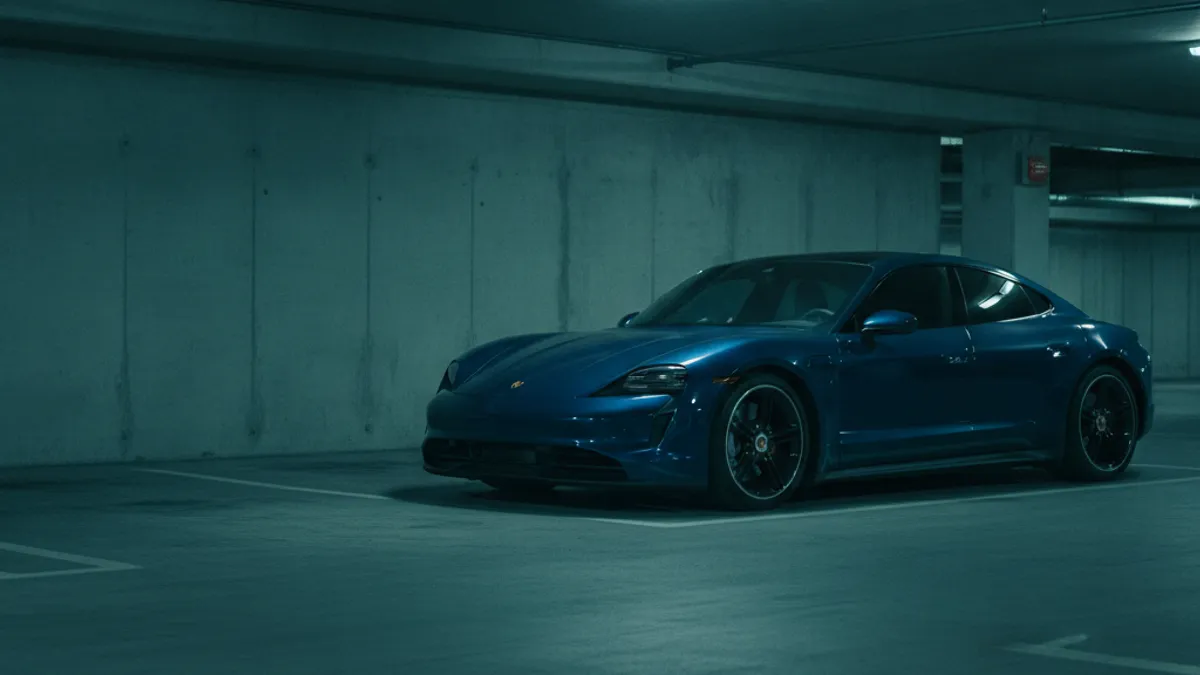
Why a Porsche Taycan won’t start
A Taycan that won’t start is a 12V problem until you prove it isn’t. That small battery feeds the electronics that boot the car. Those electronics then connect the high-voltage pack. If the 12V can’t hold voltage, the handshake never finishes. Nothing on the dash comes up, even with range left in the pack.
Two patterns keep repeating on inland streets. The car sat for weeks and the 12V slowly drained. Or the 12V simply aged out. You get the same result either way. The cabin goes black, handles die, and the car feels bricked. A jump can wake it. A worn 12V will drop you again within days.
See when an EV 12V battery dies for that shutdown path.
What you’re seeing, and what it usually means
| Symptom | Likely cause |
|---|---|
| Dash totally dark, fob does nothing | 12V fully discharged |
| Doors stay locked, frunk stays shut | 12V too weak for the electric latches |
| Red electrical system fault message | 12V sagging under load |
| Car wakes, then dies again | 12V can’t hold the load once awake |
| Another no-start days after a jump | 12V has failed and needs replacement |
If you’ve jumped this Taycan more than once lately, stop treating it as a fluke. A 12V that won’t hold a charge needs replacement, not another boost. EV 12V battery replacement signs covers what that job involves. Confirm any shop quote before you pay. No page here can set that number.
What the electrical system warning means
Taycan drivers often see a red “electrical system fault, park vehicle safely” alert. A separate white notice about a low 12V sometimes sits beside it. That pair means the low-voltage network isn’t stable.
Don’t keep stacking miles and hope it clears. A sagging 12V can fail the next time you shut the car off. Get it to a Porsche shop, or call for a roadside check. Don’t park somewhere you’d hate to be stuck. An Ontario airport garage is a bad place to learn that. So is a Fontana warehouse row. So is a Temecula valet lot after dinner.
Inland Empire places this 12V failure shows up
This isn’t a generic no-start article with a city name swapped in. Heat, grades, and cars that sit for days all show up here.
Leave a Taycan in an Ontario airport garage for a week of travel. Alarm modules, connectivity, and climate pre-conditioning still draw standby power. A weak 12V can be empty when you land. Warehouse lots in Fontana, Ontario, and Bloomington see the same drain. A car can sit there through a long shift.
The I-10 shoulder through Colton, Redlands, and Beaumont is a hard place for this job. Working a hidden key blade next to fast traffic is miserable. Calimesa and Banning continue that same climb. The I-15 Cajon climb toward Victorville and Hesperia is the same kind of shoulder. So is I-215 through Moreno Valley and Perris. SR-91 in Corona and SR-60 in Jurupa Valley don’t give you more room. You’re stuck with a dark Taycan, and the fob won’t pop the frunk.
Mountain weekends write a different version of the same failure. A car sits in Big Bear Lake or Big Bear City. Then it rolls down toward Highland or San Bernardino. It can look fine until you shut it off in a valley lot. Big Bear Lake and Big Bear City sit on Bear Valley Electric Service. Lake Arrowhead and Crestline sit on Southern California Edison. That split only matters if you plugged in at a house. It doesn’t change a dead 12V.
In Riverside, Riverside Public Utilities has served the city since 1895. A Taycan that won’t wake downtown still isn’t an RPU outage. Moreno Valley splits SCE and Moreno Valley Utility across newer tracts. Rancho Cucamonga is mostly SCE. Rancho Cucamonga Municipal Utility covers a southeast pocket around Victoria Gardens. Colton owns its electric utility inside city limits. Banning runs its own utility too. Apple Valley gets SCE delivery, with Apple Valley Choice Energy procuring generation. San Jacinto has SCE delivery and San Jacinto Power for generation. None of those names jump a Porsche.
Newer streets in Eastvale and French Valley have almost no pre-1980 housing. ACS 2019-2023 puts Eastvale at 2.2 percent and French Valley at 2.3 percent. Murrieta sits at 6.2 percent on that vintage. Temecula sits at 6.5 percent. Those garages are new. The 12V still ages on the shelf. San Bernardino’s pre-1980 share is 60.9 percent on the same ACS vintage. Redlands is 60.4 percent. Riverside is 56.4 percent. Different streets, same dark dash.
A long day parked at Pechanga can finish a 12V that was already weak. So can a Cabazon destination lot or a Glen Helen event. Valley heat does the rest. Chino Hills hillside driveways add another wrinkle. You’re often far from a shop when the handles finally stop moving. Norco, Upland, and Montclair lots can sit in the same heat.
Where the 12V lives, and why the frunk fights you
Porsche put the Taycan’s 12V in the front trunk. It sits on the passenger side, under a clipped plastic cover. That’s simple when the car has power. The frunk latch is electric. When the 12V is dead, the fob won’t open it. The interior button won’t either.
Porsche built a workaround for that lockout. Use the physical key blade hidden in the fob. Find the small hidden keyhole in the driver’s door handle. Unlock the door and get into the cabin. Open the fuse panel in the driver’s footwell. Pull the small fuse-shaped tab marked with a frunk icon. That exposes a pair of emergency contacts. Clamp a jump pack’s positive lead to those contacts. Clamp the negative to unpainted metal, like the upper door hinge.
With that emergency circuit live, press the frunk button on the fob. The lid should pop. Then you can reach the real 12V. Jump terminals sit under the trim at the back of the frunk. Check the owner’s manual for your model year. Porsche has shifted small panel details across production.
Don’t pry the frunk. Don’t force the handles. If you don’t want to run that sequence on a shoulder, wait. Call for an operator who already knows it.
Jump terminals once you can reach them
Lift the plastic cover at the rear of the frunk. You should see a red cap on the positive post. A ground terminal sits beside it. Connect a jump pack or donor car positive to positive first. Then connect negative to the Taycan’s ground terminal.
A deeply discharged Taycan can refuse a small pack that would wake a gas car. If nothing happens after a couple of tries, the booster may be too weak. Leave the pack connected for a minute or two. Then try to power the car. See the guide to jumping an EV at the curb for clamp order.
Once it wakes, don’t treat that as the finish. Drive to a shop that can load-test the 12V. If it dies again after a jump, that’s the battery, not bad luck. When an EV 12V dies again after a jump covers that repeat failure.
Who actually shows up for a Taycan here
Charge Pro IE is a referral line. We match stranded EV drivers with independent local mobile rescue operators. We don’t hold a trade license. We don’t own trucks or equipment. We don’t employ technicians. We don’t set prices, and we don’t promise an arrival time. The operator quotes you before starting and bills you directly. The pros we connect you with are licensed and insured.
Those operators jump or replace a dead 12V on site. They handle Tesla and every major EV brand, including a Porsche Taycan. They bring boosters built for this kind of lockout. That includes packs strong enough for a Taycan that’s gone fully dark. They can walk the emergency footwell steps if the frunk won’t open. They can wake the 12V. They can tell you whether it took the charge or needs a full replacement.
If the high-voltage pack is empty too, that’s a separate job. Operators can bring a 240V Level 2 source to the car. They use a CCS or J1772 adapter for non-Tesla EVs. That typically adds 10 to 20 miles in 15 to 30 minutes of charging. That’s charging time, never an arrival time.
For Porsche and other non-Tesla EVs, see non-Tesla EV rescue. We serve cities across Riverside County and San Bernardino County. That includes Chino Hills, Temecula, and the High Desert.
Frequently asked questions
Why won’t my Porsche Taycan start if the range still looks fine?
The range figure comes from the high-voltage drive battery. That’s separate from the 12V system that actually boots the car. If the 12V is dead or too weak, the startup sequence never finishes. The car stays dark no matter how much pack charge is left. A 12V jump is the usual way back.
How do I open the frunk if the 12V is completely dead?
Use the physical key blade inside the fob. Unlock the driver’s door through the hidden handle keyhole. Inside, open the fuse panel in the driver’s footwell. Pull the fuse-shaped tab with the frunk icon. Connect a jump pack’s positive clamp to the exposed contacts. Connect the negative to unpainted metal, such as the door hinge. Press the frunk button on the fob. The lid should pop.
What does the electrical system fault warning mean on a Taycan?
It’s the car telling you the 12V system can’t hold stable voltage. It often appears with a separate low 12V alert. Treat it as a stop-soon warning. A 12V that’s already struggling can fail to restart after the next shutdown. Heat and a long inland drive make that more likely.
If the Taycan is dark and the frunk won’t open, call (909) 250-2881. We’ll connect you with a local operator for the emergency access and the jump. Confirm the quote with that operator before any work starts.