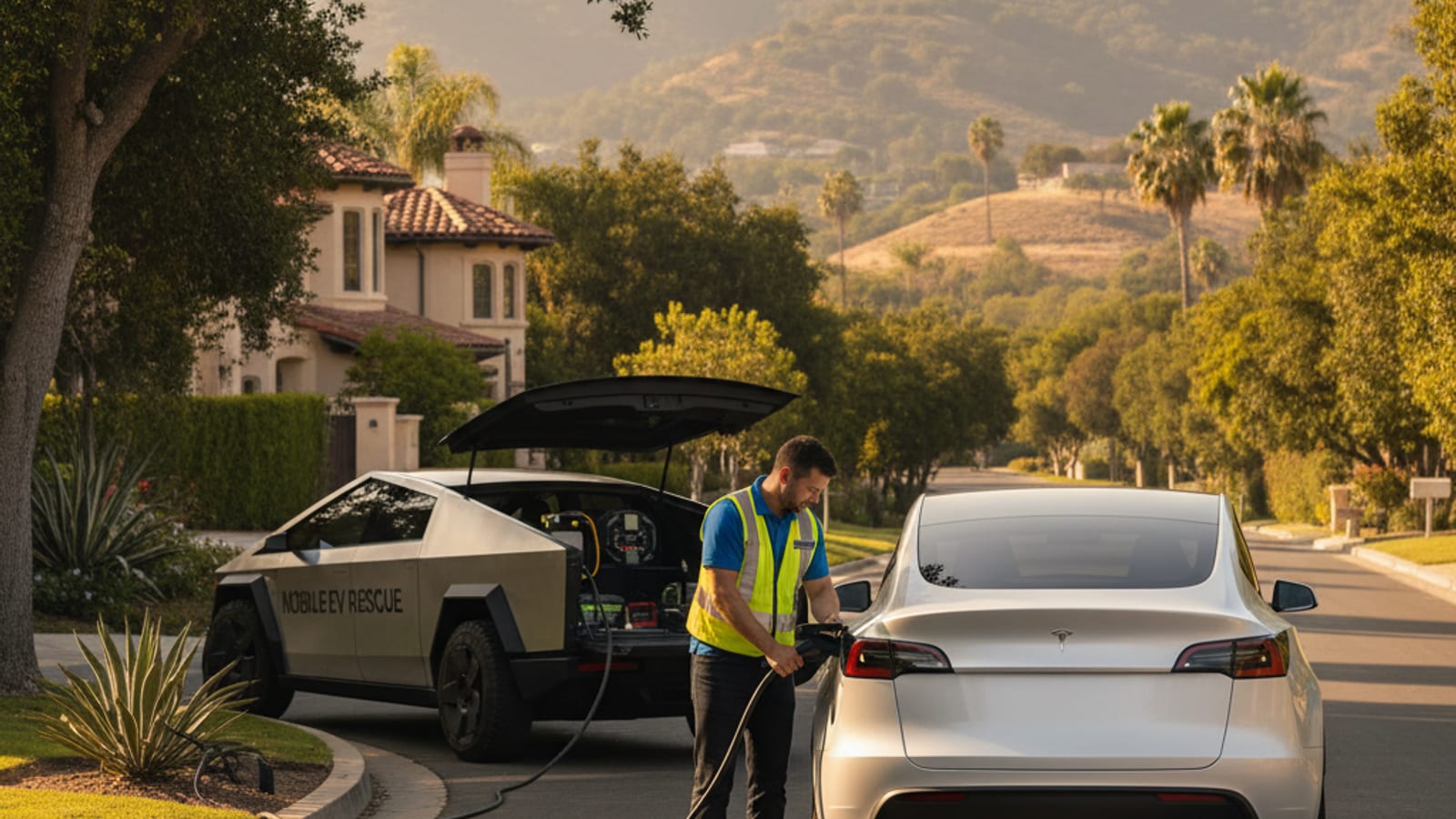
A Tesla that won’t wake in Chino Hills is often a driveway 12V call. EV roadside assistance in Chino Hills starts at the house more than the shoulder. The traction pack may still hold range. Homes in Vellano, Rolling Ridge, and Butterfield Ranch sit up the grade. You’re already parked in the driveway. The wall connector may be in the garage. A dead 12V still keeps the car from waking to use it. You need an operator who can find that driveway. They jump the small battery on site. They can bring 240V Level 2 charging if the pack is empty.
Chino Hills sits in San Bernardino County, not Orange County
The ZIP is 91709. The city borders Diamond Bar, Brea, and Yorba Linda. Streets can feel like an Orange County suburb. Chino Hills is in San Bernardino County. That county line is the one that matters on a rescue call. Don’t describe the stop as Orange County if you’re still inside city limits.
About 77,927 people live here per ACS 2019-2023. The 2024 estimate is 77,418. The land area is 44.65 square miles. Those square miles are actual hills. The name is literal. Neighborhoods climb from the valley floor toward the ridgeline. Los Ranchos, Payne Ranch, Woodview, and Sleepy Hollow share that grade on the way home. Carbon Canyon sits in the fold toward Brea.
Only 17.4% of housing was built before 1980, using the ACS 2019-2023 vintage. That’s new stock next to older San Bernardino Valley cities. Home charging is the norm. Out-of-charge calls are rarer here, and they’re road-specific. A dead 12V in the driveway is the luxury-EV call this page is for.
Southern California Edison serves Chino Hills. SCE lists a residential EV rate called TOU-D-PRIME. Confirm the current plan details on SCE’s own site. Programs change. We don’t publish utility rates. We don’t set them. The operator on your visit doesn’t set them either.
Income here ranks among the highest in this market. That shows up in the garage. Tesla is common. So are Lucid, Porsche, Mercedes, BMW, Audi, Cadillac, and Rivian. Mixed two-car EV households aren’t rare. The visit has to cover NACS and the adapter set, not Tesla only.
The hillside driveway is why the 12V call looks different
A luxury EV still depends on a 12-volt battery. That battery wakes the computers. It closes the contactors on the high-voltage pack. It runs lights, locks, and chimes. When it dies, the dash stays dark. Handles may not present. The app may stop reaching the car. The whole vehicle looks dead. The big pack can still be fine.
That’s the pattern behind a lot of Tesla no-start mornings. It’s the same pattern on a Taycan or a Lucid Air. A Mercedes EQS and a Rivian R1S fail the same way. The Chino Hills twist is location. You’re not on a wide freeway shoulder. You’re on a private drive on a hill. Long asphalt and a steep approach both change the stop. An operator who can’t take a pin wastes the visit.
The operators we connect you with jump that 12V on site. They can replace it when that’s the right fix. They quote you before they start. They bill you directly. Charge Pro IE is a referral line. We don’t own trucks. We don’t employ technicians. We match a stranded driver with a local mobile rescue operator.
If the 12V is the only failure, you often don’t need a pack charge. You need the car to boot. Then you can drive. If the pack is empty, that’s a second kind of visit. The same operator can bring a 240V Level 2 source to the car. Native NACS for Tesla. A CCS or J1772 adapter covers everyone else. That hookup typically adds 10 to 20 miles of range. That’s 15 to 30 minutes of charging time. It isn’t an arrival time. It’s time on the cable after they’re plugged in.
See our Tesla 12V battery jump page for the on-site jump. Our post on when an EV 12V battery dies on the road walks through the same failure.
How to tell a dead 12V from an empty pack
Use the app first if it still connects. Miles on the display with a car that won’t ready points at 12V. A car that went silent after a low-pack warning points at the pack. A car that sat for days in heat can be either. Heat is hard on a tired 12V.
Newer Model 3 and Model Y cars use a lithium 12V. Older ones used lead-acid. Both can fail. The lithium unit doesn’t always behave like a gas-car battery. Don’t keep cycling Ready if nothing happens. You can flatten an already weak 12V. Stop and call. Let the operator use the right procedure for the car in front of them.
If you’ve had a jump in the last few weeks, say so. Say it if the car died again after that jump. Repeat 12V failure usually means replacement. Another jump buys a little time. It doesn’t fix a battery that’s done. Operators in this network can replace a 12V on site. That’s when the car and the part allow it. Recurring high-voltage faults still belong at a shop after you’re moving.
Carbon Canyon Road is the stranding this city actually has
SR-142 is Carbon Canyon Road. Write that name down if you drive it. It’s two lanes. It winds. It climbs. The shoulder is almost gone. There’s nowhere clean to stop. People use it to reach Brea and the rest of Orange County. A low state of charge plus a traffic crawl on that climb is ugly.
We’re not guessing the next public stall from here. That distance isn’t a figure we can verify for this page. The road facts we can stand on are simpler. Narrow. Climbing. Almost no shoulder. If you’re already low, don’t enter the canyon hoping it’ll work out. Turn around toward Grand Avenue or Peyton Drive while you still can. Pipeline Avenue and Chino Hills Parkway are the other in-town options.
Sleepy Hollow and the Carbon Canyon side of town sit on this corridor. Carbon Canyon Regional Park is in the same fold of hills. A park lot is still a parked-car call. Check 12V first. Don’t assume the pack is empty just because the car is quiet.
If you’re already on SR-142, don’t stand in the lane. There’s almost no room. Stay in the vehicle if stepping out isn’t safe. Call and describe eastbound toward Brea or westbound back into Chino Hills. Direction matters. So does the nearest landmark you can actually see.
SR-71, the State Park lot, and a long sit at the Shoppes
The weekday risk is SR-71. That’s the commute into Orange County and Los Angeles County. Grades, climate control, and stop-and-go all eat range. Your trip computer doesn’t always price the last climb home. Rolling Ridge and Butterfield Ranch sit above the valley floor. You can leave work with what looks like enough. The last rise to the house spends more than the highway estimate.
That isn’t a claim about missing stalls on 71. It’s a claim about hills. Plan the return with a buffer. If you do stall on a legal shoulder, stay out of traffic. Then call for EV roadside assistance. Ask for a 12V jump if the car is dark. Ask for it if the app still shows miles. Ask for a Level 2 visit if the pack is the problem.
Chino Hills State Park is a different pattern. Trailhead parking sits on a fire road. Cars sit for hours. Summer heat soaks a weak 12V. You come back from a hike. The car won’t unlock. Or it unlocks and won’t go into Drive. That’s often the small battery. The operator still has to reach a park lot, not a cul-de-sac. Give a pin and the trailhead name. The park as a label isn’t enough.
The Shoppes at Chino Hills is the in-town version of a long sit. You shop. The car bakes. You return to a silent Tesla or a dark Porsche. Same checks. Same quote-before-start visit in a parking structure or a surface lot. Say the garage level if you have one. A pin inside a structure helps more than a mall name.
What a mobile charge is in this network
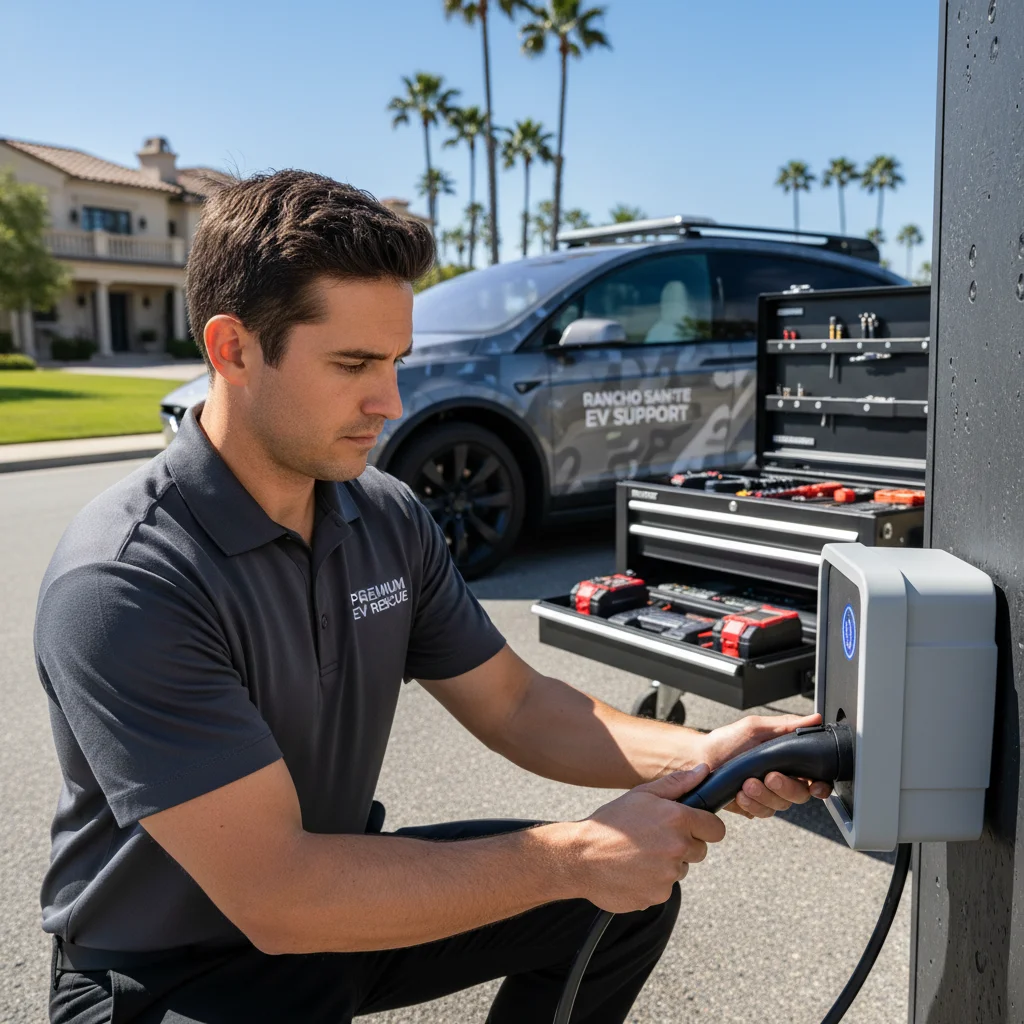
Mobile EV charging is a Level 2 source on the operator’s vehicle. It isn’t a Supercharger. It isn’t a dealer mobile service appointment. It isn’t Charge Pro IE rolling a fleet. We don’t have a fleet. Independent operators do the work. They bring 240 volts to the driveway, the park lot, or a legal shoulder.
Typical result is 10 to 20 miles of range. That’s after 15 to 30 minutes on the cable. That’s enough to get off Carbon Canyon. It’s enough to get off 71. It’s enough to get down from a ridge home. You can then use a stall you already know. We won’t name a nearest stall. Confirm one in your own app before you roll. If you need a longer session, say so on the quote. The operator sets the price. You accept or you don’t. Nobody at this referral line posts a rate.
Tesla, Lucid, Rivian, Porsche, and Mercedes all show up here. So do BMW, Audi, Cadillac, Hyundai, Kia, Ford, and Chevy. New construction and home charging mean mixed garages. A Model Y and a Taycan in one driveway is a normal call. NACS covers Tesla. CCS and J1772 cover the others. One visit type. Two plug families.
A tow is the wrong first move on a dark luxury EV
A dark EV often isn’t an empty pack. Jump the 12V first. If the car wakes and shows range, you may not need a hook. If a tow becomes necessary, ask for a flatbed. Follow the tow procedure in this car’s manual. That’s a later decision. Diagnose in the driveway first.
If the pack is empty, a Level 2 bump can be enough to move. A tow still makes sense when the car is in a live lane. It also makes sense when there’s no safe place to park a charging vehicle. On Carbon Canyon that safety question is real. Almost no shoulder. If you can’t stop legally, you may need a tow to a safer spot. Charge there after you’re out of the lane. Talk that through with the operator. We don’t pick the method from a script.
Chino, next door, has a different mix. Work lots sit on the flatter side of the line. If you split time between the two cities, read EV roadside assistance in Chino. Ontario sits north. Corona sits south. Same referral network. Different roads. Different grades.
Home charging is common. This line doesn’t install chargers.
Most homes here were built after 1980. A wall connector at the house is common. When that setup is down, the car can sit in the garage. It can sit there at a low state of charge. That’s still a driveway rescue if you need to leave now. It’s not a charger install. Charge Pro IE doesn’t pull permits. We don’t touch your panel. SCE serves the meter. Adding a home charger is an electrician plus a city permit. It isn’t this number.
Our related guide on Chino Hills EV charging, range, and rescue is the planning page. This page is for the moment the car already won’t move.
Ridgeline homes add one more wrinkle. The last grade home can drop you lower than the highway number. You pull in. You meant to plug in. You forget. Morning is a dark dash. That’s a 12V or a pack problem you can sort in the driveway. You don’t have to limp to the Shoppes first. Once the 12V is up, use the wall connector you already have. You may not need a mobile pack charge at all.
Panel capacity comes up in a wealthy new-home market. People add a second EV. The existing charger was sized for one. That’s a house-electrical project. It isn’t roadside rescue. If the home charger never got installed, you can still get a pack bump. The operator can add enough range so you can leave. The panel stays a separate contractor.
Tell the operator where you actually are
Grand Avenue, Peyton Drive, Pipeline Avenue, and Chino Hills Parkway are the in-town grid. They’re wider than Carbon Canyon. A legal stop is more realistic there. SR-71 is the commuter spine. SR-142 is the canyon. Treat those two with respect when you’re low.
Landmarks you can use on the call include Chino Hills State Park. The Shoppes at Chino Hills is another. So are Carbon Canyon Regional Park and Vellano. Don’t assume anyone knows your street’s nickname. Spell the community. Rolling Ridge isn’t Butterfield Ranch. Los Ranchos isn’t Payne Ranch. Woodview isn’t Sleepy Hollow.
Neighbors you might name by mistake include Chino and Ontario. Diamond Bar, Brea, and Yorba Linda sit just outside. Corona sits south. Crossing into Brea on Carbon Canyon doesn’t change how a 12V fails. It does change which shoulder you’re on. Stay with the facts of the road under the tires.
A pin plus a make and model is the useful version of the call. A vague near-the-hills label isn’t useful. Say Tesla Model X, or Lucid Air, or Porsche Taycan. Say whether the dash is dark or the pack reads empty. Say whether this 12V has been jumped recently.
How the call works, and what this brand isn’t
You call. We take the location, the make, and what’s wrong. Dark car versus empty pack matters. Driveway grade matters in Vellano and Rolling Ridge. We pass that to an independent operator. They quote you. They come if you accept. They bill you. We don’t promise when they’ll arrive. We don’t publish business hours. We don’t own equipment. We’re the match, not the truck.
Have the car’s exact spot ready. Peyton Drive isn’t a cul-de-sac off Pipeline Avenue. On State Park land, use the trailhead name. On SR-71, use the closest exit and the direction of travel. On Carbon Canyon, say Brea-bound or heading back into town.
Charge Pro IE serves the Inland Empire. Chino Hills is on the western edge of that map. The operators we connect you with handle Tesla and every major EV brand. They jump or replace a dead 12V on site. They bring Level 2 charging when the pack is the problem. They don’t become your mechanic. They don’t speak for Tesla, Lucid, Porsche, or Mercedes.
If a dealer mobile tech is already scheduled, you can still need a bump to move. That’s true if you’re on a canyon road and can’t wait. Those are different jobs. One moves you. One repairs you later.
Frequently asked questions
What if my Tesla 12V dies in a Chino Hills driveway?
Call for a 12V jump if the car is dark. Call for it if you still had range. Share the hillside driveway and the community name. The operator quotes you, then works on site if you accept.
Can a Lucid, Taycan, or other non-Tesla EV get the same visit?
Operators in the network handle Tesla and every major EV brand. They bring NACS plus CCS or J1772 adapters. Same driveway stop. Same quote-before-start rule.
Should I keep driving Carbon Canyon Road if I’m already low?
Don’t enter SR-142 already low. It’s two lanes, climbing, and short on shoulder. Turn back toward town while you still can. If you’re already stuck, stay out of the lane and call.
When you need that match in Chino Hills, call Charge Pro IE at (909) 250-2881. It’s a referral line for independent mobile rescue, not a truck we own.
For the city overview, start at EV charging in Chino Hills.