A warehouse van in Chino can finish a route with the pack at empty. EV roadside assistance in Chino is a 240V Level 2 charge at the stall. Charge Pro IE works as a referral line. It matches you with an independent local operator. That operator brings the charger to the work lot. They quote you before any cable goes in. You stay in the stall and leave under the car’s own power.
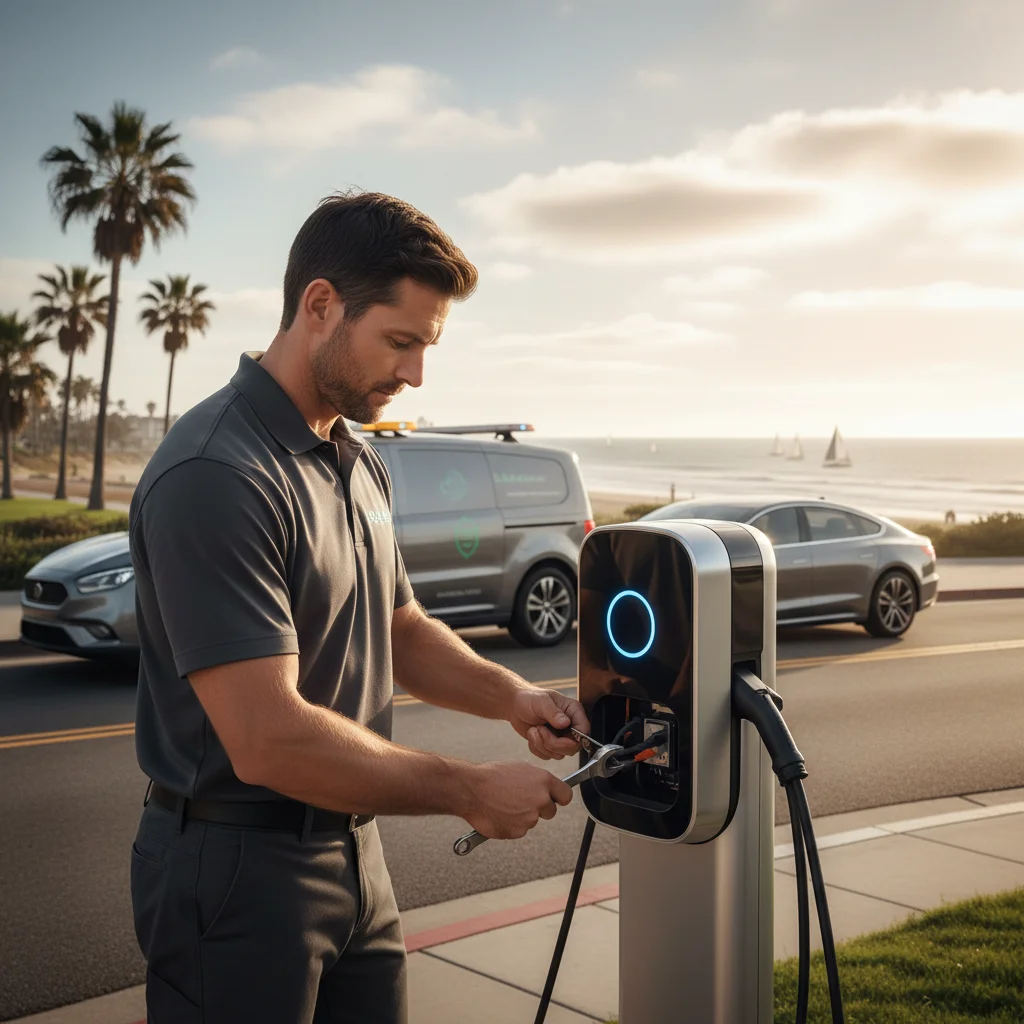
Work lots in Chino run the pack down on purpose
Last-mile and warehouse EVs often end a shift close to empty. That’s how a route is built, then the last stop runs long. The depot charger is still across the yard. The van sits where the route died.
Chino sits in the West Valley. It’s the first stretch you hit heading east from Los Angeles County on the 60. SR-71, the Chino Valley Freeway, is the city’s own north-south run. Euclid Avenue, signed as SR-83, is the local spine. Central, Pipeline, Riverside Drive, and Grand carry work traffic through the lots.
This is the west edge of the inland logistics belt in San Bernardino County. Warehouse traffic, airport traffic, and commuter traffic share the same few miles. Ontario’s distribution belt sits just north, south of Mission Boulevard. Fontana’s warehouse rows sit farther east along I-10. Chino’s work lots live in that same working landscape. Work lots gather around Chino Airport and the industrial edges facing Ontario and Eastvale.
The ground still shows dairy preserve heritage. The Preserve, a large master-planned section, occupies the south. Older streets and work yards sit closer to the airport and the 71. A driver can live in The Preserve. They can still get stuck in a warehouse stall after a long route. A house charger across town doesn’t reach that bumper.
Planes of Fame Air Museum sits at Chino Airport. Airport-area lots see long dwell during a shift or a visit. Prado Regional Park sits on the city’s edge. Those are real Chino places, and they don’t move a pack that’s already at empty. Mobile EV charging is the visit that comes to the stall.
Two clocks run in the same city
Chino has a second drain that isn’t a warehouse route. Drivers commute west into Los Angeles and Orange counties on SR-71 and SR-60. They come home on whatever that trip left in the pack. A work van and a commuter car can both die that night, for different reasons.
The van ran the route down on purpose. The commuter misread the return on the 71. If you’re the fleet driver, the stall is the scene. If you’re the commuter, it might be Euclid on the way in. It might be a lot you used as a quick stop.
Either way, the useful call is the same. You want a person with a 240V source at the car. A flatbed is the wrong first move when the only problem is energy. EV roadside assistance in Chino is that on-site charge. It also covers a 12V check when the van won’t wake.
Southern California Edison serves Chino homes and yards. Building power doesn’t roll a van that can’t reach the yard plug. The operator doesn’t need the building’s circuit. They bring their own Level 2 source.
The van looks dead, so check which battery failed
A work-lot stranding often starts with a car that won’t wake. You’ve got no lights, no app, and no door handles. That picture feels like an empty traction pack, and it often isn’t.
Every modern EV still has a 12-volt battery. That small battery runs the computers, locks, and lights. When it fails, the car looks completely dead. The main pack can still hold range. Ontario International Airport sits just north of Chino. Travelers see this after a week in long-term parking. A Chino work lot can show the same dark car after a long dwell.
Operators in the network can jump or replace that 12V on site. If the car wakes and the gauge is truly at zero, they can still help. They can add a Level 2 charge on the same visit. If the gauge shows range, you may only have needed the 12V. Tesla owners have a dedicated 12V jump path. Other brands follow the same order of checks.
Don’t assume a tow until someone reads both batteries. A flatbed is a hard way to move a van that only needed a jump.
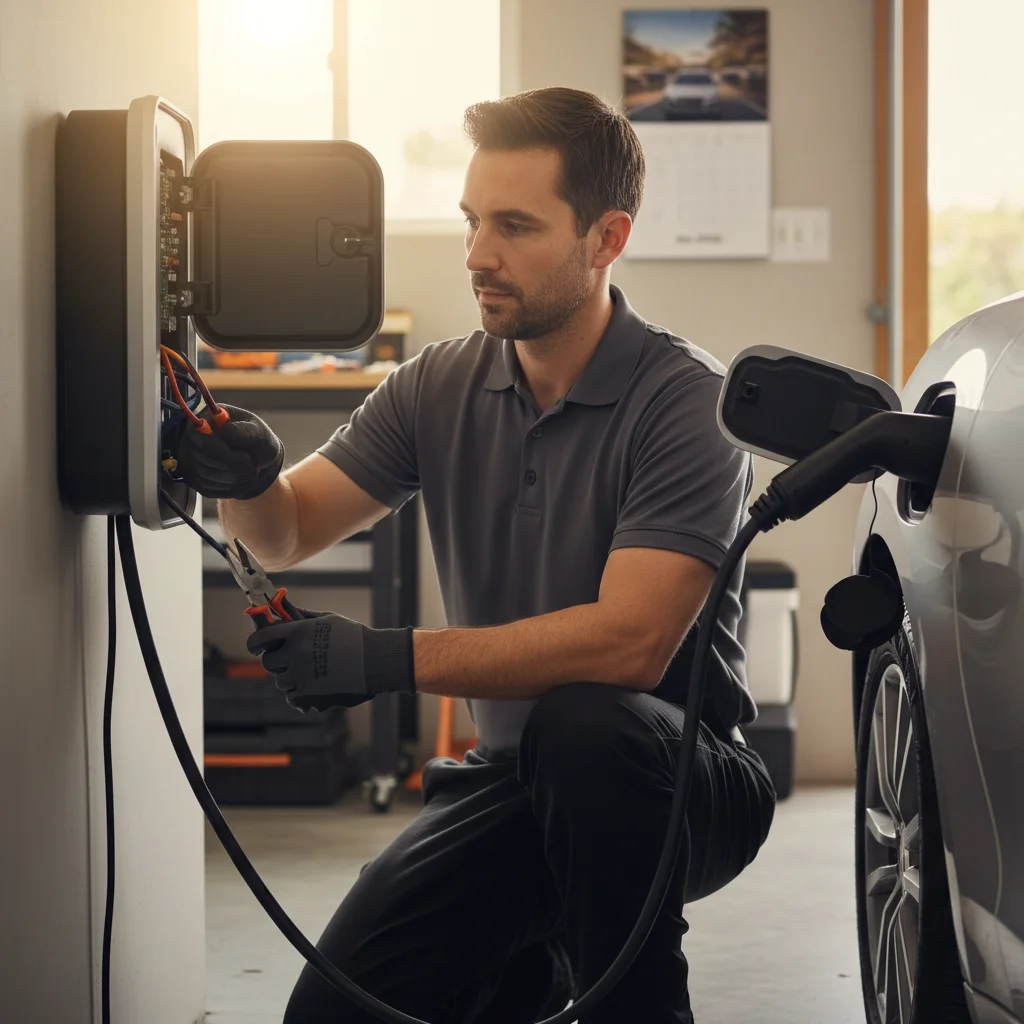
What the operator actually brings to the stall
Charge Pro IE doesn’t own trucks or a yard. It doesn’t employ technicians, and it holds no license for the work. It’s a match with a local independent operator. That operator sets the price and bills you directly. You hear the quote before they start.
The kit is a 240V Level 2 source. Tesla cars take a native NACS plug. Non-Tesla EVs use a CCS or J1772 adapter. Typical charging adds about 10 to 20 miles of range. That takes 15 to 30 minutes on the cable, not an arrival time. The operator tells you their window on the call.
Ten to twenty miles is usually enough to leave a Chino work lot. You can then drive to the plug you already use. It isn’t a full charge, and you don’t need one to clear the stall.
A Tesla, Ford, Chevy, Rivian, Hyundai, Kia, or VW work vehicle takes that same visit. Plug details sit on non-Tesla EV rescue. Tesla’s own roadside channel is a different path. A local mobile visit is the one that comes to the lot you named.
If the car has a mechanical fault, a tow can still be the right call. An empty pack in an open warehouse stall usually isn’t that case. The van stays put while the operator connects, then you drive out.
Stay with the vehicle if you can. Have the lot name, the nearest cross street, and the stall row ready. Euclid is the spine people know. Tell the operator whether you’re on the airport side or The Preserve side. You’re describing a parking stall, not a freeway mile marker.
If you’re actually on SR-71 or SR-60, that’s a different scene. Pull as far right as you can, with hazards on. Stay behind a barrier if one is there. The operator tells you whether they can work that shoulder. Don’t walk in the travel lane.
Once you can roll, pick the next plug yourself
The operator’s job is a top-up. After that, you pick the next stall with the car’s map or a charging app. Confirm it’s working before you spend the last miles. Don’t treat a listed stall as a guarantee.
The same warehouse-belt pattern shows up in Fontana and in Ontario. There’s a separate note on a dead EV by a Fontana warehouse. Ontario’s airport lots and warehouse rows have their own rescue write-up. Chino Hills, next door on the 71, is a different housing story. The work-lot call is the Chino one.
Montclair and Upland sit north along Euclid. Eastvale sits just south and east of the work streets. The network covers those cities too. The stall you name is the one that matters.
Chino sits in San Bernardino County. The 2024 Census estimate is 94,010 people. It’s a split place on about 29.6 square miles. The older core and The Preserve don’t share a charging habit. Fleet routes don’t care which ZIP you slept in. They care whether the van can leave the lot at the end of the shift.
Frequently asked questions
Can a Chino work van get a charge in the lot?
An independent operator meets you at the stall with a 240V Level 2 source. They quote before they start, then bill you directly. Tesla, CCS, and J1772 are in the kit. You get enough range to leave the lot. Charge Pro IE only makes the match. The Chino city page covers the wider map.
If the EV won’t open, is the pack empty?
Not always. A dead 12V can darken the car when the traction pack is still fine. Handles, app, and screens all go quiet. A jump or on-site 12V swap is the first check. Then you read the real state of charge.
Who sets the price for a mobile charge in Chino?
Charge Pro IE doesn’t set the price. The operator who takes the job quotes you first and bills you directly. You can decline if the number doesn’t work.
If a Chino work-lot pack is dead, call (909) 250-2881. Charge Pro IE matches you with a local operator. That operator quotes the job before they start.