A Hyundai Kona Electric that won’t start is usually a dead 12V. Warehouse idle and short commutes are the local pattern. The traction pack can still hold plenty of range. The computers just have no 12V left to wake. You’ll see this around Fontana’s warehouse rows after a shift. You’ll also see it in lots by Ontario International Airport. Short hops on I-10 and I-15 fit the same stall. This page covers the 12V checks that matter.
Hyundai sells the Kona as gas, hybrid, and electric. This guide is only for the Kona Electric. If you’ve got a fuel door, stop here. Those cars follow the usual petrol fault tree. A regular roadside jump is the right call on those.
Dark dash versus a pack that’s actually empty
You need to know which battery actually failed. A jump won’t fill an empty traction pack. A mobile charge won’t wake a dead 12V. Mix those up and you wait for the wrong help.
A dead 12V looks like a total brick. The dash stays dark and the key fob may not unlock. Interior lights ignore you and Start/Stop does nothing. You may not even get a click from the car.
An empty traction pack still talks to you. You’ll usually see range warnings on the cluster first. The cluster still lights and the menus still open. The charge door can still open on an empty pack. The car may roll a short way, then quit. That’s a pack problem, not a 12V problem.
If the Ready light never comes on, either battery can be the cause. Use the rest of the cluster to split them. No lights at all points to the 12V. Warnings about remaining miles point to the pack.
The charge port is another useful tell here. A dead 12V may keep that door shut. An empty pack still lets you plug in. If you can’t open the port, start with the 12V.
The same 12V versus pack split shows up on other EVs. Read when an EV 12V battery dies on the road for that wider picture.
Warehouse idle and the short Inland Empire commute
The Kona Electric sits in work lots all day here. Fontana’s ACS 2019-2023 population was 214,169. The Census 2024 city estimate is 218,455 people. A lot of those drives end at warehouse rows. The car sleeps in heat, not on a home plug. The 12V keeps a few modules alive while it sits. By clock-out, the dash can be fully dark.
Ontario is the other common all-day idle. ACS 2019-2023 put the city at 180,547 people. The 2024 Census estimate is 185,285 people. Airport lots and warehouse edges keep Konas parked for a shift. See EV rescue around Ontario airport lots and warehouse rows for that stall.
Chino work lots show the same dark-dash stall. The same stall shows up in Bloomington shift-end parking. You’re often not out of traction miles at all. You’re out of 12V, and the pack can still be fine. See A dead EV by a Fontana warehouse: who you actually call for that lot.
Short inland commutes add a second kind of drain. A hop from Fontana onto I-10 toward Colton isn’t a long run. A hop on I-15 toward the Cajon climb can be stop and go. The traction pack never gets a long, steady window to top the 12V. Surface streets through Rancho Cucamonga and Upland can be the same. The car can look fine for weeks on those hops. Then one morning it just won’t wake.
Riverside and Moreno Valley commutes sit in that mix too. Riverside Public Utilities serves the City of Riverside. Southern California Edison serves Fontana, Ontario, and Chino. Moreno Valley is split between SCE and Moreno Valley Utility. None of that changes the 12V check at the curb. Your home utility only matters once you can plug in. Until the computers wake, the meter is irrelevant.
Inland heat sits on that engine-bay 12V all afternoon. No verified figure for Kona 12V life turned up for this market. Treat a repeat stall as a battery that’s done. Don’t wait for a second dark dash on a commute.
If the pack is actually empty, that’s a different job. The operator can bring a 240V Level 2 source to the car. That typically adds 10 to 20 miles of range. That’s 15 to 30 minutes of charging time. That window is charging time, not an arrival time.
High desert and mountain idle follow the same 12V brick. Victorville and Hesperia lots after the Cajon climb sit in heat. Big Bear Lake and Big Bear City sit on Bear Valley Electric Service. Lake Arrowhead and Crestline sit on Southern California Edison. A Kona that sat in a mountain lot can still be a 12V brick. Don’t assume the pack is empty just because you climbed.
Corona on the 91 and Jurupa Valley on SR-60 are commute stalls too. Eastvale new streets can leave a Kona sitting during a move-in. Eastvale’s ACS 2019-2023 housing stock is only 2.2% pre-1980. Temecula and Murrieta wine-country days can park a Kona for hours. The check is the same in each of those places.
Where the 12V battery sits on a Kona Electric
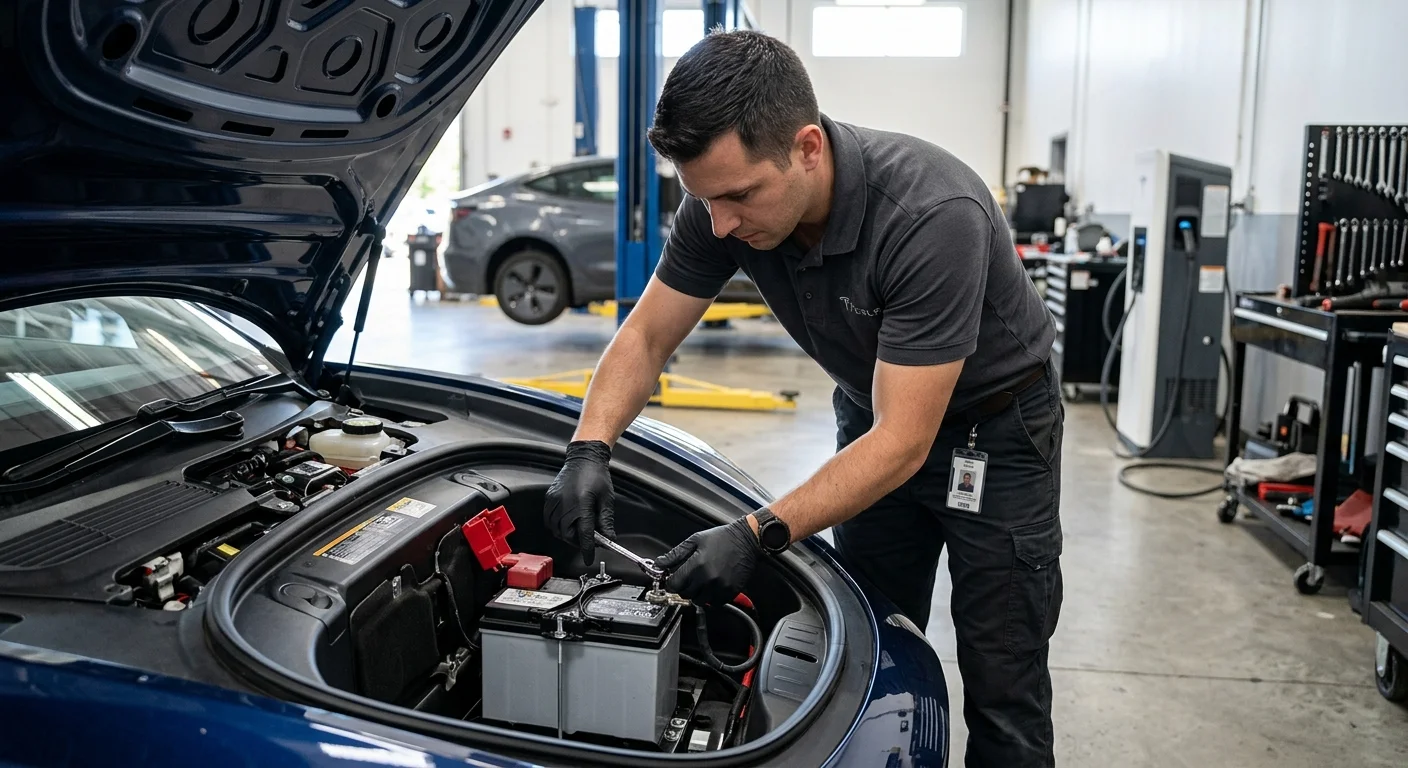
Many EVs hide the 12V under the cargo floor. Some put that battery in the frunk instead. The Kona Electric puts it in the engine bay. Look to the driver’s side, toward the rear of that bay. It’s a standard 12V AGM pack in a plastic tray.
You still have to get the hood open. Use the interior release if the doors work. If the 12V is fully dead, that latch may not move. Check the owner’s manual for the emergency hood release. Hyundai places a pull path near the driver-side fender on many years. Confirm yours in the manual before you pry anything.
Once the hood is up, find the tray. A strap or bracket holds the battery in place. The positive post wears a red protective cap. The negative is bare or under a black cap. The engine bay is tight around that tray. Gloves and eye protection are worth putting on.
That location is easier than a buried cargo-floor pack. It’s still live 12V in a hot compartment. Don’t lean on the fuse box while you clip on.
Jump points under the hood
The Kona doesn’t want clamps on the battery posts. Use the dedicated jump terminals in the engine bay. That’s safer, and it’s easier to reach.
You need a portable jump pack, or a gas car with cables. Don’t use a second EV as the donor. EVs aren’t built to source current that way. The donor EV can throw its own fault codes. See How to jump start an electric car without frying the 12V for safety.
Open the hood before you clip anything on. If it won’t release, use the emergency pull in the manual. Remove the red cap from the positive terminal on the fuse box cover. That cover sits on the driver side of the engine bay.
Find a clean, unpainted metal ground on the chassis. A bolt on the shock tower is a common pick. Skip the battery’s negative post if you can.
Clip the positive clamp to the Kona’s positive terminal. Then clip that lead to the jump pack or donor positive. Clip the negative to the pack or donor negative next. Then clip the other end to the Kona’s chassis ground.
Give the pack a short rest before you press Start. Press Start/Stop with your foot on the brake. The Ready light should come on after that.
Once it wakes, get to a Level 2 plug when you can. A charging session lets the traction pack top the 12V. If the 12V dies again soon after, the battery is done. A jump is only a bridge, not a repair. See EV 12V dies again after a jump: what that usually means next.
The 12V Battery Save setting
Hyundai added a 12V Battery Save function on the Kona Electric. It shows up from the 2019 model year onward. The idea is to catch a low 12V before the car bricks.
Look under Settings, then Vehicle, then Charge Settings. The label is 12V Battery Save on most trims. Wording can shift a little by model year.
When it’s on, the car pulls a little current from the traction pack. That current tops the 12V if it falls too low. It’s a rescue mode, not a forever fix. It won’t run as a substitute for a new battery.
If the 12V is already fully dead, the screen is dark. You won’t see the setting until after a jump. Plan a replacement if you keep turning Save on. Don’t keep leaning on that setting.
After a jump on an older battery, turn Save on for the drive home. Then get the 12V tested at a shop.
Some owners see a drain after a software update. This page can’t confirm a specific update year for that. If drain started right after an update, tell the dealer. Bring the date of the update with you.
Hyundai’s other EVs follow a similar 12V stall. See also Hyundai Ioniq 5 won’t start: what to check before you call.
When you need a person at the car
Some stalls aren’t a DIY jump. A packed warehouse lane may not give you room for cables. A shoulder on I-215 through Moreno Valley is a poor classroom. Stay in the car if traffic is close.
Charge Pro IE is a referral line for this market. We match stranded EV drivers with independent local mobile rescue operators. We don’t hold a trade license. We don’t own trucks or equipment. We don’t employ the technicians who roll out. The operator quotes you before starting any work. That operator bills you directly after the visit.
The pros we connect you with are licensed and insured. They handle Tesla and every major EV brand. That includes every Kona Electric model year. They can jump or replace a dead 12V on site. They can also bring that 240V Level 2 hookup. Non-Tesla CCS and J1772 cars are in that mix. Use Non-Tesla EV rescue in the Inland Empire: who helps CCS and J1772.
If a proper jump does nothing, stop there. The 12V may not hold any charge. A fuse in the junction box may be open. A communication fault can keep the high-voltage system off. Those cases need a tow to a Hyundai dealer or EV specialist. An on-site operator can tell you if the car still needs a tow. No price for that visit is published here. Confirm the current charge with the operator before they start.
Charge Pro IE serves drivers across the Inland Empire.
Frequently asked questions
How do you jump start a Hyundai Kona Electric?
Use a portable jump pack or a gas car with cables. Connect to the dedicated positive terminal under the fuse box cover. That cover is on the driver side of the engine bay. Use a clean chassis ground for the negative clamp. Wait a short beat, then press Start/Stop with the brake down. Don’t use another EV as the donor. After it starts, plug into Level 2 when you can.
Why does a Kona Electric 12V die after warehouse idle?
The 12V keeps modules alive while the car sleeps. A Fontana or Ontario work lot can last a full shift. Inland heat sits on the engine-bay pack the whole time. Short I-10 and I-15 hops may not top that 12V back up. A dark dash after idle is the 12V, not an empty traction pack.
What does 12V Battery Save do on a Kona Electric?
It pulls a little power from the traction pack. That keeps the 12V above a minimum threshold. Find it under Settings, Vehicle, and Charge Settings. It’s a protective feature, not a new battery. If you enable it often, plan a 12V replacement. If the dash is already dark, jump first.
Call Charge Pro IE at (909) 250-2881 if the Kona won’t wake. An independent operator will quote you before any work starts.