A Hyundai Ioniq 5 that won’t start is usually a dead 12V. After a West Valley workday, that’s the usual cause. The main pack can still hold a usable charge. The small battery that wakes the car is the one that failed. You left it parked through a shift in Ontario or Fontana. You pressed Start and the cabin stayed dark.
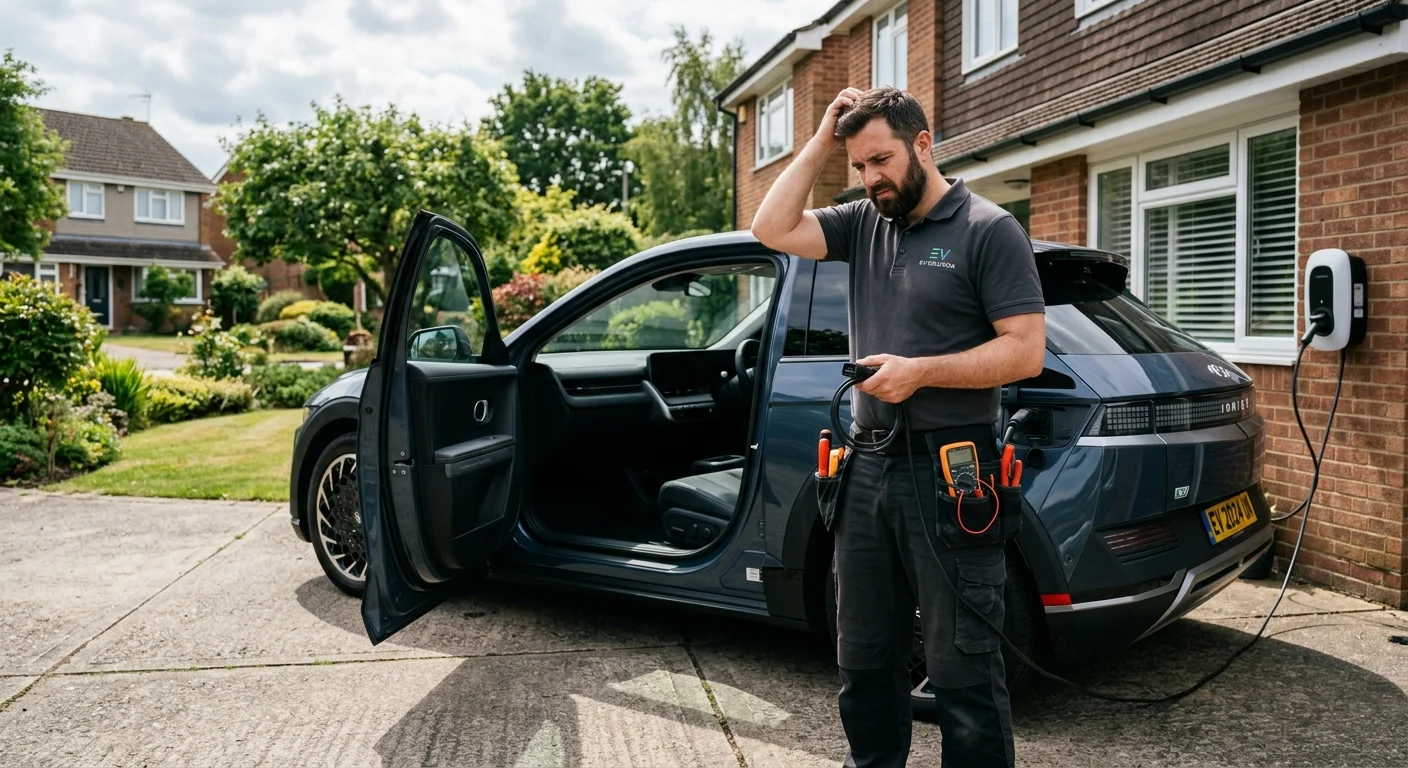
That black dash is the tell. An empty traction pack still tends to show a warning. A dead 12V shows nothing. Run the checks below before you call for a tow.
Why a West Valley shift leaves the 12V flat
Ontario, Fontana, Chino, and Rancho Cucamonga are all-day parking cities. Warehouse rows, airport lots, and office parks keep cars sitting all day. While you work, the 12V keeps feeding cameras, computers, and the fob receiver. Inland heat makes a weak 12V fail sooner.
This isn’t a range story. The Ioniq 5’s traction pack can still have miles left. The 12V is a separate battery. When it drops too low, the car can’t bring the high-voltage system online. You get a silent car with a charged pack.
Fontana’s ACS 2019-2023 population is 214,169, and Ontario’s is 180,547. Those West Valley job cities feed onto I-10 and I-15 at quitting time. Ioniq 5s sit in the sun on those lots, then refuse to wake. The same stall shows up around Ontario airport lots and warehouse aisles. It also shows up on Fontana warehouse lots after a long shift.
If the lot lights are on, it isn’t a utility outage. Only your car is dead. Ontario, Fontana, Chino, Upland, and Montclair sit on Southern California Edison. Rancho Cucamonga is split. SCE covers most of the city. Rancho Cucamonga Municipal Utility serves a southeast pocket. That pocket includes The Enclave, Day Creek Square, The Resort, and the Victoria Gardens area. A silent Ioniq 5 there is still a 12V problem. It isn’t an RCMU meter event.
Don’t treat a nearby public post as the first fix. A dark car may not start a charge session at all. The 12V has to come up first.
How to tell a dead 12V from an empty pack
Try the fob from outside. If the locks ignore you, suspect the 12V. Use the physical key inside the fob if the doors stay shut. Once you’re in, look for a black dash and a black screen. There’s no chime, no click, and no Ready light.
An empty pack behaves differently. Lights usually still work. You may see a low-charge warning. The car can complain and still refuse to roll. That’s a traction-pack problem, and it’s a different call.
Flickering cabin lights point the same way as a black dash. So do error tiles that pop and vanish. The 12V is trying to hold the computers up and losing. When the 12-volt dies, the whole EV can look finished. That can happen even with range sitting in the pack.
The car was fine this morning in Upland or Montclair. It’s mute at day’s end in Ontario. Think 12V first. Heat plus a full day of electronics is a common drain. A surprise empty pack usually comes with miles you already watched fall.
Confirm the start sequence before you pop the hood
Hyundai wants your foot on the brake, then the Start button. Skip the brake and you may get accessories only. The car never enters Ready. That looks like a no-start when it’s only the sequence.
Press the brake firmly. Press Start once. Wait for Ready. If the cabin is fully dark, this won’t save you. You still had to try it. A lot of drivers do this in a rush at a Chino lot gate. Then they think the car died.
Try the spare fob if you have one. A weak fob battery can refuse to authorize Ready. Put the fob in the backup sensing spot in the console. Use that only if your manual shows one. Then try Start again with the brake down.
Ready means the cluster is on and the car will go into gear. Accessories-only is a lit screen and a car that won’t roll. Don’t keep pressing Start. One clean sequence is enough to know.
Finding the Ioniq 5 jump terminals
The 12V itself isn’t the clamp point. Hyundai puts jump terminals under the hood so you aren’t digging for the battery. Pop the hood. On the driver’s side you’ll see a black fuse-box cover.
Open that cover. Look for a red positive post under a small cap. That’s your plus clamp. For the minus, use a clean, unpainted metal ground on the body. A marked ground stud works too. Don’t clamp onto a random painted panel.
Connection order is easy to mix up. Follow how to jump an EV at the curb instead of copying a gas-car habit.
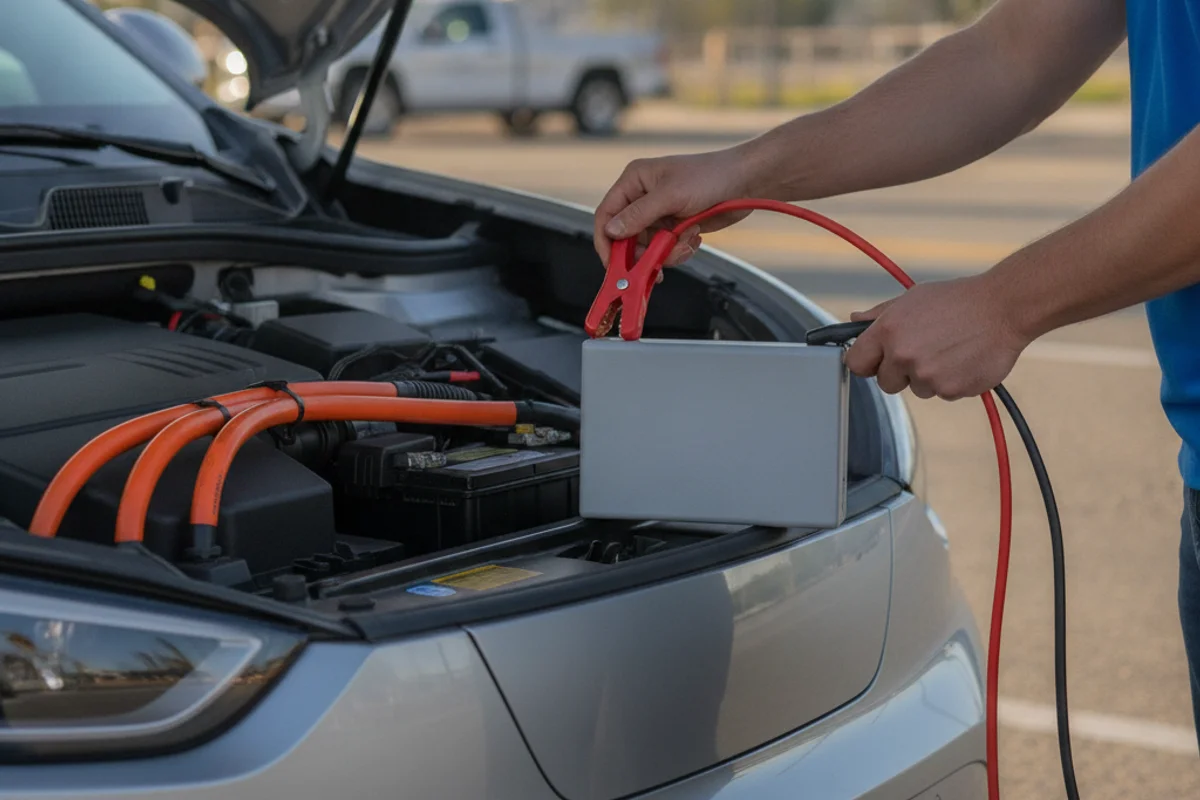
A portable jump pack is cleaner than a second car in a tight warehouse aisle. If you use another vehicle, keep cables off fans and off the orange high-voltage lines. Those orange cables aren’t 12V. Don’t clamp there.
Once the clamps are on, give the 12V a couple of minutes to charge. Then put your foot on the brake, press Start, and look for Ready. If it wakes, leave it in Ready for a bit. The car can try to recharge the 12V from the main pack. Don’t shut it down in the lot and hope.
If you get Ready in a warehouse row, move to a safe spot first. Do that before you lose it again. Don’t pull onto I-10 or I-15 on a dash that just came back from black. Some drivers also cut home on SR-60 through Jurupa Valley. Don’t do that on a 12V that just woke up. A collapsing 12V on the freeway is worse than a stall in the lot.
Soft reset if the dash is alive but Ready never comes
A dark car is 12V until proven otherwise. A lit dash that won’t go Ready can be a software hang. Hold Start for about ten seconds with your foot off the brake. That can force a reboot on many Ioniq 5s. Lights may flicker and the screen may restart. Wait a minute. Then brake and Start as normal.
Check cabin fuses only if you can do it without guesswork. A total blackout is rarely one dash fuse. It’s still the 12V most days.
If a jump brings the screens up and Ready still refuses, stop. That’s past a parking-lot fix. Don’t keep cycling the button.
If it starts, then dies on the drive home
A jump that lasts to the I-10 ramp and then dies is a failed 12V. It isn’t a fluke. The battery took a surface charge and collapsed under load. A 12V that dies again after a jump usually needs replacement, not another pack.
Same story if you make it into Rancho Cucamonga or Chino. It won’t restart at a quick stop. Get it to a Hyundai shop on a running car if you can. If it dies on the shoulder, you need on-site help. An operator can jump or replace the 12V there.
Don’t keep jump-starting it every morning before a Fontana shift. That pattern means the 12V can’t hold a charge. The car may also have a charging-circuit fault. That circuit should keep the 12V topped up from the pack. That’s shop work. The roadside job is to wake the car and get you off the lot.
Upland and Montclair housing is older on average than the new tracts farther south. ACS 2019-2023 puts pre-1980 housing at 55.9% in Upland and 68.5% in Montclair. Ontario is 50.7%. A home charger on an older panel still can’t wake a car that won’t boot. Plug in after you have Ready, not before.
What a mobile operator can do, and what they can’t
Charge Pro IE is a referral line. We match you with an independent local operator. We don’t own trucks. We don’t employ technicians. The operator quotes you before any work starts, then bills you directly.
On an Ioniq 5, the first job is usually the 12V. Operators can jump it on site. They can replace a dead 12V when that’s the right fix. You have to agree to the quote first. They also handle Tesla and every major EV brand. A Hyundai isn’t a special exception.
If the pack is empty too, that’s a different tool. The operator can bring a 240-volt Level 2 source. It uses a CCS or J1772 adapter for a non-Tesla. Typical charging time adds about 10 to 20 miles of range. That takes 15 to 30 minutes of charging. That’s charging time, not a promise of when someone arrives. That’s enough to reach a charger you already planned. It isn’t a full fill.
Non-Tesla EV rescue is the service path for an Ioniq 5. A tow is the last resort. Use it if the 12V won’t hold and the car can’t roll. Ask the operator before anyone hooks a dolly.
We serve the Inland Empire, including these West Valley cities. Ontario, Fontana, Chino, Upland, Montclair, and Rancho Cucamonga are in the service area. So is the rest of the two-county map.
When you should skip the DIY steps
Skip the clamps if you aren’t sure which post is which. Skip them in a live traffic lane. Skip them if you don’t have room to stand clear of passing cars. Call instead.
Call if the car is silent after a proper jump. Call if doors, windows, and the charge port all stay dead. You’re past a sequence error.
If you got Ready and you still need miles, that’s a charge problem. Plug in at home if you can. Or meet an operator for a Level 2 hookup. Don’t wait at a public post with a car that still can’t boot.
For a 12V no-start after a West Valley shift, start simple. Check the fob, the brake, and the underhood posts. If that doesn’t produce Ready, call Charge Pro IE at (909) 250-2881. We’ll connect you with a local operator. That operator can quote a 12V jump or replacement on the spot.