Most Teslas don’t have run-flat tires. A puncture on I-15 still needs tire help. You can’t limp on a stiff sidewall the factory never fitted. Plan on a kit, a tire tech, or a flatbed. That’s what Model 3, Y, S, and X owners here should assume.
What Tesla puts on the car instead
New owners open the frunk and lift the trunk floor. There’s no spare hiding there, and that gap makes people guess the tires must be run-flats. They usually aren’t, not from the factory.
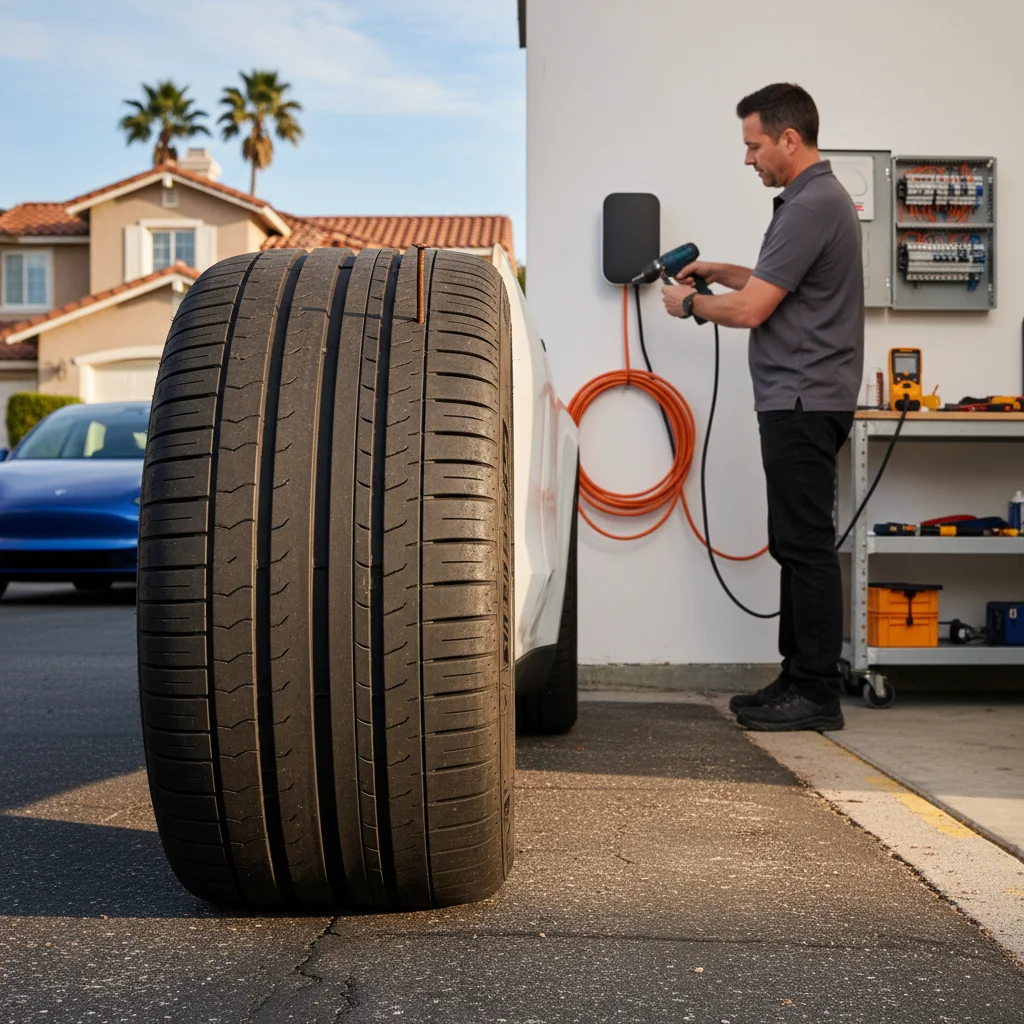
A run-flat tire uses a thick, reinforced sidewall. After the air leaves, that wall can still hold the car for a short, slow crawl. Tesla skipped that design on the cars most Inland Empire owners drive. You get a conventional radial instead. Many original-equipment tires from Michelin, Pirelli, and similar suppliers add a polyurethane foam liner inside the carcass. The foam’s job is cabin quiet. It soaks up cavity noise, and it doesn’t plug a hole. It also doesn’t keep a shredded tire on the rim.
An EV has no engine roar to hide road noise. Tesla chose the foam for comfort and for range. Run-flats add mass and rolling resistance, and they ride stiffer. Shops often can’t repair them after a puncture. Those trade-offs fight why people buy a Tesla, so the factory went the other way. Treat the foam as a comfort layer, never as a spare.
That matters on a hot shoulder in Riverside or San Bernardino. A foam liner won’t roll you from Temecula toward Corona after a blowout. It won’t save a Model Y that picked up a screw in a Fontana warehouse row. A Tesla flat is still a tire job.
Why an I-15 shoulder still needs tire help
I-15 is the spine a lot of local Tesla owners use. It runs through Temecula and Murrieta, then mixes with the 91 in Corona and Norco. It feeds Ontario and Rancho Cucamonga warehouse traffic. Then it climbs Cajon toward Hesperia and Victorville. Construction debris and metal scraps show up on those miles, and heat-soaked asphalt does too. None of that turns your Tesla into a run-flat car.
Fontana and Ontario lots are another common scene. Delivery vans and passenger EVs share the same rows. A screw in a Model Y tread doesn’t care that the car is electric. The pressure warning still comes on, and the foam liner still does nothing for the hole.
East of the valley, I-10 toward Redlands, Beaumont, and Banning adds long grades. SR-60 through Jurupa Valley does similar work. I-215 through Moreno Valley and Perris does too. A low tire on a grade cooks the sidewall faster than a low tire on a flat street. You still can’t limp on a run-flat you don’t have.
If the pack is also low after you stop, that’s a separate problem. Out of charge on I-15 at the Cajon climb toward Victorville covers the empty-pack case. A flat and an empty pack can stack, so don’t mix the two calls in your head.
The warning on the screen is your first clue
Tesla watches pressure with TPMS. A puncture usually shows up as a warning on the main display. You’ll see which corner is low, and you may watch the number fall while you drive. Don’t wait for a bang you can feel.
Pull over as soon as you have a safe spot. A soft tire on I-15, I-10, or I-215 can wreck the sidewall fast. Then a plug is off the table, and the alloy wheel can take damage too. Put the hazards on, get as far right as you can, and stay out of the travel lane.
Look at the tire before you reach for a kit. A nail in the center of the tread is one kind of job. A slash in the sidewall is another. A tire that’s already off the rim is a third. Only the first one has any chance with sealant.
Stay in the car if the shoulder is narrow. Cajon, the 91 through Corona, and I-10 through Colton are live, fast lanes. Kneeling there with a sealant bottle is a bad trade. Call tire help from inside the car, then wait for a truck or a tow.
What Tesla’s repair kit can actually do
Tesla’s official stopgap is a tire repair kit. Some cars include it, and some owners buy it later as an accessory. Confirm what is in your own trunk. Don’t assume the last owner left one.
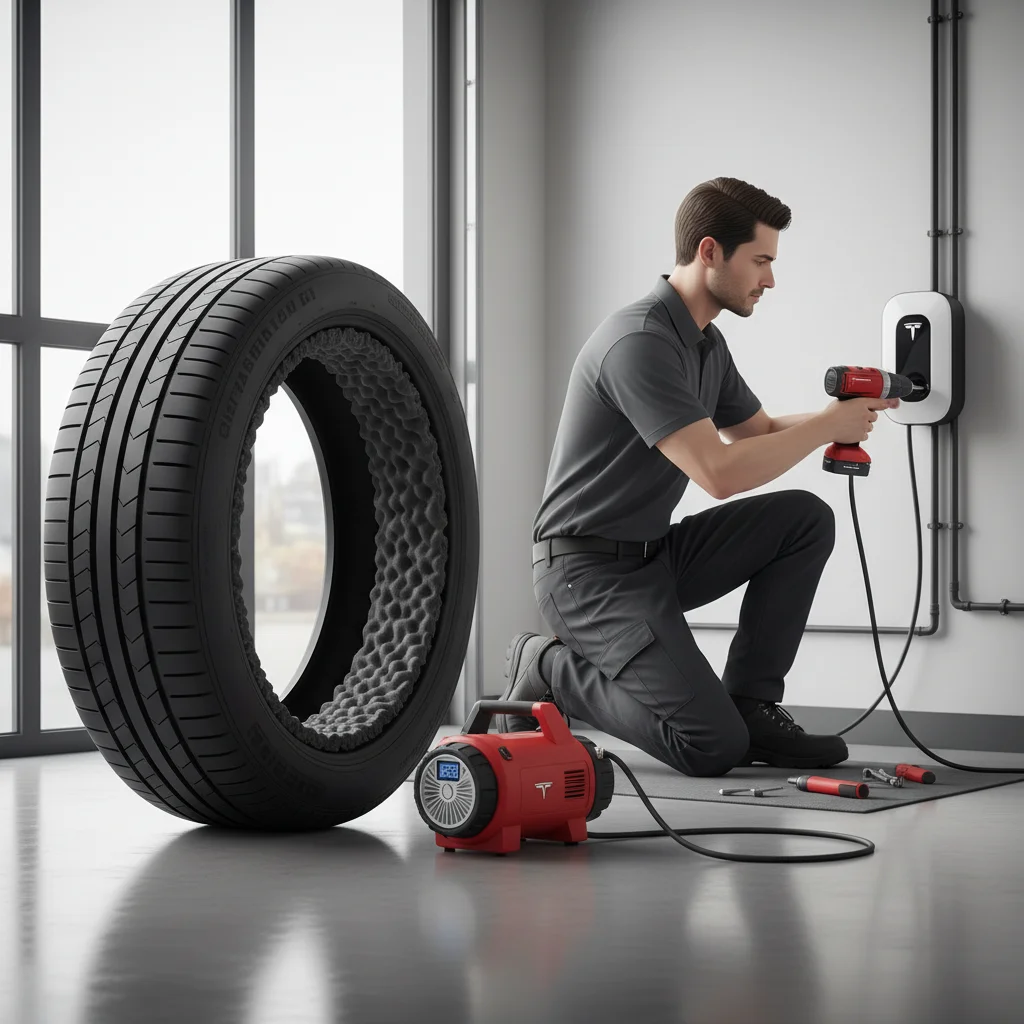
The kit is a bottle of sealant and a small 12V compressor. You thread the bottle onto the valve, couple the compressor, and push sealant into the tire. Then you inflate toward the pressure on the door sticker. The goo is meant to coat the inner surface. It can fill a small hole in the tread as the tire turns. It’s a get-to-the-shop fix, not a repaired tire.
It won’t seal a large gash, fix a sidewall cut, or remount a tire that left the wheel. If the compressor runs and the tire won’t rise, stop. More sealant won’t invent a patch. It only makes a mess for the next person.
Ask a shop before you inject if you can still roll there slowly. Sealant can complicate a proper patch, and it can coat a TPMS sensor. Some shops will replace the tire once sealant is inside, rather than clean and plug it. That’s their call, not a brochure promise. Tesla’s kit instructions live in the car’s manuals and the accessory page. This site couldn’t confirm a single Inland Empire shop’s sealant policy, so ask before you pay.
Why there’s no spare in a 3, Y, S, or X
Tesla didn’t forget the spare. The skateboard pack sits in the floor, so there’s no deep well like a gas car’s trunk. A spare would steal cargo space and break the flat load floor. It could also fight the pack and motor packaging. Tesla kept the floor clean and skipped the wheel.
Mass is the other reason. A spare, a jack, and a lug wrench add weight the car has to haul every mile. Range is the selling point, and extra stored mass works against it. Tesla made the same trade many other brands have made: an inflator kit instead of a fifth wheel. No verified spare-kit weight turned up in the sources for this page, so this piece doesn’t quote one.
You can buy an aftermarket spare and park it in the trunk. That’s an owner choice, not how the car left the factory. Some owners also fit aftermarket run-flats later. Don’t count on either when you plan a drive to Lake Arrowhead, Big Bear Lake, or across the High Desert. Check what is actually on the car before you leave.
Mountain miles add a second risk after the puncture. A damaged tire on the descent from Running Springs or Crestline is a control problem, not a range problem. Get the car to a safe turnout. Don’t try to nurse a flat down a grade.
On-site tire work versus a tow
When the kit is the wrong tool, you’re choosing between a mobile tire tech and a flatbed. Charge Pro IE doesn’t make that dispatch. Independent tire trucks and Tesla’s own roadside path do.
A mobile tire tech can plug a clean tread puncture in place. They can mount a new tire if they have your size. Tesla sizes, especially acoustic-foam OEM fits, are specific. The truck that arrives may not stock your exact tire. Ask what they have before they start. They quote you and bill you, and that’s between you and that shop. No dollar figure belongs here, because this referral line doesn’t set tire prices.
A tow is the honest path for a blown sidewall, a tire off the bead, or a bent wheel. Tesla roadside, through the app, can arrange a tow to a Tesla Service Center or a tire shop they approve. Coverage limits live in Tesla’s own policy, not on this page. Read them in the app before you need them. Tesla flat tire coverage, and the Inland Empire’s free freeway option is the local companion to this piece. Tesla tire repair on the roadside: what they will and won’t do is the other.
If a flatbed is coming, the car needs to be in Tow Mode. The operator should use a flatbed, not a wheel-lift that can load the drive unit wrong. How to tow a Tesla with no power without damaging the drive unit walks through that sequence. Confirm the procedure with the driver on scene.
For who actually answers a stranded Tesla here, Tesla roadside versus a local Inland Empire rescue lays out the paths. A tire event and a dead pack are different tickets.
When to stop DIY and call tire help
Call for tire help as soon as the shoulder is unsafe. Call when you can see sidewall damage, a large object in the wall, or a tire already off the rim. Call when the compressor can’t build pressure, or when the tire goes flat again after one try.
Tesla’s app is the default for many owners, and it can send a contractor. That contractor may be a tow, not a tire mounter with your size on the truck. Wait times aren’t published here, because no verified Tesla arrival figure turned up for Riverside County or San Bernardino County. Watch the app, and if the update stalls, use Tesla’s roadside number from the app and keep that thread.
None of those parties is Charge Pro IE. This brand connects you with mobile rescue operators for power problems. It doesn’t mount tires or carry Tesla sizes. It owns no trucks and employs no technicians.
What this referral line is for
A flat is frustrating, and it’s rarely the call this line exists for. Call Charge Pro IE when the problem is power: an empty traction pack, a 12V that died while you sat with the flashers on, or a car that can’t roll to a shop on what’s left in the pack.
The operators we connect you with bring a 240V Level 2 source to the car. They use a native NACS plug, and they carry CCS or J1772 adapters for non-Tesla EVs. They typically add 10 to 20 miles of range in 15 to 30 minutes of charging. That window is charging time, never a promise of when someone arrives. They can jump or replace a dead 12V on site. They handle Tesla and every major EV brand. The operator quotes you before starting and bills you directly. Charge Pro IE holds no license, sets no prices, and publishes no hours.
If a flat is your only problem, stay on the tire path. If the wait kills the 12V, or you can’t roll to a shop, add a power call. Tesla roadside rescue is the service page for that power-side match. For the 12V path, Tesla 12V battery failure: when it hits and what to do is the explainer.
To reach Charge Pro IE, call (909) 250-2881. An independent operator quotes the job. You decide before any cable goes on.