Tesla roadside assistance tire repair is usually a tow or a temp inflate. That holds on Inland Empire freeways, warehouse lots, and mountain grades. It isn’t a vulcanized patch on the shoulder. A mobile charge won’t plug a nail. On a live freeway, patrol can still handle a flat.
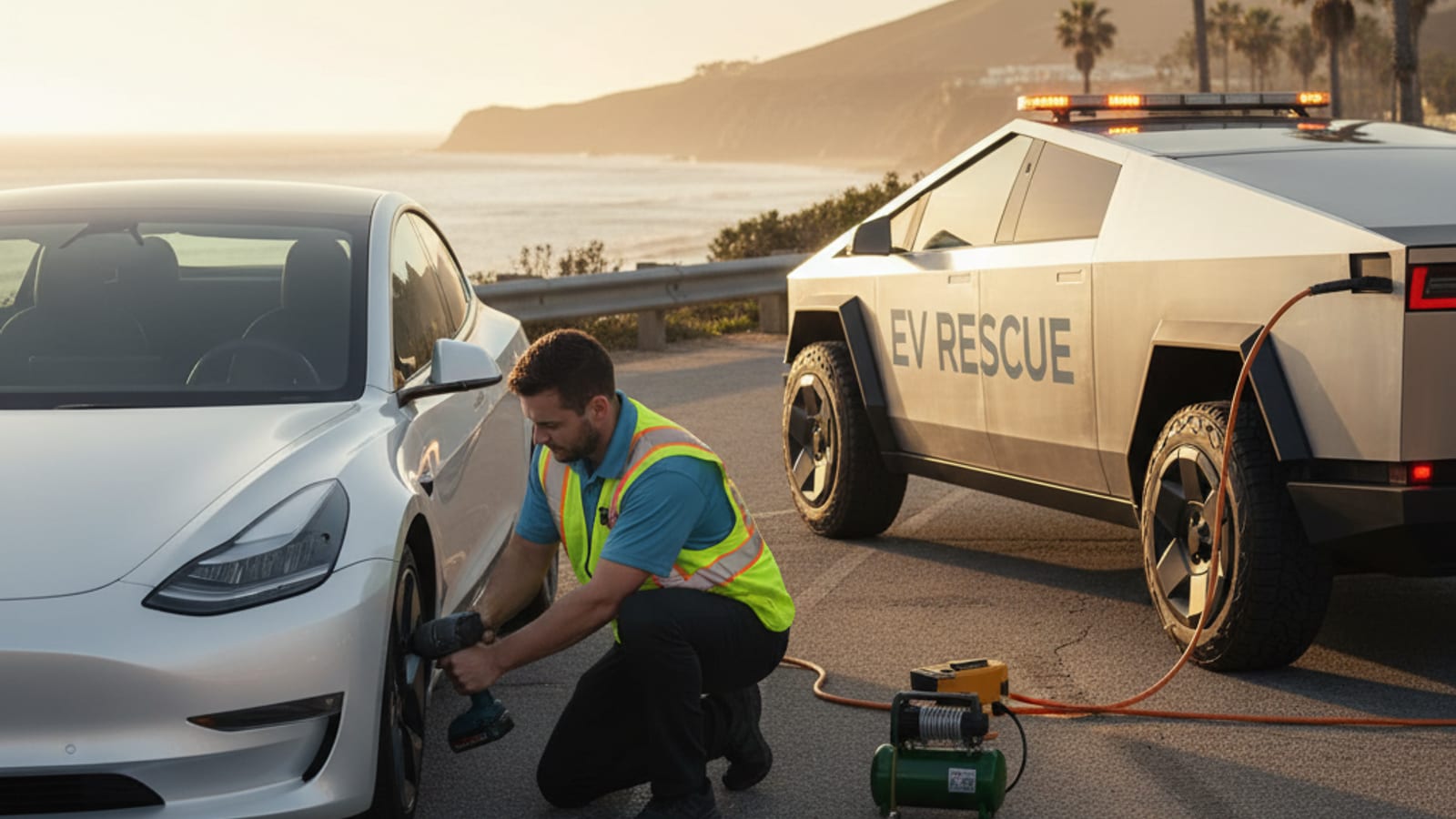
A low tire and a dead pack can look identical from the seat. The car won’t roll. The dash looks angry. They’re still different jobs. One needs air, a plug, or a flatbed. The other needs electrons. Call the wrong channel and you wait for a truck that can’t help.
A flat isn’t an empty pack
Your Tesla can sit at a healthy charge and still be stuck. A torn sidewall does that. So does a nail on a Fontana warehouse row. So does a pinch on the I-10 shoulder in Colton. Charge percent isn’t the diagnosis.
Open the Tesla app and read it slowly. A tire pressure warning isn’t a propulsion fault. It isn’t a need-charge banner either. If the car would drive on four sound tires, you don’t need a roadside Level 2 lead.
Charge Pro IE is a referral line. We match stranded EV drivers with independent local operators. Those operators bring a 240V Level 2 source to the car. They don’t operate a tire bay on the shoulder. They don’t stock Tesla-sized rubber. If the pack is healthy and a tire isn’t, that’s another call.
Get safe, then look at the wheel
Stay out of live traffic. Park. Hazards on. Get behind a barrier if one exists. Then look at the tire.
A slow leak in the tread is one case. A sidewall bulge is another. A wheel that hit a curb is a third. Rim bends and sidewall tears don’t take sealant. A nail in the center of the tread sometimes holds long enough to limp.
Most Teslas don’t come with a spare. That’s Tesla’s design, not an Inland Empire quirk. Weight, cargo space, and aero won. You can’t jack and swap unless you bought a spare and actually keep it in the car.
Check the trunk well and the frunk. Some cars include a compressor and sealant. Some don’t. Tesla’s owner’s materials are the source for your VIN. If the kit isn’t in the car, don’t assume a contractor brought yours.
What Tesla roadside assistance usually does with a tire
Request help in the Tesla app, or use Tesla’s published roadside number. Tesla’s support pages describe a contractor network. It isn’t a Tesla employee in every cab. Who arrives in Ontario or Hemet on a given night isn’t listed here. This page can’t verify that dispatch.
Treat Tesla’s tire path as a mobility service. The point is a safer place or a shop. It isn’t a rolling tire store.
For the broader split of what they send, read what Tesla roadside covers. A tire event isn’t the same as a warrantable breakdown.
A tow, more often than a repair
With no spare, a flatbed is the usual Tesla outcome. The contractor loads the car. They head to a Tesla Service Center or a shop Tesla will accept. This page won’t invent a service center address. Confirm the drop-off in the app before they hook up.
A shoulder on I-15 at Cajon is a poor place to demand a perfect plug. So is I-215 through Moreno Valley. Getting off the live lane can be the whole win. That’s a tow. It isn’t shop-quality Tesla roadside assistance tire repair.
Air or sealant, if the tire can hold it
For a small tread puncture, some visits add air. Some use sealant. Tesla doesn’t publish a promise that every contractor carries both. Ask before they start. Sealant is a limp-home tool. It isn’t a permanent patch. A shop still has to see the tire.
Sidewall cuts, broken belts, and bent wheels don’t get that treatment. Don’t talk anyone into pumping a tire that can’t hold a bead.
A spare swap, only if you packed a spare
If you carry an aftermarket spare, they can often swap it. That’s the uncommon Tesla case. Most owners never packed one. Say so in the first app message if you did. If you didn’t, don’t wait on a wheel that isn’t coming.
A look, then a fork
Someone inspects the tire. They pick inflate, seal, swap, or tow. Their job is a safer car, not a lasting repair. If they say it won’t hold, listen.
What Tesla roadside assistance won’t do
Owners hear roadside assistance and picture a plug kit. Tesla’s published list isn’t a tire-shop menu.
No permanent patch on the pavement
Tesla roadside assistance tire repair isn’t a dismount and buff on I-10 in Redlands. It isn’t a vulcanized patch on that shoulder either. A nail in the tread still often ends as a tow. That’s annoying. It’s how this channel is built.
No new tire out of the truck
They don’t arrive with your size in a cubby. Staggered performance sets make that even less likely. If the tire is finished, the car goes where stock exists. After closing time you may wait until a shop opens. This site doesn’t publish shop hours. Call the shop they name. Ask if you can redirect.
The tire bill is still yours
A covered tow isn’t a covered tire. Road hazard, wear, and a pothole aren’t a pack defect. Tesla’s warranty text lives in Tesla’s documents. Confirm what your car still includes in the app. The rubber and the mount labor are almost always on you.
Tesla, AAA, or a local rescue helps when the question is who shows up. For a tire, who shows up may still be a tow truck.
The missing spare changes the night
No spare means you can’t self-rescue. You wait for air, sealant, or a hook. That’s true on Eastvale’s newer streets. It’s true in older San Bernardino neighborhoods too. Housing age doesn’t add a spare. ACS 2019-2023 data puts pre-1980 housing at 60.9% in San Bernardino. Eastvale’s share is 2.2%. Neither figure fixes a flat. They only mark how different the street can feel.
Instant torque and a heavy pack are hard on tires. That’s an EV fact. Inland heat makes underinflation worse. This research file has no verified local tire-failure rate. We won’t invent one. Use the door-jamb spec and the app. Do that before a High Desert run toward Adelanto. Do it before a climb toward Yucaipa too.
How a slow leak hides, then dumps you
Teslas watch pressure. A slow drip can look like weather. You park at a Moreno Valley warehouse. You park at a Temecula tasting lot. You park at Pechanga. Overnight the drip continues. Morning is a rim on the pavement.
If the car warns you and you keep driving, you can cook the tire. Don’t. Pull off. A destroyed tire plus a damaged wheel is a tow. We won’t quote shop prices. There aren’t verified figures in the research file.
A 12V fault can also leave you looking fully dead. That’s a different checklist. If the screens are dark, look at the tires. If they look round, think 12V before rubber.
Where you are changes the next call
The Inland Empire isn’t one shoulder. A Fontana logistics lot is one job. A Corona ramp on the 91 is another. A street in Big Bear Lake is a third.
On a freeway shoulder
If you’re on a designated freeway, California’s Freeway Service Patrol is built for this. CHP and Caltrans run it with local transportation agencies. Patrol trucks work the live lanes. They can often add air. They can try a spare swap. They can tow you a short way off the freeway.
This site’s research pull didn’t include a current FSP route map. It didn’t include an hours list either. Don’t assume every mile of I-10 has a truck. Don’t assume SR-60 or SR-91 does either. Confirm with CHP whether your stretch is covered. There’s a longer walkthrough in Tesla flat tire coverage and the freeway option.
A patrol stop isn’t Tesla roadside assistance tire repair. It’s a freeway safety program. Use it when you’re in their lane space. Don’t wait on Tesla’s contractor if a patrol truck is already there.
In a warehouse row or an airport lot
Fontana, Ontario, Bloomington, and Jurupa Valley work lots aren’t freeways. Patrol doesn’t cruise those rows. Tesla’s contractor still can. A tire shop can too, if you can limp. If you can’t limp, you need a lot tow, not a charge.
Airport lots and warehouse yards have their own gate rules. Follow posted instructions. This page won’t invent a terminal phone.
Chino and Ontario industrial streets fill with delivery Teslas at shift change. Other EVs sit there too. A flat there is a lot problem. It isn’t a Cajon Pass problem. Call for a tow or a shop. Don’t call for electrons.
On a grade, in the mountains, or on the High Desert
A flat on the Cajon climb toward Victorville is a shoulder plus a grade. Hesperia and Oak Hills sit on the other side of that climb. A flat in Running Springs or Crestline is a mountain road. That isn’t an FSP beat unless you’re on a covered freeway. A flat in Phelan, Wrightwood, or Adelanto can mean a long wait. None of that is a claim about charging. It means a tire is still a tire.
Big Bear Lake and Big Bear City sit in Bear Valley Electric Service territory. Lake Arrowhead and Crestline are listed on SCE’s tariff index. Utility maps change a home charger. They don’t mount a tire. If the car can’t roll down, you need a grade-capable tow. You don’t need a Level 2 lead for the rubber.
Ortega Highway near Wildomar is the same logic. It’s a road, not a shop. If you’re in a live lane there, call for highway help. If you’re in a lot in Lake Elsinore or Menifee, you’re in town.
Beaumont and Banning sit on the I-10 climb toward the pass. A shoulder there is fast. Get out of the live lane. Highland sits at the foot of the mountain climb. Yucaipa sits on the way up. Same tire. Different wait. Same rule: don’t mix it up with a charge call.
Freeway patrol, and the spare you don’t have
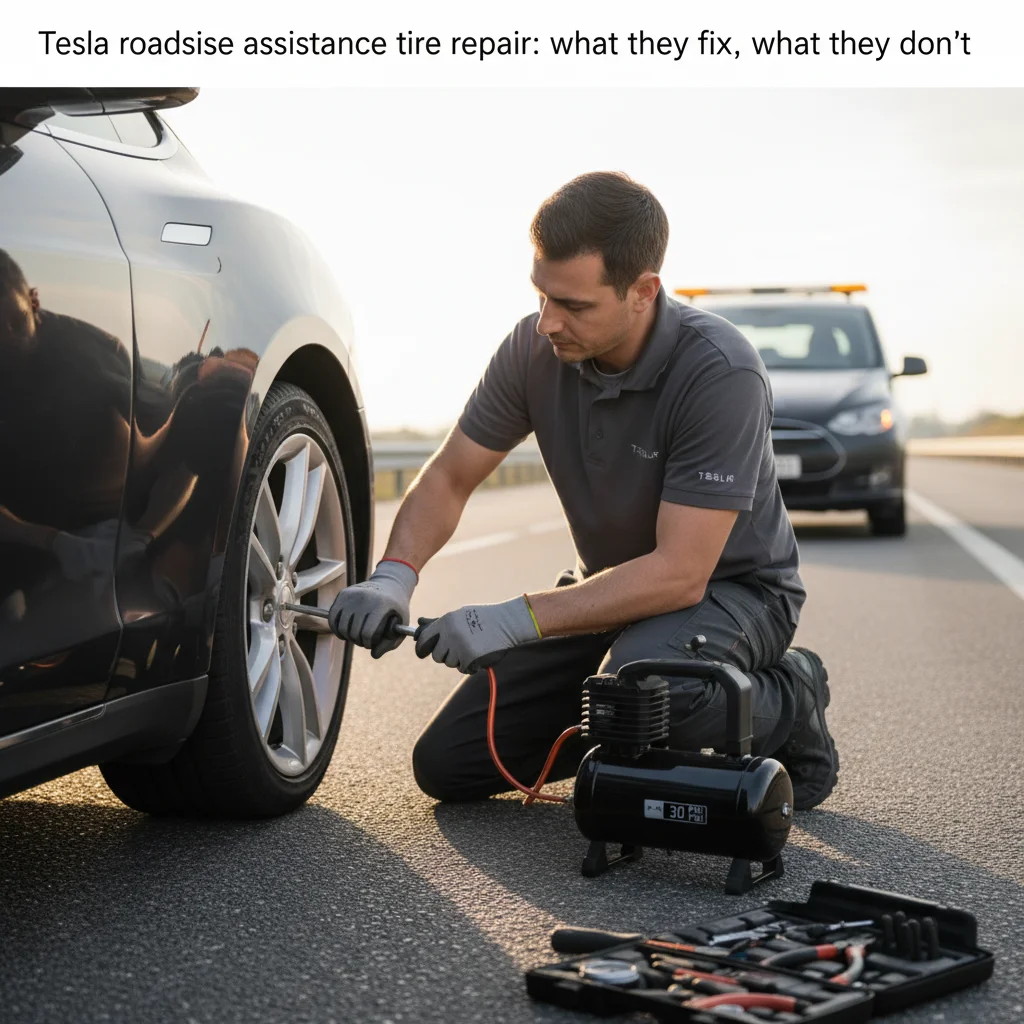
Classic patrol playbooks assume a spare in the trunk. Most Teslas don’t have one. Ask the driver what they can do before they jack anything.
They may inflate a tire that still has a bead. They may not. They may offer a short tow to the next exit. That short tow is still a win on I-215 in Perris. It’s a win on I-10 in Beaumont. It’s a win on SR-60 in Jurupa Valley. You’re off the live lane.
Don’t expect them to install a new Tesla-spec tire. Don’t expect a mobile charge operator to do it either.
When a Charge Pro IE call is the wrong call
Call us for an empty pack or a dead 12V. Don’t call us because a tire folded. The operators we connect you with are mobile rescue operators. They bring a 240V Level 2 source. They bring a native NACS plug. They bring CCS or J1772 adapters for non-Tesla EVs. Typical charging time on site is 15 to 30 minutes. That usually adds about 10 to 20 miles of range. That’s charging time, never an arrival time.
They can jump or replace a dead 12V on site. They handle Tesla and every major EV brand. The operator quotes you before they start. They bill you directly. Charge Pro IE doesn’t own the trucks. We don’t set the price. We don’t hold a trade license.
A flat tire doesn’t take a NACS plug. If the car would drive on a good tire, skip the charge call. If the pack is also empty, the wheel still has to sit safely. Handle the tire first when it won’t support the car.
What a mobile EV charging visit actually is spells out that job. EV rescue versus EV repair is the other split. A plug in the tread is repair. An empty pack is rescue.
Riverside drivers sometimes mix this up with a dark house panel. Riverside Public Utilities serves that city. A home outage and a flat tire can land on the same night. They’re still two jobs. Corona, Norco, and Eastvale are on Southern California Edison for electricity. That still doesn’t patch rubber.
What to do, in order
Get stable and visible. Don’t stand in a lane.
Read the Tesla app. Separate tire, pack, and 12V.
If you’re on a covered freeway, flag patrol or ask CHP about Freeway Service Patrol.
If Tesla roadside is the path you want, request it in the app. Ask what they’ll actually do for Tesla roadside assistance tire repair on your car tonight.
If the pack is empty and the tires are sound, that’s the Charge Pro IE path. Start at Tesla roadside rescue.
Once you can roll, go to a tire shop. Sealant isn’t the end.
Don’t stack three trucks on one shoulder. Pick the failure.
After you can roll, finish the tire
Sealant and a compressor buy a shop visit. They don’t buy months of highway miles. Tell the shop you used sealant. Some shops dislike the mess. Some will still repair a tread puncture. Sidewall damage means a new tire. This site doesn’t publish tire prices. Ask before they break the bead.
If Tesla towed you to a Service Center, ask whether they do the tire. Ask whether they send you on. Service Center tire work couldn’t be confirmed from this research. Get the plan in the app thread.
Staggered performance sizes may not swap left to right. Don’t mix a wrong-spec spare across an axle. If a shop warns you off it, listen. Tesla’s owner’s materials are the spec source.
Run-flats aren’t the default Tesla assumption. If you need that detail, read run-flats on a Tesla. Don’t assume the car has them because it’s an EV.
Upland, Rancho Cucamonga, and Fontana all have general tire shops. This page won’t rank them. It also won’t invent wait times. Call ahead. Ask if they work on Tesla sizes. Ask if sealant is a problem.
Pressure, heat, and the miles you already drive
Underinflation is the quiet problem. The app will nag. Believe it. Inland valleys run hot in summer. Heat raises pressure when you park. It also unmasks a slow leak once you roll. We don’t have a verified local psi study. Use the door-jamb number, not a guess.
Check tires before a Temecula run. Check them before a Fontana shift. Check them before a lake day that ends downhill. Look for nails, bulges, and inner-shoulder wear. Instant torque eats inside edges when alignment is off.
Rotation intervals live in Tesla’s maintenance schedule. We won’t invent a mileage. Follow Tesla’s published interval. Then confirm with your shop.
Debris on I-10 through Redlands is a real hazard. So is debris on SR-60 in Jurupa Valley. We can’t quote a pothole count. Give trucks space. Don’t clip a warehouse apron. EV wheels are easy to crack. The research file has no wheel-price table. We won’t fake one.
Rialto, Colton, and Grand Terrace sit in that same valley weave. I-10 and I-215 both cut through. A flat there is urban freeway or surface street. Know which one you’re on before you wait for patrol. Patrol is a freeway tool.
Murrieta, French Valley, and Winchester are more spread out. A rural shoulder isn’t automatically FSP. Confirm. Hemet and San Jacinto are town streets more often than freeway lanes. A lot in Cabazon is a lot. Treat it like Ontario, not like Cajon.
Tesla roadside vs a local charge call, for this job
For a tire, Tesla’s channel at least talks about tows and air. A local mobile charge call is the wrong tool. Charge Pro IE will still pick up if you mis-dial. The operator should tell you they can’t patch a tire. If the pack is dead too, you may need both later. Sequence it. Tire first if the car can’t sit on the wheel. Charge first if the tire is round and the pack is why you’re stuck.
Don’t treat Tesla roadside rescue as a tire shop. It’s for electrons or a 12V in a Tesla that won’t move.
Apple Valley and Victorville sit after the Cajon climb. Those are long, hot miles. A tire that was a little low in San Bernardino can be done when you get there. Check before you start that drive. Loma Linda, Redlands, and Calimesa are shorter hops. A flat is still a flat.
Insurance and clubs, without invented coverage
Some policies and some clubs include tire hazard or roadside. This research file has no carrier-by-carrier matrix for Inland Empire Tesla owners. Read your own card. If your club will change a tire, they still need a spare. You probably don’t have one. Ask the same question you ask patrol.
Tesla Insurance is a separate product. Don’t assume it duplicates Tesla roadside. Confirm inside Tesla’s own insurance documents if that’s your policy.
We also won’t invent a deductible or a dispatch fee. Those numbers change. They’re not in this research file. Ask the carrier.
Frequently asked questions
Does Tesla roadside assistance patch a tire on the shoulder?
Usually no. Tesla roadside assistance tire repair, as Tesla publishes the service, is built around mobilizing the car. That often means air, sealant, or a flatbed. It doesn’t mean a shop-quality plug and patch on an Inland Empire shoulder. Confirm what the contractor will do before they roll. The tire itself is typically on you.
Should I call for a mobile EV charge when I have a flat?
Not if the pack is fine. A 240V Level 2 visit won’t seat a bead or plug a nail. Call a charge only when the battery is why the car won’t go. If you’re empty and flat at once, start with the tire. It still has to be safe to sit on. Otherwise you’re charging a car that can’t leave.
Can freeway patrol help if my Tesla has no spare?
Sometimes. Freeway Service Patrol is for designated freeway stretches. It isn’t a city street in Hemet. It isn’t a lot in Chino. They can often get you off the live lane. They may not mount a spare you don’t carry. Ask the driver. Confirm coverage with CHP. This page couldn’t verify a current route list from the research file.
A flat Tesla on an Inland Empire road is a tire problem until proven otherwise. Tesla roadside assistance tire repair won’t become a shop visit on the asphalt. A charge truck won’t either. Use patrol on a covered freeway. Use Tesla’s app when you want their tow network. Use a tire shop once you can roll.
If the tires are round, look at the pack. If the pack is why you’re stuck, that’s our match job. Charge Pro IE connects you with local mobile operators across the Inland Empire. Call (909) 250-2881 when you need a charge or a 12V rescue. Don’t call it for a patch. The operator quotes you before they start.