A Tesla with a black screen still needs the right tow. That holds if a freeway patrol truck is already behind you. It holds on I-10 through Colton and the 91 in Corona. It also holds on I-15 at the Cajon climb. The unit on scene may only be there to keep the lane moving. That unit doesn’t rewrite Tesla’s towing rules. You still need Transport Mode when the car can wake. You still need every wheel off the pavement. You still need designated tow points, not a chain on a control arm.
No power isn’t one failure
A dark Tesla can mean two different problems. Mix them up and you call for the wrong truck.
The 12-volt battery runs the computer, the locks, and the screen. When it dies, the car looks fully dead. The high-voltage pack can still hold range. A jump at the low-voltage terminals can wake the screen. That jump doesn’t fill the pack. It can let you turn on Transport Mode. It can also let you drive to a charger if miles remain.
An empty high-voltage pack is the other case. The car rolled until the last usable energy was gone. Jumping the 12-volt won’t create drive range. Then you’re choosing a flatbed or a mobile Level 2 visit.
If you can’t tell which failure you have, start with the 12-volt. The Tesla 12V battery jump path is the check that usually comes first. Locked doors and a silent app are covered in Locked out of a dead Tesla: the rescue sequence that works.
A freeway truck on scene isn’t the tow plan
Inland Empire shoulders fill fast on I-215 through Moreno Valley and Perris. They fill on SR-60 in Jurupa Valley too. Warehouse rows in Fontana are a regular stall point. Ontario airport lots after a long shift are another. A freeway service patrol truck can get there before you have a plan.
That isn’t a reason to wave the first hook onto the car.
Say the model out loud. Say the car has no power. Ask whether they’re using a flatbed. Ask whether they know Tesla Transport Mode. If the answer is a dolly, two wheels up, or a drag, wait. A patrol truck’s job is often lane clearance. It isn’t automatically Tesla drivetrain protection. Confirm the method before anyone connects a cable. For how that freeway option usually fits a Tesla stop, see Tesla flat tire coverage, and the Inland Empire’s free freeway option.
Why the motors can’t roll on the pavement
A gas car can often roll in neutral with the engine off. The transmission can disconnect the engine from the wheels. A Tesla doesn’t work that way. The motor sits on the axle through a reduction gear. Spin those wheels with the car unpowered and the motor becomes a generator. The current has nowhere safe to go. Heat builds in the drive unit. That’s the damage you’re trying to avoid.
Dual Motor cars have motors on both axles. Rear-wheel-drive Model 3 and Model Y cars still have a motor on the driven axle. Tesla’s published towing guidance is a flatbed for every model. Don’t assume a two-wheel lift is safe because only one axle is driven.
Regen doesn’t help you here. With the car dark, you can’t count on software to protect the unit. Treat rolling drive wheels as the failure mode.
Transport Mode when the screen is black
Transport Mode releases the parking brake. It lets the wheels turn without loading the drive unit. On a live car you open Controls, then Service, then Transport Mode. A dead 12-volt blocks that menu.
The usual fix is a temporary 12-volt jump. Tesla publishes jump points behind the front tow-eye cover on many Model 3 and Model Y cars. Model S access is different. Walk the operator to the published points for your exact model. Don’t clamp onto random underbody metal.
The jump is only for electronics. It won’t refill the pack. Once the screen wakes, enable Transport Mode before the winch pulls. If the screen never wakes, don’t drag the car onto the bed. Tell the operator Transport Mode is off. They need the recovery method Tesla publishes for that model, not a guess.
Model S owners can use the separate checklist: No-power Model S tow: what to check before the hook.
Insist on a flatbed before the truck lines up
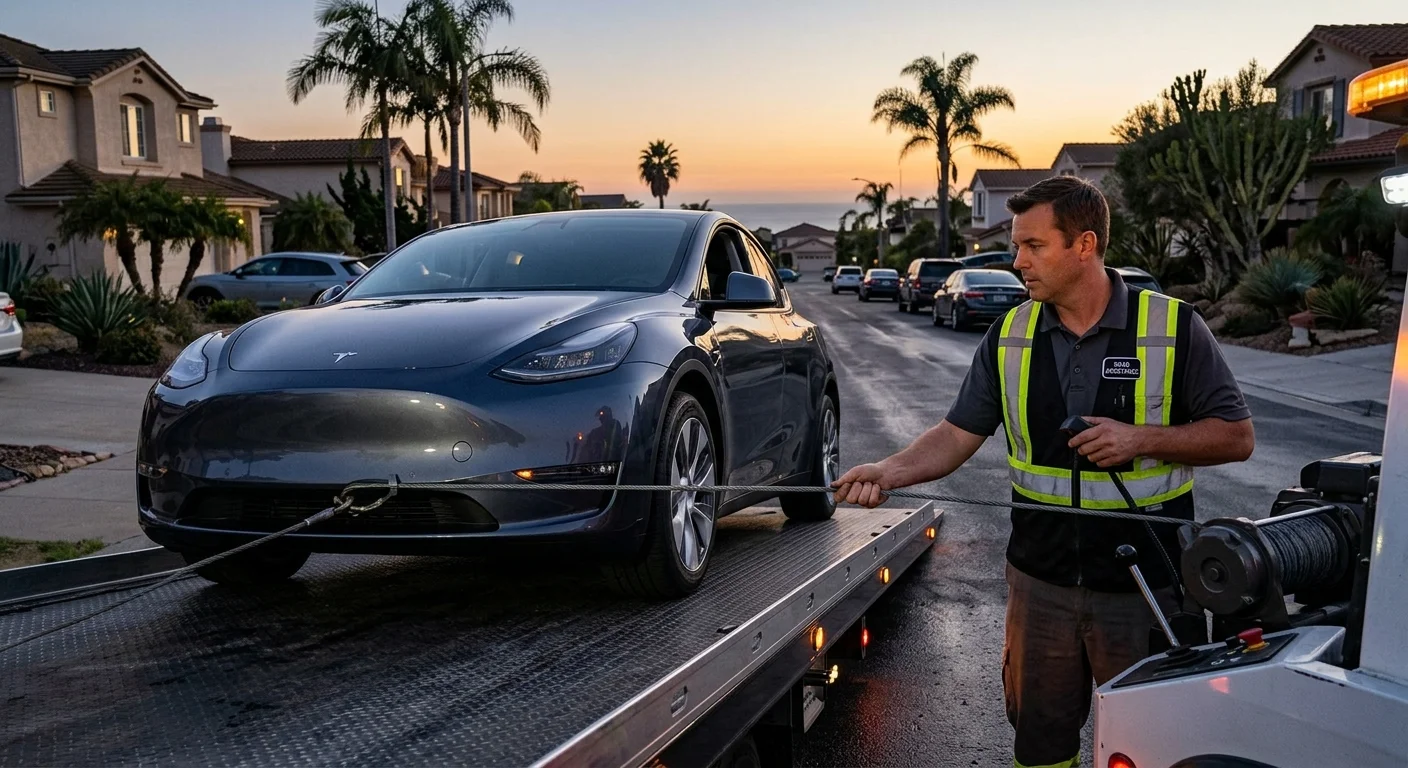
All four wheels need to leave the ground. A dolly that leaves one axle rolling is the damage path. A hook-and-chain drag is worse. Say it before the truck commits: this Tesla rides on a flatbed, not a dolly, and not a two-wheel tow.
Winch with the wheels pointed straight. Use Tesla’s designated tow points. Those are the reinforced locations in the owner’s manual. Chains on suspension arms, subframes, or the battery pan are a no. If your car has air suspension, set the height Tesla’s manual calls for before the winch.
If the operator hesitates, stop the hookup. You can wait for a truck that will do it Tesla’s way. Charge Pro IE doesn’t own wreckers and doesn’t drive the truck. We connect you with independent local operators who already work these cars.
Inland Empire stalls aren’t one kind of shoulder
The Inland Empire isn’t one kind of shoulder. Grades, heat, and lot types change what stranded looks like.
The I-15 Cajon climb toward Victorville is a range eater. A pack that looked fine in Rancho Cucamonga can be empty after the grade. That’s a high-voltage empty, not a 12-volt mystery. Read Out of charge on I-15 at the Cajon climb toward Victorville if that’s where you sat down.
I-10 through Colton and Redlands is stop-and-go with a hot cabin. Warehouse lots in Fontana and Bloomington are common stall points after a shift. Ontario airport lots sit in the same pattern. A 12-volt that was weak in the morning can be silent when you walk back out.
Temecula and Murrieta add longer wine-country miles. The Ortega near Wildomar is a two-lane problem, not a freeway shoulder. Menifee has long last-mile roads between newer tracts. Mountain trips to Lake Arrowhead, Running Springs, or Big Bear City add sitting time after the climb.
None of that changes the tow method. It changes whether you need a jump, a mobile charge, or a flatbed to a shop. The geography tells you which call to make. The drivetrain still wants the same flatbed rules.
Riverside sits on Riverside Public Utilities, not Southern California Edison. Colton runs its own electric utility inside city limits. Big Bear Lake and Big Bear City sit on Bear Valley Electric Service. That matters if you wake the car and drive home to charge. It doesn’t change how the wrecker loads the car on I-10.
When a mobile charge beats the wrecker
Towing is the right call when the car can’t roll. It’s also right when a shop is the destination. It’s right when Transport Mode won’t engage and the car must leave the lane. Towing is the wrong first call when the pack is empty and the car is otherwise fine.
A mobile Level 2 visit brings a 240-volt source to the car. Operators use a native NACS plug. They use a CCS or J1772 adapter for non-Tesla EVs. Typical charging time adds 10 to 20 miles of range in 15 to 30 minutes. That’s charging time, not a promise of when someone arrives. The operator quotes you before starting and bills you directly.
That bump is often enough to leave the shoulder. You can then reach a Supercharger or your home charger. You skip the winch, the bed, and the second wait at a stall. Compare the two paths here: Mobile EV charging vs a tow: which one do you actually need.
If the 12-volt is the only failure, you may not need a charge or a tow. If the pack still has range, drive after the jump. If you need the car moved without driving it, Tesla roadside rescue is the matching call. The operator still follows the flatbed rules above.
What to say before any cable moves
Name the model: Model 3, Y, S, X, or Cybertruck. Name the power state next: screen black, 12-volt suspected, or pack at zero. Require a flatbed, and say dolly and two-wheel tows are out. Ask how they’ll wake Transport Mode: jump points, then the Service menu. Confirm tow points from the manual, not the first metal they see. Keep the steering straight for the winch.
If any of those get a shrug, you don’t have a Tesla-safe plan yet. Stay out of the lane and wait for an operator who will follow Tesla’s method.
Who to call when you need a match
Charge Pro IE is a referral line for the Inland Empire. We don’t own a flatbed and we don’t send our own technicians. We match stranded Tesla drivers with independent local mobile rescue operators. The pros we connect you with are licensed and insured. Those operators handle Tesla and every major EV brand. They can jump or replace a dead 12-volt on site. They can also bring Level 2 charge to the car.
If you need that match, call (909) 250-2881. The operator quotes before work starts.
Frequently asked questions
How do you tow a Tesla with no power?
Use a flatbed so all four wheels leave the ground. Wake Transport Mode with a 12-volt jump if the screen is dark. If Transport Mode won’t enable, tell the operator before they pull.
What if a freeway patrol truck is already there?
Confirm the method before anyone hooks a cable. A lane-clearance truck isn’t automatically a Tesla-safe tow. You still need a flatbed and Transport Mode when the car can wake.
Does a dead 12-volt mean the Tesla has to be towed?
Not always, because a temporary jump can restore the screen. If the pack has range, you may be able to drive. The jump doesn’t recharge the high-voltage pack.