Your pack is empty on an Inland Empire shoulder. You don’t need a flatbed first. You need range in the car, right where it stopped. A tow only moves an empty battery to a new address. Mobile EV charging puts about 10 to 20 miles back in on site. Then you drive.
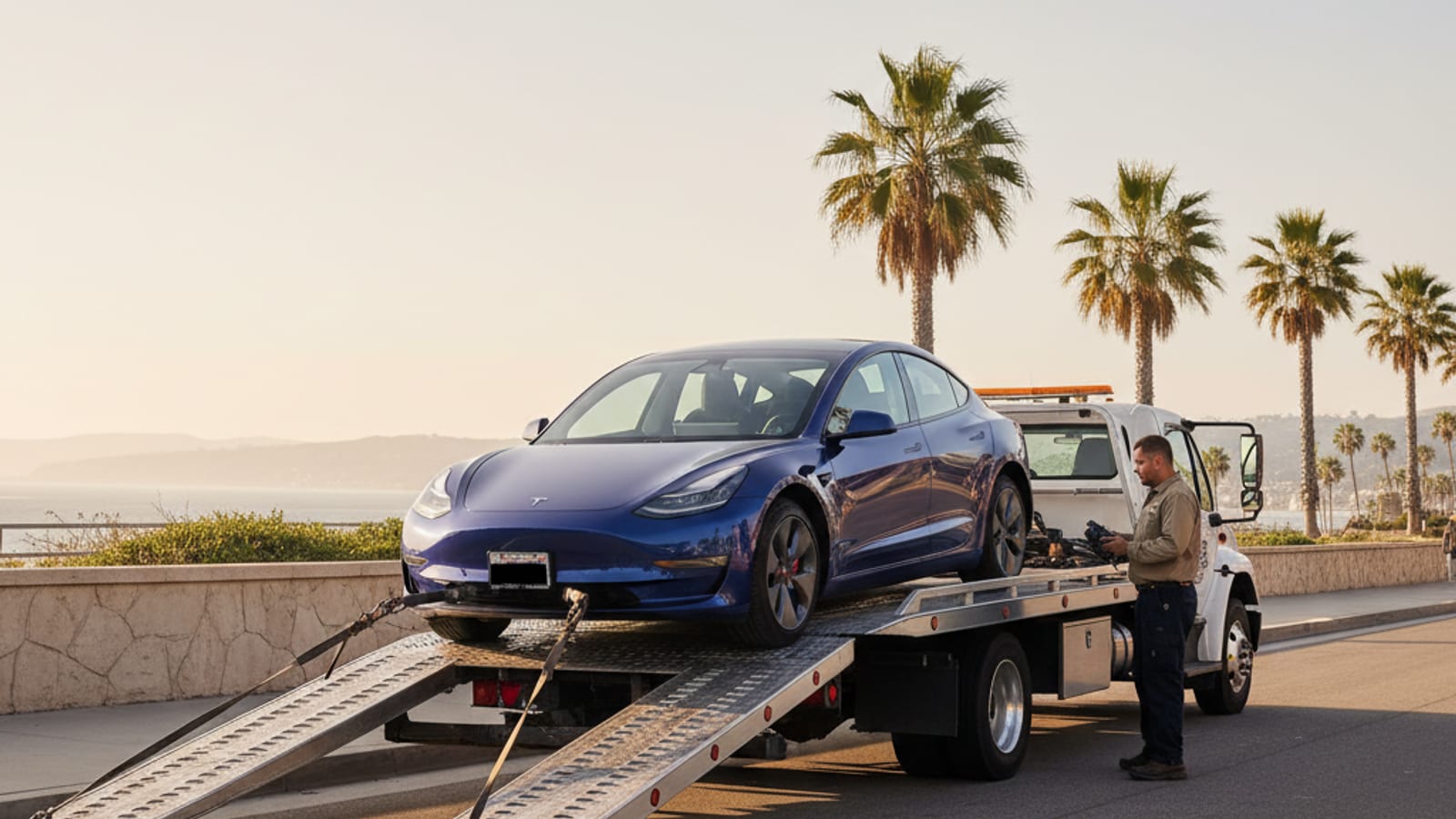
Charge Pro IE is a referral line for the Inland Empire. We match stranded drivers with independent mobile rescue operators. We don’t own trucks, and we don’t perform the work. The pros we connect you with are licensed and insured. The operator quotes you before anything starts, then bills you directly.
Empty pack and broken car are different jobs
A dark dash on the I-10 shoulder in Redlands can mean two different things. The traction pack hit zero, or the 12-volt battery quit and the car won’t wake. A third case is mechanical damage. Those three jobs don’t share a fix.
If the pack is empty and the car still rolls, you want energy on site. A flatbed still leaves you needing a charge at the other end. You haven’t solved the empty-pack problem. You’ve only moved it.
If the 12-volt is dead, the car can look fully dead. Miles may still sit in the pack. Operators we connect you with can jump or replace that 12-volt on site. They can also bring a 240-volt Level 2 source to the car. Native NACS for Tesla, with CCS or J1772 adapters for other brands.
If the car can’t drive with a charged pack, a tow is the right tool. Don’t ask a charge visit to fix a bent suspension.
What mobile EV charging actually puts in the car
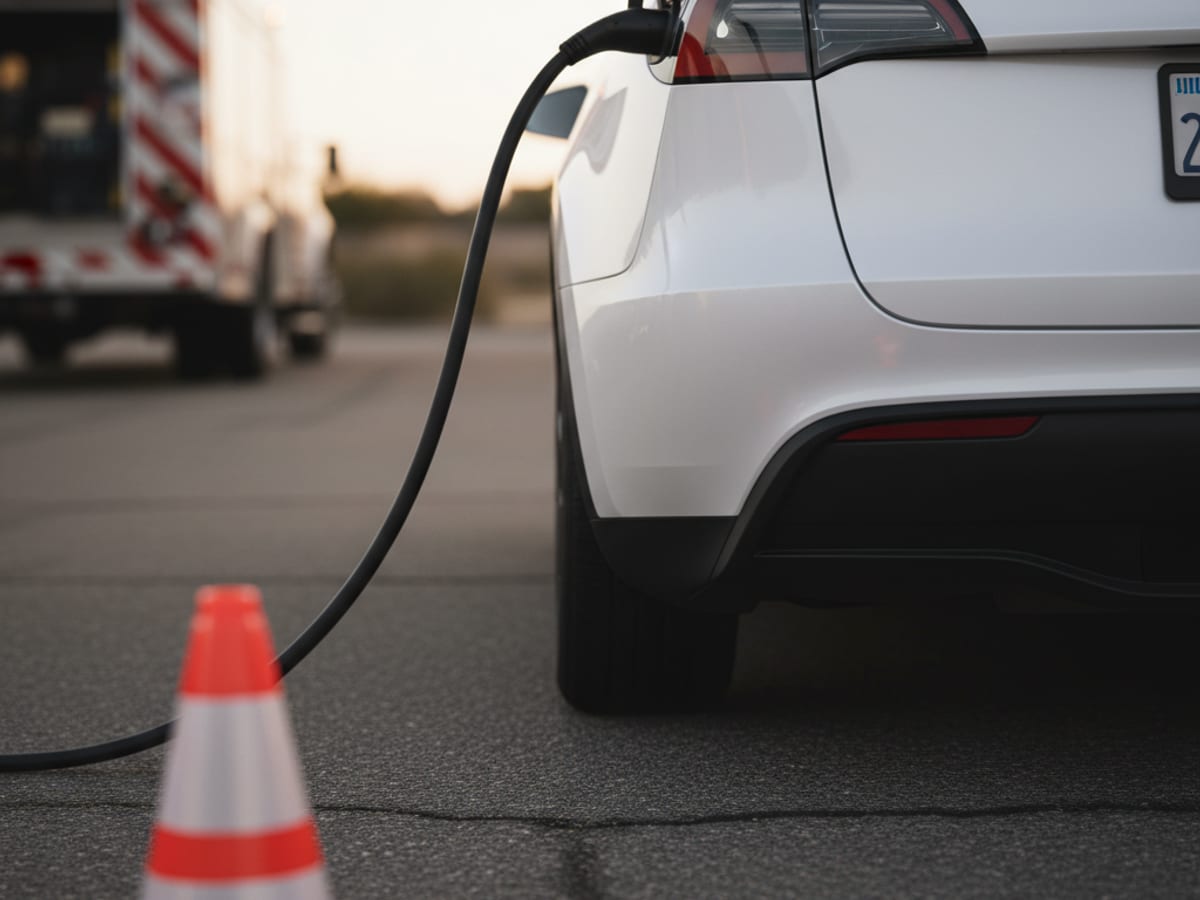
A roadside Level 2 visit isn’t a Supercharger session. It’s a 240-volt hookup at the bumper. Typical charging time is 15 to 30 minutes. That window usually adds about 10 to 20 miles of range. Those minutes are charging time, not a promise of when someone arrives.
Ten to twenty miles is a bump to get you rolling again. That’s toward home, or toward a public stall you already meant to use. It isn’t a full overnight fill. You’re buying enough energy to unstick the trip.
The operator brings the source to you. You don’t wait for a flatbed to load the car. You don’t ride along while the pack stays empty.
For the visit itself, read what a mobile EV charging stop actually is.
Where empty packs show up inland
This market isn’t one climate or one grade. Valley warehouse miles, desert climbs, and mountain runs drain a pack in different ways.
Fontana and Ontario sit on logistics corridors. Delivery vans and shift cars sit in warehouse rows and airport lots. A pack that was fine at lunch can be empty when the shift ends. That’s the pattern around Ontario airport lots and warehouse rows.
I-15 through Cajon toward Victorville is a long grade. Heat and climb both tax range. Out of charge on I-15 at the Cajon is a different stall. A downtown Riverside curb isn’t the same job. After you crest, Hesperia, Adelanto, and Apple Valley add High Desert miles and heat.
I-215 through Moreno Valley and Perris Valley mixes stop-and-go with grade. I-10 through Colton and Redlands piles on freight traffic and heat. Beaumont and Banning sit on that same I-10 climb. Banning has its own City of Banning Electric Utility. Beaumont is on Southern California Edison. Neither utility rolls a charger to your bumper.
SR-60 through Jurupa Valley and the 91 through Corona show the same empty-pack pattern. The car is fine, and the battery isn’t.
The Ortega near Wildomar is a winding climb. Temecula, Murrieta, and French Valley add distance after a long day. None of that means a charger is missing. It means the car can still sit down between the stalls you planned.
Lake Arrowhead, Crestline, Running Springs, and Big Bear sit above the valley. Bear Valley Electric Service powers Big Bear Lake and Big Bear City. Southern California Edison serves Lake Arrowhead and Crestline. The utility doesn’t unstick an empty pack on the shoulder.
When a tow is still the right tool
A mobile charge can’t repair a car that shouldn’t roll.
Call for a tow if you’ve got collision damage. Front end, suspension, or deployed airbags belong on a flatbed. So does a high-voltage warning triangle on the dash. Smoke, a burning smell, or a fluid leak is a tow. A motor or drive-unit fault that blocks driving is a tow.
A flat tire you can’t repair is a tow to a shop. That isn’t an energy problem.
If the 12-volt and the main pack are both dead, stop. Jumps with no response can mean two failures at once. A shop tow is safer than guessing on the shoulder.
Tesla’s published roadside path may send a tow toward a Supercharger. That’s when the pack is depleted. Confirm Tesla’s current roadside policy in the app for your car. Charge Pro IE doesn’t set that policy and doesn’t perform Tesla’s work. Local operators we match you with handle Tesla and every major EV brand. They quote you before they start.
Read the inland comparison of towing a dead EV versus a mobile charge.
The driveway stall runs on a different clock
Not every empty pack is on a freeway. You plug in overnight in San Bernardino, Montclair, or Norco. Morning comes and the car still won’t wake. Older housing is common there. ACS 2019-2023 figures put pre-1980 housing at 60.9% in San Bernardino. Montclair sits at 68.5%, and Norco sits at 68.8%. An older panel can drop a home charger without anyone noticing until dawn.
Eastvale is the opposite vintage. Only 2.2% of its housing predates 1980. New streets can still leave a car empty. The home charger may never have been finished. The session may never have started.
Riverside Public Utilities serves the City of Riverside, not Southern California Edison. Colton owns its electric utility inside city limits. Moreno Valley is split. SCE covers much of the city. Moreno Valley Utility covers newer pockets. None of those agencies will roll a 240-volt source to your bumper.
If the car is safe in a driveway, stay put. On-site charging still solves the empty-pack half. A 12-volt jump may be part of the same visit. A tow from a garage still leaves you without a car at home. It still leaves you needing a charge. If the car will drive once it has range, skip that loop.
A public stall that never starts a session
You pulled into a public stall with almost no miles left. The session never started. The handshake failed, the stall sat idle, or the cable wouldn’t lock. You can’t cover the next leg on what’s left.
A tow would haul the empty car to another address. You’d still need a session there. An operator can plug a Level 2 source straight into the car. That happens at the same lot, and it adds enough range to leave. It bypasses the failed stall. It doesn’t fix the stall.
Don’t wait on a dead session if the pack is already on the floor. Confirm the car isn’t throwing a high-voltage fault. If it’s only empty, range on site is the direct path.
Out-of-charge recovery is the name for that empty-pack job.
Who quotes the job, and who doesn’t
Charge Pro IE doesn’t set prices. The operator on the call quotes you before work starts. Distance and time of day sit in that quote. A 12-volt jump plus a pack top-off sits in it too. We can’t publish a typical figure, because we don’t bill the job.
A tow company’s hook rate isn’t a figure we can confirm here. No public Inland Empire tariff publishes that number in a form we can verify. Confirm the current tow quote with the company that would send the truck. Do that before you authorize a load. Confirm the mobile charge quote the same way, on the phone. Do that before anyone plugs in.
You’re comparing two quotes for two different outcomes. One adds 10 to 20 miles where you sit. The other moves an empty car.
How to choose without overthinking it
Start with the car, not the app.
If the car will drive with 10 to 20 more miles, choose a mobile charge. That’s if there’s no damage, smoke, or high-voltage warning. If the car won’t drive even with a charged pack, you want a tow.
If you can’t tell pack-empty from 12-volt-dead, say that on the call. A silent dash isn’t proof the traction pack is at zero. Operators can sort a 12-volt jump from a pack top-off at the car.
If you already know you need a shop, skip the charge visit. Don’t add range to a car that shouldn’t be on the road.
For a wider inland map, start with this 2026 roadside guide for Inland Empire drivers.
If you’re stuck on an Inland Empire shoulder, call (909) 250-2881. We’ll connect you with a local operator. That operator quotes the job before anything starts.