Tesla roadside assistance cost by model isn’t a published menu. Model 3, Y, S, and X owners here get billed by whoever Tesla sends. You can also call a local operator yourself. The badge changes the parts and the tow setup. It doesn’t change Tesla’s dispatch product much. Tesla is 61.7% of Riverside County battery-electrics. The share is 66.4% in San Bernardino County. Most stranded EVs in this market are one of those four.
The short answer for Inland Empire owners
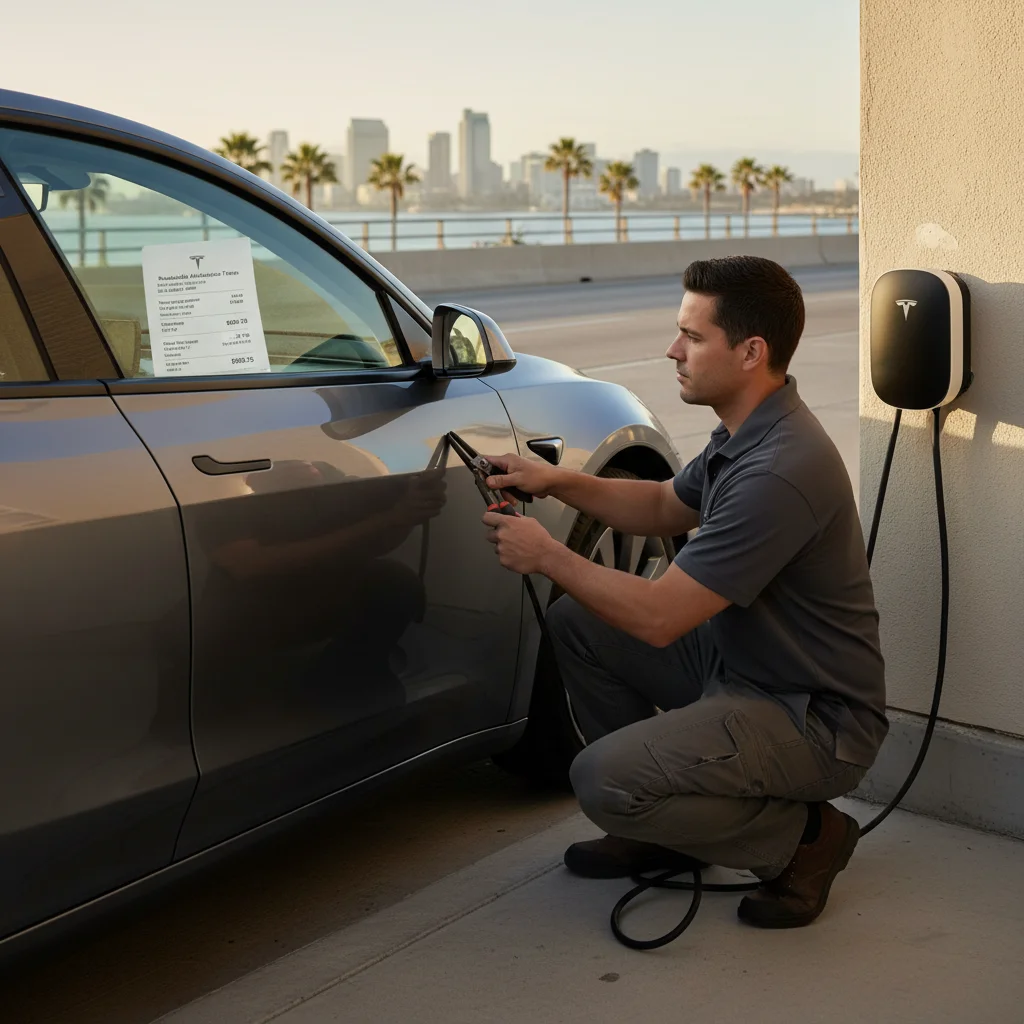
Nobody here can quote Tesla’s 2026 roadside invoice in advance. Tesla doesn’t post a public, model-by-model fee card. The contractor who rolls from the Tesla app sets the bill. That person quotes you, then bills you. Charge Pro IE doesn’t set prices either. The independent operators we connect you with quote before they start. They bill you directly.
What does change by model is the job itself. A Model 3 on I-10 in Colton isn’t the same load as an X. Tire size, 12V type, and vehicle weight all shift the work. Tow miles shift it more than the badge does. A stall on the Cajon climb toward Victorville isn’t a stall in downtown Riverside. Confirm every figure with the person at your bumper. If a number isn’t on Tesla’s site or in the app, treat it as unconfirmed.
What Tesla actually sells you
Tesla roadside is a dispatch. During the Basic Vehicle Limited Warranty, warrantable failures are often covered. Tesla publishes that warranty as 4 years or 50,000 miles. That’s whichever comes first, on new cars. Read the current terms in the Tesla app before you assume you’re inside it. Used cars can sit on different clocks. Tesla’s own pages are the source. Charge Pro IE can’t certify your coverage.
Warrantable usually means the car broke. An empty pack is a different category. Tesla’s published path for a depleted pack is a tow toward charging. It isn’t a truck that carries 240 volts to you. That’s true for a 3, a Y, an S, and an X. The model doesn’t unlock a Tesla mobile charge. Start with Tesla’s 2026 roadside policy: what changed for Inland Empire owners. Then open the app and read the live screen.
After the Basic Vehicle Limited Warranty, expect a billable visit. The invoice comes from the local contractor. It doesn’t come from a Charge Pro IE price list. Tesla doesn’t publish a verified 2026 dispatch fee we can print. Per-mile tow, lockout, and 12V jump rates aren’t posted either. Those figures couldn’t be confirmed from Tesla’s public pages for this piece. Ask the contractor for the quote before they hook the car. What Tesla roadside assistance covers versus a local mobile charge walks that split. It doesn’t pretend we have Tesla’s private rate card.
Model 3 and Model Y, the volume cars
Most Tesla traffic in both counties is a 3 or a Y. That follows from Tesla’s share of battery-electrics here. Fontana, Ontario, Moreno Valley, and Riverside city run a lot of 3s and Ys. They stack on I-10, I-215, and the 60. Ontario’s ACS population is 180,547, Fontana’s is 214,169, and Riverside city is 319,069. Those are commute machines across the Inland Empire charging map.
On a 3 or Y, two failures get mixed up. The 12V runs the computers and contactors. Many newer 3 and Y cars use a lithium low-voltage battery. Older ones used a classic lead-acid 12V. When that battery dies, the car looks fully dead. The high-voltage pack can still hold range. A jump or a 12V swap on site can wake it. Do Teslas have a 12V battery? A model-by-model guide covers the hardware. Read How to jump a Tesla Model 3, Y, S, or X the safe way.
The empty-pack case is the other bill. Tesla’s contractor brings a flatbed. Local mobile operators we connect you with bring a 240V Level 2 source. That’s a native NACS plug on a Tesla. That Level 2 visit typically adds 10 to 20 miles of range. Plan on 15 to 30 minutes of charging. That’s charging time. It isn’t an arrival time. Ten to twenty miles is often enough to roll to a Supercharger. It can also be enough to get home, if home still has power.
Older housing makes the empty-pack call more common. San Bernardino County has 43.8% of housing built before 1980, ACS 2019-2023. Riverside County is 30.2% on the same vintage. San Bernardino city sits at 60.9% pre-1980, Ontario at 50.7%, and Eastvale at 2.2%. Older San Bernardino housing often never got a home charger. A 3 or Y there still ends up on the shoulder. A 3 in Eastvale often already has a wall unit. The roadside product is the same. The reason you’re on the shoulder isn’t.
Model S and Model X, same dispatch, heavier job
Tesla doesn’t publish a higher dispatch tariff for S and X that we can verify. Treat that claim as unconfirmed unless the contractor says it on the quote. What’s different is the car.
An S or X is larger and heavier than a 3 or Y. Loading it onto a flatbed is a bigger setup. Tesla’s towing guidance still calls for a flatbed. A rope or a wheel-lift can damage the drive unit. Confirm the method before anyone hooks a corner. The X’s size also changes tire work. Loaner wheels, if offered, have to match that car. The tire shop that finishes the repair sets that later bill. We couldn’t confirm a Tesla 2026 loaner-wheel fee from public Tesla pages. Don’t pay a number you haven’t heard from the person on scene.
12V access on S and X isn’t the 3/Y frunk layout. If the low-voltage battery is dead, doors and the powered liftgate can act strange. Don’t force a stuck charge port or a frozen door. The operator who knows Teslas will start with the 12V, not the pack. If the dash is dark and the app is mute, think 12V first. If the car is awake and the range says zero, think pack.
Inland Empire miles move the bill more than the model year
Tow miles are the quiet multiplier. Tesla’s contractor bills for the trip they actually drive. We can’t print a per-mile figure. Tesla doesn’t post a verified 2026 rate we can cite. The geography still matters.
Start with I-15 at the Cajon climb toward Victorville. Out of charge on I-15 at the Cajon climb toward Victorville is the High Desert version of this call. Hesperia, Adelanto, Apple Valley, and Phelan sit on the far side of that grade. Victorville’s ACS population is 137,627. Residential power there is Southern California Edison. A Tesla-arranged tow from that shoulder follows whatever charger or service site the app names. Confirm that destination before the winch comes out. A mobile Level 2 visit stays on the shoulder. It puts miles back into the pack.
I-10 is the other long east-west line. Colton, Redlands, Beaumont, Banning, and Cabazon string along it. Colton runs City of Colton Electric Utility, not SCE. Banning runs City of Banning Electric Utility. Those facts shape the home bill. They don’t set Tesla’s roadside invoice.
I-215 through Moreno Valley and Perris Valley is a commute spine. Moreno Valley is a split-utility city. Southern California Edison covers much of it. Moreno Valley Utility covers a newer pocket of more than 6,500 customers. SR-60 through Jurupa Valley and the 91 through Corona add more 3 and Y traffic. Downtown Riverside is on Riverside Public Utilities, which has served the city since 1895. None of those utilities publish Tesla’s contractor rates. Don’t mix a home plan with a roadside quote.
Mountain roads change the recovery. Lake Arrowhead and Crestline sit on SCE. Big Bear Lake and Big Bear City sit on Bear Valley Electric Service. A Tesla that won’t wake in Big Bear Lake still needs a 12V check or a pack top-off. The Ortega near Wildomar and Menifee is a winding mountain road, not a freeway lot. Give the operator a mile marker and a direction. Don’t guess a charger distance. We don’t have a verified figure for that.
Tesla’s contractor versus a local mobile rescue
Tesla’s app is easy to tap. It’s still a call center that assigns a local truck. That truck is often a tow. For an empty pack, a tow is a two-step day. You wait for the bed. You wait again at whatever charger they choose. The model doesn’t change that sequence.
A local mobile rescue is a different product. Charge Pro IE is a referral line. We match you with independent Inland Empire operators. We don’t own the trucks or employ the technicians. We don’t hold a contractor license for the work. The pros we connect you with are licensed and insured. They bring 240V Level 2 to the car. They handle Tesla and every major EV brand. They can jump or replace a dead 12V on site. They quote you before they start.
That quote is the only number that matters on the shoulder. Compare it to Tesla’s contractor quote, line by line. Include destination miles if Tesla is towing. Include charging time if the local operator is plugging in. Tesla roadside rescue is the page for the Tesla-specific match we offer. It isn’t Tesla’s own program.
How to get a real number before anyone starts
Ask four things, in this order. First, decide whether this is a 12V failure or an empty pack. A dark car with a pack that still shows range is a 12V job. A car that’s awake at zero miles is a pack job. Second, are you inside Tesla’s Basic Vehicle Limited Warranty for this incident. Warrantable breakdowns and driver-empty packs aren’t the same bucket. Third, what exactly will the contractor do, and what do they quote before they start. Fourth, what does a local Level 2 visit cost for the same stop. Charge Pro IE doesn’t publish that figure because we don’t set it.
A Model X on the 60 in Jurupa Valley can ask those same four. A Model 3 in Rancho Cucamonga can too. Rancho Cucamonga is mostly SCE. Rancho Cucamonga Municipal Utility covers a southeast pocket. That pocket includes The Enclave, Day Creek Square, The Resort, and Victoria Gardens. That split can confuse a home charging bill. It shouldn’t confuse a roadside quote.
If you’re already on the shoulder
Stay out of the travel lane. Put the car in Park. Use the Tesla app if it still wakes. If the 12V is dead, the app may not help. Then you need a person, not a screen.
A depleted pack on I-15, I-10, or I-215 doesn’t need a bed. A mobile Level 2 top-off puts miles in on the shoulder. For a dark dash in Upland, Rialto, Hemet, or Murrieta, start with the 12V. We serve every city in the Inland Empire. The operators quote first.
Call (909) 250-2881 when you want us to match you with a local operator. That number is a referral line. It isn’t a promise of when someone arrives.
Questions Model 3, Y, S, and X owners ask
Does Tesla roadside assistance cost the same for every model?
Tesla doesn’t publish a verified, model-by-model roadside menu we can print. The dispatch product is the same idea on all four cars. The job isn’t. 12V type, tire size, and vehicle weight change the work. Tow miles on Inland Empire freeways change the invoice more than the badge. Get the contractor’s quote for your car, at your pin.
Why isn’t there a 2026 Tesla roadside price table here?
Dollar figures for Tesla dispatch, towing, lockouts, jumps, and loaner wheels couldn’t be confirmed from Tesla’s public pages for this article. Printing a plausible range would be a guess. Tesla’s contractor, or the local operator you call, is who actually sets the number. Ask them before they start. Confirm current warranty language in the Tesla app.
If my pack is empty, is Tesla’s tow the only way to get help?
No. Tesla’s published path for a depleted pack is a tow toward charging. Independent operators we connect you with bring a 240V Level 2 source to the car instead. They typically add 10 to 20 miles in 15 to 30 minutes of charging. Compare both quotes. Pick the work you actually need.