An F-150 Lightning can charge another EV from Pro Power Onboard. Inland Empire work trucks get that ask after the Cajon climb. The truck shares AC through bed outlets, not through its DC fast-charge port. You still need the right portable charger and adapter. You’ll sit there while Level 2 does slow work.
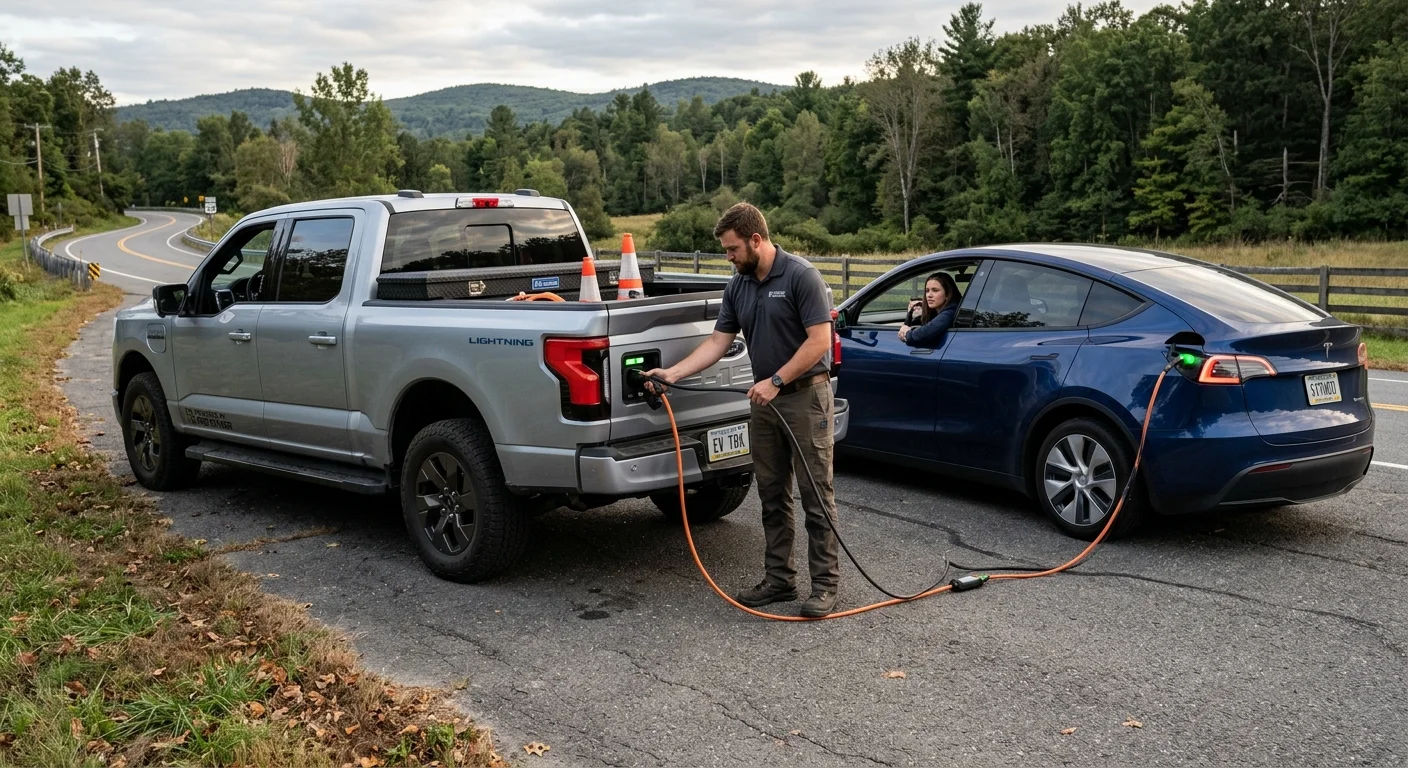
Why a Lightning on inland roads gets waved down
I-15 over Cajon Pass is a steep pull toward the High Desert. Drivers bound for Victorville or Hesperia watch range drop faster than in the valley. A Ford Lightning in work trim looks like a generator that already arrived. Drivers flag it down and ask for a share.
The same ask shows up off the freeway. Fontana warehouse rows and Ontario freight lots mix work trucks with other EVs. A coworker who rolled in low may want a share. That lot is a calmer place to try it than a live shoulder.
Southern California Edison serves Fontana, Ontario, and Hesperia. Victorville homes sit on SCE, and the city utility doesn’t serve houses. None of that powers a bed outlet on I-15. SCE’s TOU-D-PRIME rate is a home plan. It doesn’t run Pro Power Onboard on the Cajon grade.
Charge Pro IE doesn’t run those work trucks. We connect stranded drivers with independent local operators. The Lightning in the next stall is someone else’s vehicle. Treat it as a private truck, not a rescue unit.
What Pro Power Onboard is actually sending
Ford built Pro Power Onboard for tools, job sites, and backup loads. Outlets in the bed and cabin put 120-volt and 240-volt AC on tap. A portable EV charger can clip into the 240-volt receptacle and feed another car.
That path is vehicle-to-load, not a DC handshake with the other car. Speed follows the AC cap on your trim, not Supercharger math. See home 240-volt charging vs a roadside Level 2 hookup for the AC picture.
Ford publishes Pro Power Onboard ceilings of 2.4 kW, 7.2 kW, and 9.6 kW. Check the sticker and the owner’s manual for your truck. Don’t guess the number from a forum post. A 2.4 kW bed is in household-outlet territory. The 7.2 kW and 9.6 kW trims land in portable Level 2 range. None of those figures are DC fast charging.
Confirm the other car will accept AC at all. A locked charge port can refuse the plug. A dead 12-volt can leave the car dark. A dash fault can stop the session before a mile lands.
The cord kit, or you’re just parked
A lamp extension cord won’t do this job. You need a portable EVSE with a NEMA 14-50 plug. That plug has to match the Lightning’s 240-volt outlet. Then you need the connector the stranded car expects.
Most non-Tesla EVs here take J1772 from that EVSE. A Chevy, Hyundai, Kia, Mach-E, or Volkswagen usually plugs in as-is. A Tesla needs a J1772-to-NACS adapter on the end of the same cable.
The wider version of this question is can one EV charge another. The Lightning is the work truck that makes a yes feel obvious. It still fails without the kit in the box.
Match the EVSE’s rating to your Pro Power number. Look at the plug faces before you energize them. If a prong is burned or a cable is cut, stop. Stay with the hookup until the session ends. Don’t leave two vehicles joined on a shoulder while you walk away.
How long you’ll actually sit there
This is the part most Lightning owners get wrong. Pro Power Onboard can move energy into another pack. It doesn’t do it like a highway DC stall. You’re running a portable Level 2 session from a work truck. That same pack still has to get you home.
A 2.4 kW truck will crawl on the shoulder. Higher trims move more, and you still wait. There’s no verified miles-per-hour figure we can publish for every car. Pack size, cabin climate, and how empty the other car is all change it. Ford’s kW rating is the number you can check. Time on the shoulder is the cost you feel.
Operators we connect you with bring a 240V Level 2 source to the car. They typically add 10 to 20 miles of range. That takes 15 to 30 minutes of charging, not travel time. They use a native NACS plug for Teslas. CCS or J1772 adapters cover the other brands.
If they still have to finish the Cajon climb, miles matter. Those 10 to 20 miles are the useful unit, not a trickle. A 2.4 kW trickle may not cover the rest of the grade. Same story if they still have High Desert miles left toward Hesperia or Adelanto. See our Cajon Pass out-of-charge guide for that grade.
Watch your own state of charge the whole time. Sharing power spends the Lightning’s pack as you sit. After a hot inland day and a grade, your own miles matter. You can strand yourself next to the person you meant to help.
A warehouse stall isn’t the I-15 shoulder
A short top-off in a Fontana or Ontario lot can be a decent favor. You’re off the travel lanes and you can watch the session. The other driver might only need enough to reach a planned stop. They don’t need a full fill from your pack.
A live freeway shoulder is a worse office. Two big vehicles, a cable, and traffic make a long sit. If the other car is fully dead on a live shoulder, skip the goodwill charge. Point them to mobile EV charging instead of a long job-site AC sit.
Skip the share if you lack the EVSE or the Tesla adapter. Skip it if your own pack is already thin. Skip it if you can’t stay until the cable comes out. Don’t turn the Lightning into someone’s daily charger. It’s a work truck, not a public stall.
A Lightning after a shift in Chino or Rancho Cucamonga can get the same ask. The rule doesn’t change with the city. Calm pavement and spare range, or don’t start.
What a rescue operator brings that a Lightning doesn’t
The Lightning is the truck you already drove to the site. A rescue operator’s setup is built to roll to a stranded EV. See what’s actually on a mobile EV charger truck for that difference.
Charge Pro IE is a referral line, not a fleet. We match you with independent local mobile rescue operators. We don’t own trucks, employ technicians, or set prices. The operator quotes you before starting and bills you directly. The pros we connect you with are licensed and insured.
They handle Tesla and every major EV brand. They can jump or replace a dead 12-volt on site. A bed outlet won’t wake a car whose 12-volt is gone. If your own Lightning won’t start, that’s a different problem. Start with Ford F-150 Lightning won’t start: the dead 12V fix.
If you’re empty, or you own the Lightning
If you’re the stranded driver, get as far right as you can. Put the hazards on and stay out of the travel lanes. Don’t stand in a lane to aim a plug. If a Lightning with the full kit is already there, take the short AC session. If they’re missing the EVSE, the adapter, or spare range, don’t wait.
Call (909) 250-2881 to reach our referral line. We’ll connect you with a local operator who quotes before they start.