A passing EV can’t fill your pack just by parking beside you. Sharing range only works if that second car can export power. You need a real outlet or a vehicle-to-load adapter. You also need a cable the stranded port will take. Most cars on Inland Empire roads can’t do that. Model 3 and Model Y traffic on I-15 and I-10 can’t help. Neither can a random Tesla on the High Desert run toward Adelanto and Phelan.
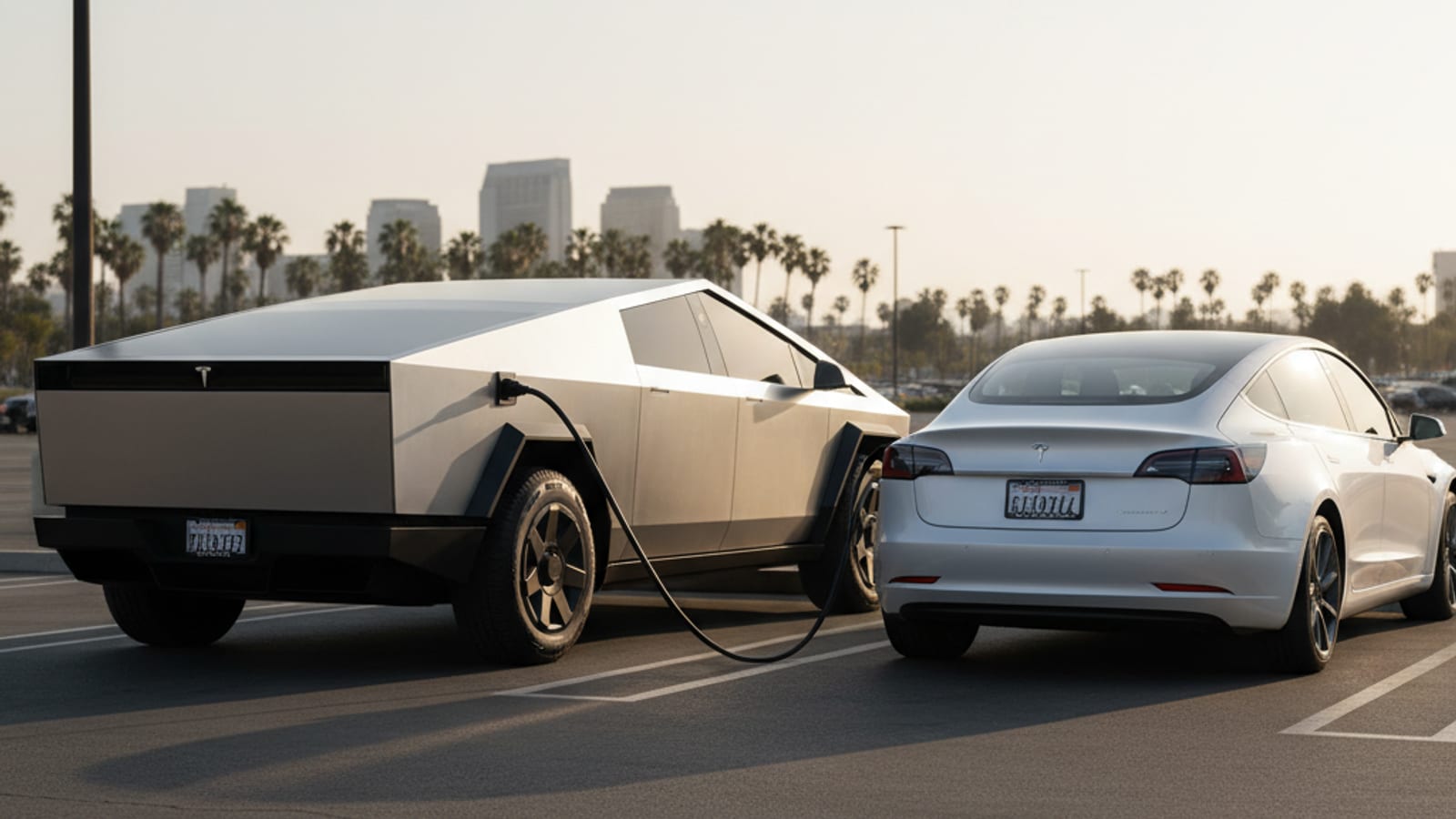
Sharing range is hardware, not goodwill
Every EV stores a lot of energy in the traction pack. Moving some of it into another EV isn’t a 12-volt jump. The other EV needs an inverter that can send current out. It needs an outlet or adapter that exposes that current. It needs a cable the receiving car will accept. That cable is NACS, CCS, or J1772, matching the inlet.
Most commuter EVs never route that path outside the shell. They can run the cabin from the pack. They can keep the 12-volt system alive, but they can’t hand you a plug. A friendly Tesla in the next lane doesn’t change that.
Regular Teslas stay one-way
Inland drivers ask this after the low-battery warning. Model 3, Model Y, Model S, and Model X take power in. They don’t send traction-pack power back out. The onboard charger turns wall AC into DC for the pack. It isn’t set up to run that path in reverse.
The 12-volt pigtail at the tow eye is a different circuit. It can wake another car’s 12-volt battery. It can’t fill a high-voltage pack. For that limit, see Can a Tesla jump-start another car?.
Tesla has shown bidirectional charging in lab demos. That isn’t a switch on the cars already here. It won’t help you on I-15 through Cajon. It won’t help on I-10 through Colton either.
The vehicles that can export
Trucks and a few adventure EVs are the exception. They were built to run tools, camps, and job sites.
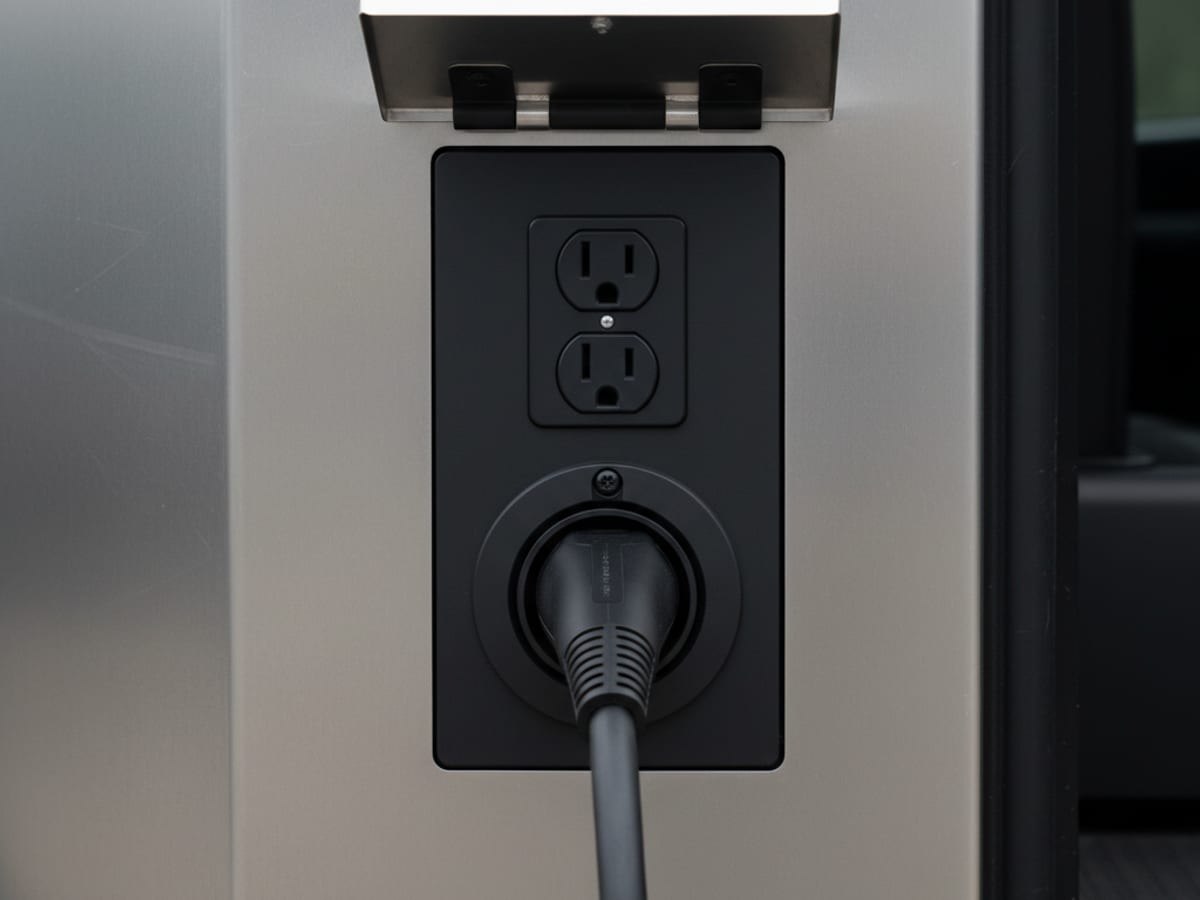
A Cybertruck with Pro Power puts outlets in the bed and the frunk. The bed-wall receptacle is a 240-volt NEMA 14-50. That’s the same shape as a dryer outlet. That outlet can put out up to 9.6 kW continuous. That’s enough to feed a portable Level 2 charger into another EV.
A Ford F-150 Lightning with Pro Power Onboard can do similar work. Ford’s extended export also reaches 9.6 kW. The standard Lightning export is 2.4 kW. If that’s the truck next to you, start here. Read Can an F-150 Lightning charge another EV on the shoulder.
Hyundai Ioniq 5, Kia EV6, and Kia EV9 can export too. They use a V2L adapter on the charge port. Output is 3.6 kW, enough for a small load and slow as a range rescue.
Rivian R1T and R1S trucks with the Camp Package add 120-volt bed outlets. Output is 1.4 kW, camp power rather than highway range. Chevrolet’s Silverado EV advertises power takeoff through multiple outlets. One high-output path is rated at 10.2 kW.
The other driver has to show a 240-volt outlet or a V2L adapter. If they can’t, they can’t share range with you.
What the clock looks like once you’re plugged in
A 9.6 kW export is Level 2 speed, not Supercharger speed. The stranded car’s onboard charger sets the pace. Independent operators in this network bring a 240-volt Level 2 source. It’s the same class of power. They typically add 10 to 20 miles of range. That takes 15 to 30 minutes of charging. That’s charging time, not an arrival time.
A 120-volt V2L tap crawls, and a few extra miles can take a long sit. A Supercharger is a different tool. It pushes DC into the pack at highway-charge rates. Car-to-car power is a bridge to a working stall. A roadside Level 2 visit is that same kind of bridge. Neither one is a full fill.
That distinction matters on inland grades. The I-15 climb toward Victorville eats range. So does the pull toward Yucaipa. So does the I-10 rise through Beaumont and Banning. A short Level 2 session can get you to a stall you already mapped. It doesn’t replace that stall.
If the pack is already at zero, start here. Read Out of charge on empty High Desert miles near Adelanto. Or read Out of charge on I-15 at the Cajon climb toward Victorville.
The inland reason a passing EV rarely helps
Apple Valley covers 77 square miles of land, and Phelan covers 60. Victorville covers 74 square miles, and Adelanto covers 53. Those 2023 Census Gazetteer figures are huge. The Lightning that could help you might be a town away.
Riverside County’s ACS 2019-2023 population is 2,478,600. San Bernardino County’s is 2,197,104. Export still sits on certain trucks and a handful of V2L cars. A Model 3 in the carpool lane can’t help your pack.
Warehouse shifts add the same false hope. Fontana’s ACS population is 214,169, and Ontario’s is 180,547. A dead van in a work lot still needs an export-capable truck. It doesn’t magically find a Silverado EV in the next stall.
Mountain miles don’t change the hardware either. Bear Valley Electric Service powers Big Bear Lake and Big Bear City. Southern California Edison covers Lake Arrowhead and Crestline. Your pack still needs a compatible inlet. It still needs a car that can export.
Don’t treat another driver’s goodwill as a charging plan. Map a stall before you leave. If you still stop short, you need a source built for the job.
What a mobile Level 2 visit actually is
Charge Pro IE is a referral line. It matches stranded EV drivers with independent local mobile rescue operators. It doesn’t own trucks, employ technicians, or set prices.
Operators bring a 240-volt Level 2 source to the car. Tesla drivers get a native NACS plug. Other EVs get a CCS or J1772 adapter. The operator quotes you before starting, then bills you directly. That’s mobile EV charging, not one EV siphoning another in the lane. For the process, see What a mobile EV charging visit actually is, and isn’t. If the pack is empty, out-of-charge recovery is the matching page.
240-volt AC is the practical roadside setup. It uses the stranded car’s own onboard charger. It also uses the car’s native protections. You don’t need a DC fast station on the shoulder. A Level 2 hookup can still add those 10 to 20 miles.
Leave the dryer cord in the garage
Don’t improvise EV-to-EV charging with a dryer extension and a portable charger. High-power AC between two vehicles needs a specced cable and correct grounding. A mismatched cord can trip protection, damage a connector, or hurt someone. Leave that hookup to a trained operator.
If the dash is dark, you may have a 12-volt failure. That isn’t the same as an empty pack. Jumping the 12-volt won’t charge the traction battery. Those are different jobs.
Bidirectional charging isn’t tonight’s backup
Automakers have shipped pieces of this already. Ford offers vehicle-to-home backup on the Lightning with the right home kit. Hyundai and Kia ship V2L. GM puts takeoff power on the Silverado EV. Tesla has talked about vehicle-to-home for the wider fleet. None of that helps a random Model Y on the 215. That car still isn’t a rescue truck.
Plan around the cars that actually export in 2026. For everyone else, the working path is a public stall. The other working path is a mobile Level 2 visit.
If you’re already stopped, call (909) 250-2881. Charge Pro IE can connect you with a local operator who brings the 240-volt source. The operator quotes before any cable goes in.