A mobile EV charger truck is a roadside vehicle that brings a 240V Level 2 source to a stranded EV. On Inland Empire shoulders, the operators we connect you with bring a native NACS plug and CCS or J1772 adapters. They don’t bring a dealership DC rig. The usual result is 10 to 20 miles of range in 15 to 30 minutes of charging. That’s charging time on the cable. It isn’t a promise of when someone arrives.
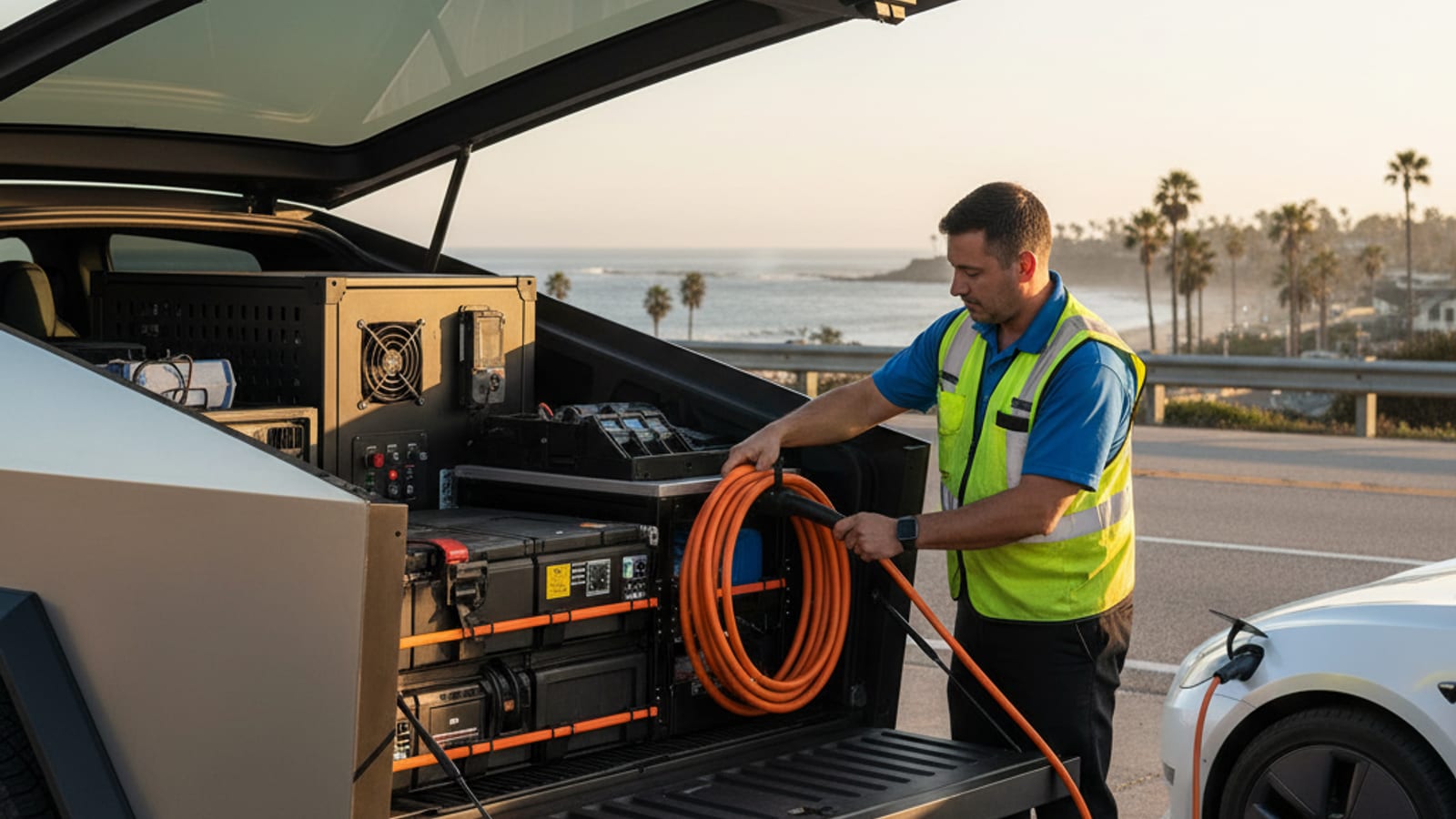
People picture a rolling Supercharger. Others picture a parts van or a wrecker with a boom. What actually shows up is simpler. Independent local operators bring 240-volt power to the bumper. Charge Pro IE is a referral line. We match stranded drivers with those operators. We don’t own the truck. We don’t set the price. We don’t do the work. The operator quotes you before starting. They bill you directly.
What a mobile EV charger truck actually carries
The search is literal. Drivers want to know what’s on the bed. That question comes up on the 91 in Corona, on I-10 through Colton, and in a Fontana warehouse row. The answer is a compact power setup, cables, and the adapters your inlet needs.
A 240-volt Level 2 source, not a shop on wheels
The operators we send use a 240V Level 2 source at the car. That’s the same voltage class as a home wall unit. The power comes from equipment on the operator’s vehicle. It isn’t a DC fast stall on a trailer. It isn’t Tesla Supercharger hardware. It’s AC power, delivered at the bumper, for a limited top-off.
That distinction matters when you’re already empty. You’re not waiting for a public stall to free up. You’re not hoping a 120-volt brick will crawl you off the shoulder. You’re getting a Level 2 hookup where the car sits. For the garage comparison, read Home 240-volt charging vs a roadside Level 2 hookup.
A mobile EV charging visit is that hookup. It isn’t a repair order. It isn’t a tow to a shop. The operator’s job is to add driveable miles. Then you leave under the car’s own power.
Native NACS, plus CCS or J1772 adapters
Tesla inlets take a native NACS plug. Most other brands here still use CCS or J1772. Operators in this network carry the native NACS connection. They also carry adapters for CCS or J1772. One visit can cover Tesla and every major EV brand.
That mix matches the fleet on these roads. Fontana has 214,169 residents. Ontario has 180,547. Riverside has 319,069. San Bernardino has 222,724. Moreno Valley has 211,666. Those counts are ACS 2019-2023. The cars in warehouse lots, Eastvale cul-de-sacs, and older San Bernardino streets aren’t one brand. You’ll see Teslas, Hyundais, Fords, Chevys, Rivians, and the rest. A NACS-only truck would miss the CCS calls. A CCS-only truck would miss a Model 3 on the Cajon shoulder.
If your car isn’t a Tesla, the adapter step is part of the visit. Read Non-Tesla EV rescue in the Inland Empire: who helps CCS and J1772 for that path.
A 12-volt kit next to the charge cable
A lot of dead-EV calls aren’t an empty traction pack. The 12-volt battery runs the computers, contactors, and door electronics. When it fails, the car looks fully dead. That can happen even if the last drive still showed miles. Operators in this network can jump or replace a dead 12V on site.
That kit is why the truck isn’t only a charger. On a Model Y in Yucaipa, the first question is pack versus 12-volt. Same check for an ID.4 in Riverside. Same for a Lightning in a Chino work lot. Charging the high-voltage pack does nothing if the 12-volt won’t close the contactors. The operator checks that first. Then they spend charging time only if the car can actually wake.
What is not on that truck
This is the part people skip. A mobile EV charger truck in this network isn’t a factory service vehicle. It doesn’t carry high-voltage pack modules. It doesn’t hold a parts warehouse. It doesn’t come with a manufacturer warranty desk in the cab.
It also isn’t a tow truck. Some operators may work around a wrecker. The charge visit itself doesn’t relocate the car. If the car can’t take a charge, or the 12-volt won’t hold, the next decision is a flatbed. Compare those paths in Towing a dead EV versus a mobile charge, inland.
You won’t get a published arrival window from Charge Pro IE. We don’t promise one. The operator who takes the job quotes you. That quote includes when they can be there. Treat that timing as theirs, not ours.
You won’t get a price from this page. Operators set their own rates. Confirm the number before they plug in.
Why this kit shows up on Inland Empire roads
The Inland Empire isn’t one commute. It isn’t one utility either. Riverside County has 2,478,600 people. San Bernardino County has 2,197,104. Both figures are ACS 2019-2023. The roads between those households climb, bake, and cut through warehouse grids. A downtown garage story doesn’t cover that.
Warehouse rows, airport lots, and new streets
Ontario’s airport-adjacent lots pin cars in place for a full shift. Fontana’s logistics yards do the same. A driver finishes late. The pack is lower than planned. The car sits between trailers. A mobile EV charger truck is built for that. The car is boxed in. So the 240-volt source comes to the bumper.
Eastvale sits at the other end of the housing timeline. Only 2.2% of its housing was built before 1980, ACS 2019-2023. French Valley is similar, at 2.3%. New streets still leave people waiting on a wall unit, a panel upgrade, or a utility appointment. Moreno Valley splits power. Southern California Edison covers much of the city. Moreno Valley Utility serves over 6,500 customers in newer development since 2004. Rancho Cucamonga splits too. SCE covers most of the city. Rancho Cucamonga Municipal Utility serves a southeast pocket. It covers over 3,900 metered businesses and residents. That pocket includes The Enclave, Day Creek Square, The Resort, and the Victoria Gardens area.
None of that is the operator’s billing department. It’s why the truck exists as a separate tool. When the house circuit is dark, the roadside Level 2 source is for the car. Same if you can’t use a plug on that lot tonight. The truck doesn’t fix the panel.
South county still uses the same bumper hookup. Temecula has 111,167 residents. Murrieta has 112,064. Menifee has 110,305. Those are ACS 2019-2023 counts. The adapters change by inlet. The 240-volt source doesn’t.
Grades, heat, and mountain utilities
The I-15 climb through Cajon toward Victorville spends range on elevation. Hesperia and Adelanto sit on the High Desert side after that grade. Out of charge on I-15 at the Cajon climb toward Victorville covers that run. I-215 through Moreno Valley and Perris Valley is a long inland stretch. I-10 through Colton and Redlands, then the climb toward Banning, is another. SR-60 through Jurupa Valley stacks commute traffic on a low pack. So does the 91 through Corona. The Ortega near Wildomar is a two-lane problem if you’re already on fumes.
Summer heat here isn’t a mild afternoon. Cabin cooling pulls energy. Battery thermal management pulls more. Grades add a second tax. We don’t have a verified percent for that loss. We won’t invent one. Heat plus climb is the Inland Empire pattern. It isn’t a rare weekend trip.
Up the hill, the utility map changes. Bear Valley Electric Service, not SCE, serves Big Bear Lake and Big Bear City. It also names Sugarloaf, Moonridge, Fawnskin, Boulder Bay, Lake Williams, and Erwin Lake. Lake Arrowhead and Crestline sit on SCE’s tariff index as mountain communities. A dead pack at the lake is a downhill planning problem. The truck’s job is still a 240-volt top-off at the bumper. The mountain part is access and weather. It’s also which utility owns the wall at the cabin. It isn’t a different plug standard.
Victorville is easy to misread. Southern California Edison serves residential customers. Victorville Municipal Utility Services covers the Southern California Logistics Airport and Foxborough Industrial Park only. It states it doesn’t provide utility services in residential areas at this time. A stranded car in a Victorville driveway is an SCE household story. A stranded car at the logistics park is a different meter. The mobile EV charger truck doesn’t care which utility printed the bill. It cares whether the car can accept a Level 2 charge on the spot.
How a roadside Level 2 visit actually runs
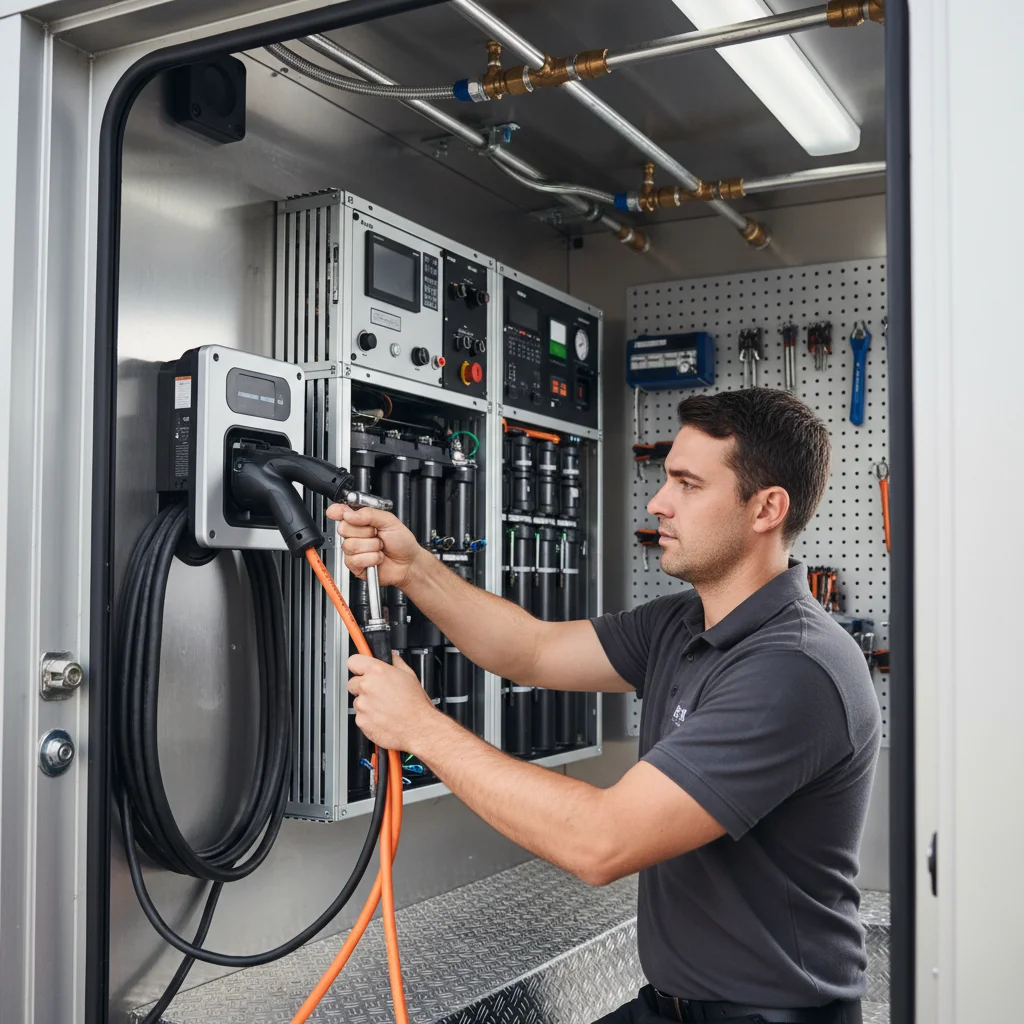
Charge Pro IE doesn’t roll a branded fleet. You call. We connect you with an independent local operator. Stay with the car if it’s safe. Hazards on. Out of the travel lane.
The operator confirms the model and the inlet. They also check whether this is an empty pack or a 12-volt failure. They quote before they start. If you don’t like the quote, you don’t have to proceed. If you do, they plug in with NACS or the right adapter. Then they run the 240-volt source.
Charging time is typically 15 to 30 minutes for about 10 to 20 miles of range. That window is how long the cable is on the car. It isn’t a clock on the operator’s drive to you. Once you have enough miles to leave, you drive. The operator isn’t your navigator. This page won’t name a nearest charger. If a specific site is already in your plan, use that pin. The Tesla stalls in Calimesa are one named site in this market. If those stalls are packed or offline, you still need miles to reach the next stop you trust.
For the full visit shape, not the hardware list, read What a mobile EV charging visit actually is, and isn’t.
Colton is its own electric island. The City of Colton Electric Utility owns the entire electrical infrastructure within city boundaries. Riverside Public Utilities has served the city since 1895. Banning runs a city electric utility. San Jacinto takes delivery from SCE. San Jacinto Power supplies generation as a community choice aggregator. Apple Valley is similar. SCE delivers. Apple Valley Choice Energy procures. Home rates and rebate names live with those agencies. A mobile EV charger truck doesn’t bill like a utility. It’s a roadside service call. The operator quotes it. You pay it.
Older housing changes the home side, not the truck side. San Bernardino’s housing stock is 60.9% pre-1980. Riverside is 56.4%. Redlands is 60.4%. Upland is 55.9%. Ontario is 50.7%. Montclair is 68.5%. Temecula is 6.5%. Murrieta is 6.2%. Those are ACS 2019-2023 shares. An older panel can stall a home charger install. It doesn’t change what the operator brings to the bumper. The truck still shows up with Level 2 and adapters.
Home Level 2 versus the truck on the shoulder
A garage unit and a mobile EV charger truck share a voltage class. They don’t share a job. Home charging is overnight replenishment on your meter. SCE households may be on TOU-D-PRIME. Riverside residents may be on Riverside Public Utilities’ Electric Vehicle Rate. Colton and Banning set their own tariffs. Program names change, and funding runs out, so confirm current details with the utility. The truck is a short rescue so the car can move.
If the home unit is down, the wall is dark. Or you never made it home. Then the operator’s 240-volt source comes to the car. It won’t fill a long-range pack the way a garage session does. It isn’t a replacement for a working home circuit. It’s the difference between sitting and rolling.
Don’t treat a 120-volt convenience cord as the same class. Those portable bricks are Level 1. They trickle. They’re for a driveway with hours to spare. They’re a poor match for a live shoulder on I-10 in Colton. Same for a two-lane Ortega pull-off. The mobile EV charger truck exists because Level 1 is too slow for that moment.
When the truck is the wrong tool
If the car took impact, charging may be the wrong call. Same if it sits in a live lane. Same if it shows a high-voltage fault you can’t clear. If doors won’t unlock, start with the 12-volt. The operator does that before the charge port. If you need the car in another city tonight, and you can’t drive it, you need a tow. You don’t need a top-off.
Public stalls still matter for the rest of the trip. This page won’t claim a lot or a freeway segment lacks charging. That kind of gap talk wasn’t verified here. Use your car’s map. Then keep a rescue number for the case where you can’t reach the stall you had in mind.
The operators we connect you with handle Tesla and every major EV brand. They don’t perform shop work under the Charge Pro IE name. This brand refers. The independent operator does the roadside job.
Frequently asked questions
How much range does a mobile EV charger truck add?
Operators in this network typically add 10 to 20 miles of range in 15 to 30 minutes of charging. That’s time on the cable, not travel time to you. Enough miles to leave is the point. It isn’t a full pack.
Can one mobile EV charger truck help Tesla and CCS cars?
Yes. The operators we connect you with bring a native NACS plug for Tesla. They bring CCS or J1772 adapters for other brands. Confirm your inlet when you call. Then the operator arrives with the right lead.
Is a store-bought portable charger the same as the truck?
No. Most owner-carried units are Level 1, 120-volt devices meant for slow top-offs. A mobile EV charger truck brings a 240V Level 2 source to the car. That’s a different power class. It’s a roadside rescue, not an overnight trickle.
If you’re already stuck, Charge Pro IE can connect you with a local operator. Call (909) 250-2881. The operator quotes before they start and bills you directly. We serve cities across the Inland Empire. We don’t own the truck you’ll see on the shoulder.