You’re on the I-15 Cajon climb toward Victorville. The Tesla won’t roll. The app and Tesla’s roadside phone both reach Tesla’s transport desk. They don’t send a charger on a truck.
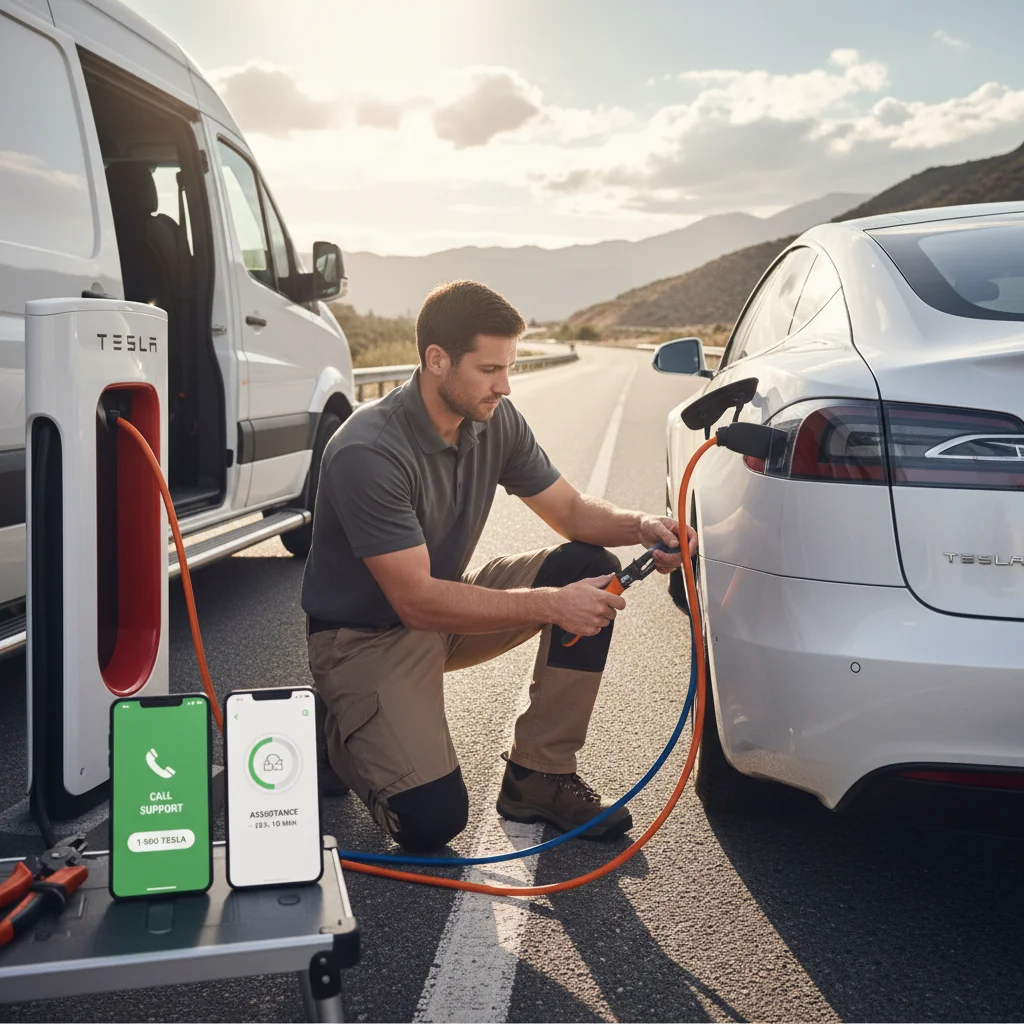
Drivers type tesla roadside phone number vs app because they want a person. They want someone who can move the car. Tesla’s two official doors do reach a person. That person sits at Tesla Roadside. The hardware Tesla then assigns is usually a contracted transporter. It isn’t a 240-volt source on the shoulder.
Both doors open the same Tesla desk
Tesla publishes two contact paths for owners. One is Roadside Assistance inside the Tesla mobile app. The other is the roadside phone on Tesla’s own support site. Save that number from Tesla, not from a random post. We keep a local backup path at Tesla’s roadside number, and a local Inland Empire backup.
There’s no hidden lane. Both requests enter Tesla Roadside. Tesla then assigns a contracted provider. The contractor Tesla sends is who rolls to you. In the usual empty-pack case, that’s a tow to a Supercharger or service.
A dead 12-volt battery is a different ticket. The dash can go dark even with range left in the pack. Tesla may treat that as a no-start. Adding miles of charge is a different job. Read what Tesla roadside covers before you’re on the shoulder.
Tesla doesn’t publish a verified hold time for the Inland Empire. It doesn’t publish a verified arrival window either. Anyone quoting those numbers is guessing. Guessing isn’t useful when you’re already stopped.
What the app actually does
The app is a form with a map pin. You open it and tap Roadside Assistance. You pick a problem type from Tesla’s list. You confirm the pin and send the request. Your GPS goes with the ticket. You aren’t squinting at a mile marker on I-10 through Colton.
When the request goes through, Tesla already has the pin and the problem type. That beats describing I-10 through Colton by voice. It still doesn’t convert the ticket into a mobile charge.
You also get a request you can reopen later. If you call after that, you can read the case back. A voice call only has that trail if you ask for a number.
The limit is data. The app has to load, submit, and confirm. A parking structure at Ontario’s airport lots can stall a page. So can a mountain grade toward Lake Arrowhead or Crestline. A voice call can sometimes complete when a form won’t.
What the phone actually does
The phone is a live agent. You describe the car, the road, and the problem in your own words. That helps when Tesla’s menu doesn’t fit. A stuck charge-port latch isn’t a clean tap. A bumper that won’t let the car roll isn’t a clean tap. A car that won’t enter tow mode needs a person, not a dropdown.
The phone also helps after a silent app ticket. You call with the case. You ask whether a provider is assigned. Confirm the current number on Tesla’s site. Don’t trust last year’s screenshot.
Location is the slow part of a call. “I’m on the 91 in Corona” isn’t a pin. “I’m in a Fontana warehouse row” isn’t a pin. The app already sent coordinates. On the phone, you and the agent build the spot by voice. On I-215 through Moreno Valley or Perris, that can mean naming a nearby exit. On SR-60 in Jurupa Valley, same work.
The choice is transport versus charge, not app versus phone
App versus phone isn’t two flavors of charging. It’s two ways to reach Tesla transport. Tesla charging service, or an Inland Empire roadside rescue is the real fork.
A transporter hooks the car and takes it. A mobile Level 2 visit leaves the car where it sits and adds range. The independent operators we connect you with bring a 240-volt Level 2 source. They bring it to the car. They use a native NACS plug. For non-Tesla EVs they use a CCS or J1772 adapter. They typically add 10 to 20 miles of range. That takes 15 to 30 minutes of charging. That figure is charging time. It’s never an arrival time. They can also jump or replace a dead 12-volt battery on site.
If you want the car to drive to a Supercharger, that’s the local visit. If you want the car on a bed, Tesla’s two doors start that process. What a mobile EV charging visit actually is walks through the stop itself.
How the same two doors feel on Inland Empire roads
The Inland Empire isn’t one commute. The Cajon climb on I-15 toward Victorville and Hesperia is grade plus heat. I-215 through Moreno Valley and Perris mixes clogged stretches with open ones. I-10 through Colton, Redlands, and Banning carries freight and weekend mountain traffic. The 91 through Corona and SR-60 through Jurupa Valley stack in the afternoon.
None of that changes Tesla’s two contact doors. It does change what you need the person to do. On a freeway shoulder, a tow can be the safe next step. On an Ontario airport lot or warehouse row, you may want the car to roll. Downtown Riverside is served by Riverside Public Utilities, not Southern California Edison. That matters for a home charger. It doesn’t change Tesla Roadside. Big Bear Lake and Big Bear City sit on Bear Valley Electric Service. That’s the same split. Utility and roadside are different systems.
Work lots in Chino and Fontana don’t change Tesla’s two doors. Neither do new streets in Eastvale. Neither do wine-country miles around Temecula and Murrieta. They change whether you need the car to roll off a lot. A dark house charger in Rancho Cucamonga is a home-power problem. Tesla Roadside still isn’t a 240-volt truck. Moreno Valley is split between Southern California Edison and Moreno Valley Utility. That split matters at the panel. It doesn’t pick your roadside door.
High Desert miles around Adelanto, Phelan, and Apple Valley add distance between services. Mountain streets in Running Springs and Lake Arrowhead add grades on the way down. Tesla’s app still sends a pin. Tesla’s phone still talks to a dispatcher. The hardware that usually arrives is still a truck that tows.
Tesla’s published menu covers empty pack, no-start, lockout, and flat tire. Those tickets still route through Tesla’s contractor network. They don’t become a Level 2 hookup because you tapped instead of dialed.
Pick the door that matches the job
Use the app when you have data and a standard problem. Use the phone when the app won’t submit. Use the phone when the story is messy. Use the phone when you already have a ticket that hasn’t moved.
Then ask the question Tesla’s menus skip. You still have to choose transport or enough charge to drive. The Tesla roadside rescue page is the local match for that second job. It connects you with the operators we work with.
Charge Pro IE doesn’t own trucks. It doesn’t employ technicians. It doesn’t hold a trade license. It doesn’t set a price or promise when someone arrives. The operator quotes you before they start. They bill you directly. They handle Tesla and every major EV brand. The pros we connect you with are licensed and insured.
If Tesla’s tow path isn’t the job you want, call (909) 250-2881. Say where you are. Say whether the pack is empty or the 12-volt is dead. They connect you with a local operator who can talk through the next step.