A home battery keeps the house up when your utility drops the feeder. Mobile EV charging is a 240-volt visit to a car that’s already stranded. Those are different jobs inland, because the grid here isn’t one company.
The grid here is split, so backup isn’t one story
Most owners treat Southern California Edison as the power company on every inland block. It isn’t.
Riverside Public Utilities has served the City of Riverside since 1895. Colton Electric Utility owns the electrical infrastructure inside Colton. Banning runs the City of Banning Electric Utility. Big Bear Lake and Big Bear City sit on Bear Valley Electric Service. That service area also names Lake Williams, Erwin Lake, Sugarloaf, Moonridge, Fawnskin, and Boulder Bay.
Rancho Cucamonga is split. SCE covers most of the city. Rancho Cucamonga Municipal Utility serves a southeast pocket of over 3,900 metered businesses and residents. That pocket includes The Enclave, Day Creek Square, The Resort, and the Victoria Gardens area. Compare that with Rancho Cucamonga home backup when the EV is still dead. Start with which meter you have.
Moreno Valley is split too. SCE still serves much of the city. Moreno Valley Utility has covered newer development since 2004, with over 6,500 customers. MVU publishes an address lookup. Use it before you treat SCE’s EV pages as yours.
San Jacinto has another layer. SCE delivers the power. San Jacinto Power, a community choice aggregator, supplies the generation. Apple Valley works the same way. SCE delivers. Apple Valley Choice Energy procures.
Victorville is easy to get wrong. Residential service is SCE. Victorville Municipal Utility Services only serves the Southern California Logistics Airport and Foxborough Industrial Park. It doesn’t serve residential areas.
Chino, Ontario, Fontana, San Bernardino, Corona, Menifee, Temecula, Murrieta, Hemet, and Perris are on SCE. Lake Arrowhead and Crestline are on SCE as well. Bear Valley’s service-area page doesn’t list those two mountain communities.
A wall battery follows whoever feeds that panel. SCE’s residential EV rate is called TOU-D-PRIME. Riverside Public Utilities publishes its own Electric Vehicle Rate and Electrify Riverside pages. Those aren’t shared programs. Confirm current terms with the utility that bills you. What shapes Tesla charging cost across Inland Empire utilities treats inland rates as a split.
SCE publishes Public Safety Power Shutoff resources, and Cabazon appears on that PSPS list. A city-owned utility is a different outage desk. Don’t call Riverside Public Utilities about an SCE shutoff. Don’t call SCE about a Colton feeder either.
What a home battery covers at the house
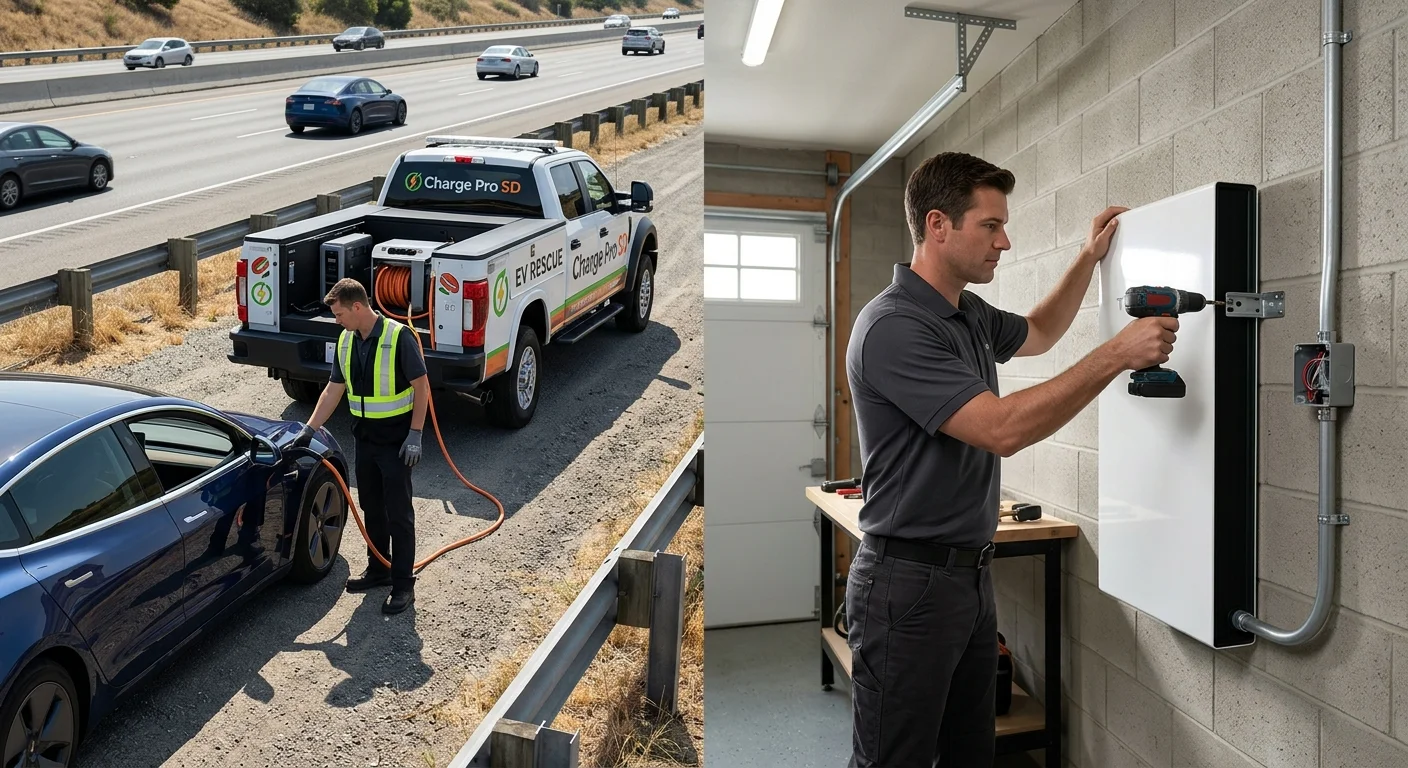
A home battery is a fixed storage pack on the garage wall. Tesla’s Powerwall is the name most owners use. Other brands sell the same idea. The system stores solar or grid power. When the feeder dies, backed-up circuits can stay on.
That can include a garage charger if that circuit is on the backup load. It can’t follow you onto I-15 at Cajon Pass. It can’t meet you on I-215 in Moreno Valley. It can’t roll to SR-91 in Corona. A Powerwall in Temecula doesn’t reach a car that’s already empty in Winchester.
Licensed electricians and solar contractors do that install work. Charge Pro IE doesn’t do that work. We don’t sell wall packs. We don’t hang them. We don’t service them. We don’t own a warehouse of batteries. This brand is a referral line for stranded EVs.
Housing age changes the panel conversation. ACS 2019-2023 puts 43.8% of San Bernardino County housing before 1980. Riverside County is 30.2%. San Bernardino city is 60.9% pre-1980. Eastvale is 2.2%. Temecula is 6.5%. French Valley is 2.3%. A 1960s panel in Montclair isn’t an Eastvale tract. Older Inland Empire panels and EV chargers is the hardware path for that question. This page doesn’t quote rebate amounts. Confirm them with the utility that bills you. Programs change, and funding runs out.
What mobile EV charging is on the road
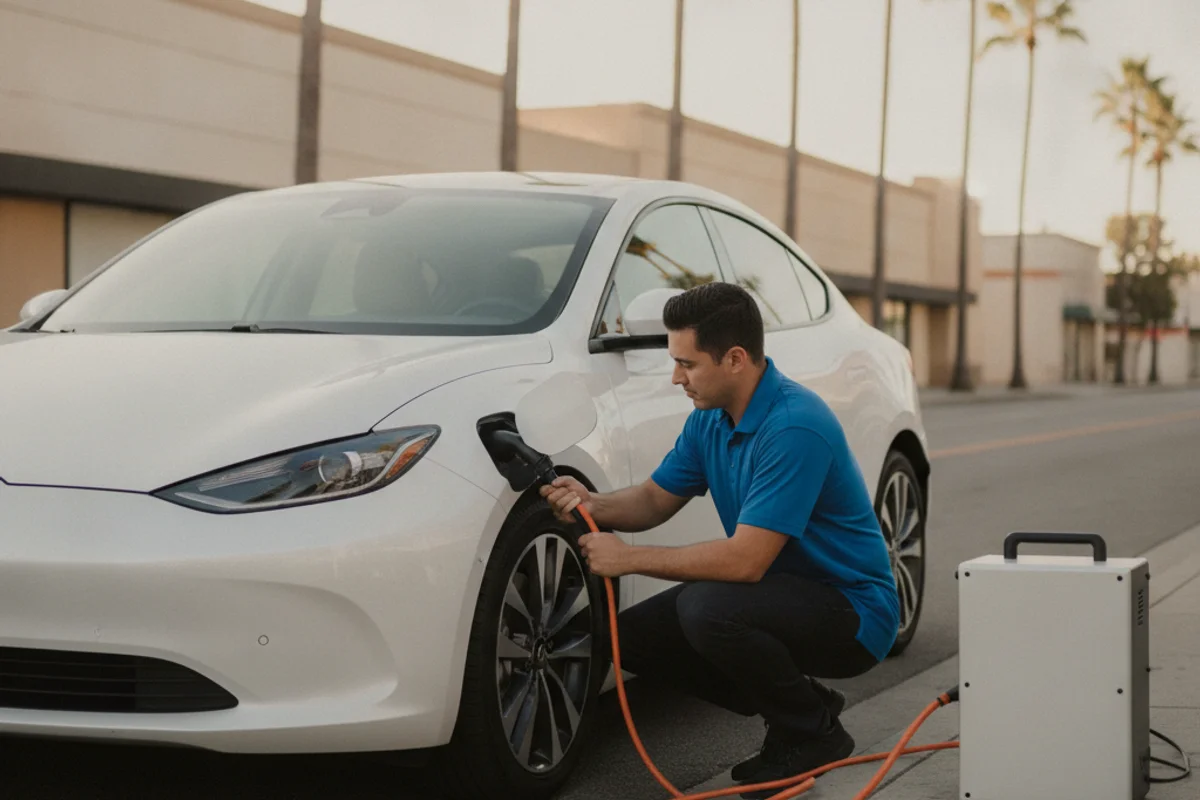
Mobile charging is energy for the car, at the car. An independent operator brings a 240-volt Level 2 source. Teslas take a native NACS plug. Other EVs use a CCS or J1772 adapter. A typical visit adds 10 to 20 miles of range. That takes 15 to 30 minutes of charging. That’s cable time on the car. It’s not when anyone shows up.
The same operators can jump or replace a dead 12-volt battery on site. They handle Tesla and every major EV brand.
Charge Pro IE matches stranded drivers with those local operators. We perform no work. We own no trucks. We employ no technicians. We set no prices. The operator quotes you before starting and bills you directly.
If the traction pack is empty, that’s out-of-charge recovery. If the dash is dark but the pack has miles, start with the 12-volt. Those are different failures. A home battery doesn’t sort that from the driveway. The car’s already on the shoulder.
They’re not interchangeable
Location and job are the whole difference.
Mobile charging is for a vehicle that’s stuck away from a working plug. Home backup is for a house when the utility feeder is down. You don’t call a roadside operator to power a dark kitchen. You don’t expect a garage wall pack to meet you on I-10 in Colton.
A tow moves a silent EV. It doesn’t put range in the pack. A Level 2 visit adds enough miles to roll to a charger or home. Corona home backup vs a mobile charge when the panel’s dark covers that west-side fork.
When the house is dark
If the block is out, call the utility that actually serves the meter. In Riverside that’s Riverside Public Utilities. In Colton that’s the city’s electric utility. In Banning that’s Banning Electric Utility. In Big Bear that’s Bear Valley Electric Service. On the SCE city list, it’s SCE. In Rancho Cucamonga’s southeast pocket, check RCMU. In Moreno Valley, use MVU’s address lookup.
If you already have a home battery, that’s the outage plan for backed-up loads. If the EV is in the garage on a backup circuit, it may keep charging. If the car is at a Fontana warehouse shift, the wall pack doesn’t help. Same for an Ontario airport lot, or the Ortega near Wildomar.
French Valley housing is mostly new. Only 2.3% of units there predate 1980. A new-tract battery still doesn’t roll a dead EV off a Temecula Valley road. See Powerwall at home in French Valley, and an EV that still won’t move.
Menifee is SCE territory. A home battery there stays on the lot. It doesn’t follow you toward the Ortega.
When the car is empty away from the driveway
You’re on the shoulder with a traction pack that’s empty. Or you’re too low to reach the plug you already picked. That’s the mobile-charging case.
It shows up after the Cajon climb toward Victorville and Hesperia. It shows up on I-10 through Colton, Redlands, Beaumont, and Banning. It shows up on I-215 through Moreno Valley and Perris. It shows up on SR-60 in Jurupa Valley and on the 91 through Corona. Mountain miles toward Lake Arrowhead, Crestline, Running Springs, and Big Bear are about grade. High Desert miles near Adelanto, Phelan, and Apple Valley are a distance problem. Neither one is a reason to bid a wall battery from the shoulder.
A dead 12-volt can look like a dead car. Doors, screens, and the ready state can fail while the main pack still holds energy. The operators we connect you with can jump or replace that 12-volt on site. A home battery won’t jump a 12-volt on I-215.
Rescue matching, not a battery install
Charge Pro IE connects stranded EV drivers with independent local mobile rescue operators. The pros we connect you with are licensed and insured. We serve the Inland Empire.
We don’t install Powerwalls. We don’t sell solar. We don’t wire a home charger. If you want backup at the panel, hire a local electrician or solar contractor. If the EV is already stuck, that’s the call we take.
When to call
Call when the car won’t make the next plug, or won’t wake. We’ll match you with an operator. That operator quotes before any cable goes on. Call (909) 250-2881.