An EV charger electrical panel upgrade shows up first in older Inland Empire housing. San Bernardino County has 43.8 percent of units built before 1980. That’s the ACS 2019-2023 figure, the vintage this page uses. The charger on the wall is rarely the first thing to fail. Spare capacity in the panel is what fails first.
Older cores, newer edges, different panels
The Inland Empire isn’t one housing market, and the panel story isn’t either. San Bernardino County’s pre-1980 share is 43.8 percent. Riverside County’s share is 30.2 percent on the same ACS 2019-2023 vintage.
In the older county, core cities run higher. San Bernardino sits at 60.9 percent pre-1980, and Redlands at 60.4 percent. Montclair sits at 68.5 percent, and Crestline at 77.7 percent. Ontario sits at 50.7 percent, and Fontana next door at 28.9 percent.
New-edge cities run much newer. Eastvale is 2.2 percent pre-1980, and Temecula is 6.5 percent. A new Eastvale tract isn’t a pre-1980 bungalow in Colton. Colton’s pre-1980 share is 51.8 percent.
Those numbers don’t tell you leftover capacity on your panel. They tell you why this talk is common in older cities.
What fails first on those older services
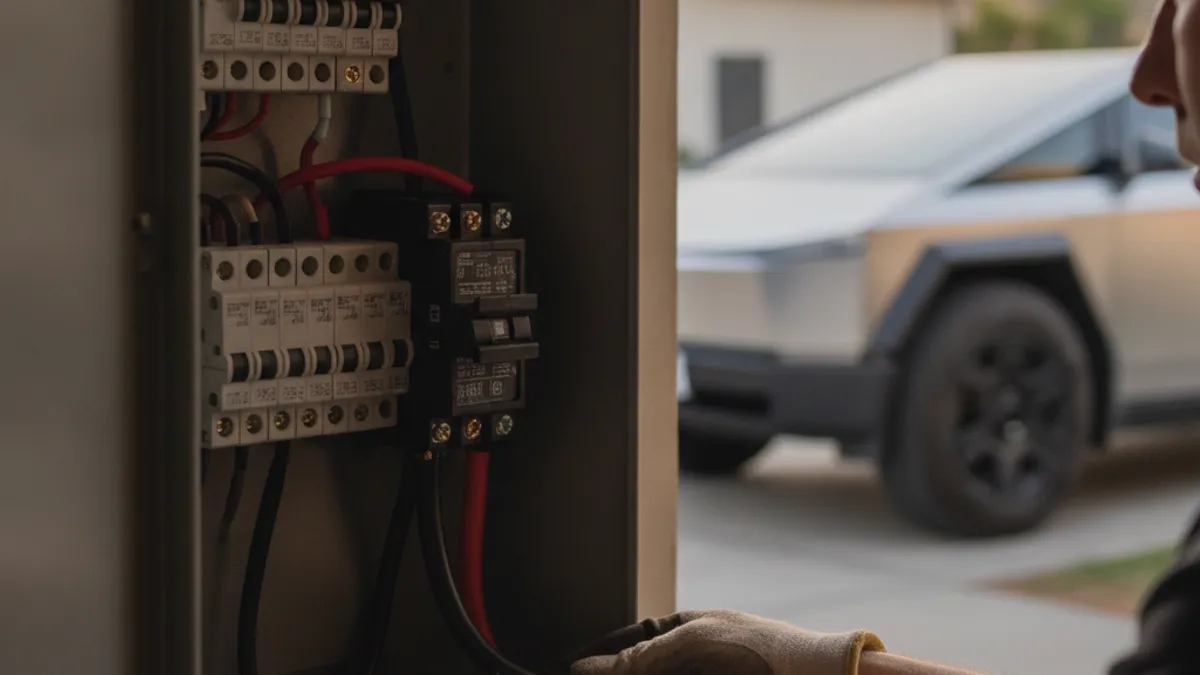
A home Level 2 charger needs its own 240-volt circuit. That’s a large new load on a panel that already runs the house. Before wire gets pulled, a licensed electrician runs a load calculation. They add up lights, HVAC, kitchen, laundry, and everything else on that service.
If the math is short, the wall unit didn’t fail. The service is already full, and that’s the first failure. You might notice it as a breaker that won’t hold. You might notice it as a charger that never got approved. See what’s making your EV charger trip the home breaker for that live version.
A house that can’t charge overnight leaves less margin. That’s true on I-10 through Colton and Redlands. The same squeeze hits the 60 through Jurupa Valley, and I-15 toward the Cajon climb.
What an electrician may propose
No verifiable dollar figure for an Inland Empire panel upgrade was confirmed for this page. Your electrician sets the price after they see the gear. Ask for a written quote before anyone opens the panel.
- A load management device can throttle the charger when the house is drawing hard. That sometimes avoids a full panel swap.
- A full panel replacement is the heavy path when leftover capacity is gone. It can mean a new panel, a new main breaker, and updated grounding. It may also mean coordination with whatever utility owns that service.
- Circuit sharing uses an existing heavy circuit if the layout allows it. It doesn’t fit every garage or every code path.
Your electrician and the city inspector decide what’s legal at that address. Charge Pro IE is a referral line, not an electrical contractor. We don’t hold a trade license, and we don’t own trucks. We match stranded EV drivers with independent local mobile rescue operators.
The utility map isn’t one company
Most people assume every inland city is on Southern California Edison. That isn’t true, and it matters when a panel upgrade needs utility coordination.
SCE serves Ontario, Fontana, San Bernardino, Upland, Redlands, and Yucaipa. Corona, Eastvale, Jurupa Valley, Perris, Menifee, Temecula, and Beaumont are on SCE too.
Riverside is on Riverside Public Utilities, in the city since 1895. Colton’s city electric utility owns the infrastructure inside city limits. Banning runs its own City of Banning Electric Utility. Big Bear Lake and Big Bear City are on Bear Valley Electric Service.
Rancho Cucamonga is split between two electric providers. SCE covers most of the city, and Rancho Cucamonga Municipal Utility covers a southeast pocket. That pocket has more than 3,900 metered businesses and residents. It includes The Enclave, Day Creek Square, The Resort, and the Victoria Gardens area.
Moreno Valley is split as well between SCE and Moreno Valley Utility. MVU has served newer development since 2004 and lists more than 6,500 customers.
Victorville homes are on SCE, not the city’s industrial utility. Victorville Municipal Utility Services covers the Southern California Logistics Airport and Foxborough Industrial Park only. It doesn’t provide utility service in residential areas at this time. Apple Valley Choice Energy procures generation while SCE still delivers the power. San Jacinto Power does the same job in San Jacinto.
If your upgrade needs a service change, that named utility is who coordinates it.
Permits live at city hall
A panel upgrade is permitted electrical work in every city on this list. San Bernardino and Riverside each run a building counter. Unincorporated pockets go through the county. No permit fee was confirmed for this page. Ask the building department for the current amount before you budget.
A quote that skips the permit is a warning, not a discount. Unpermitted work can follow the house at sale. Confirm insurance effects with your carrier, because this page couldn’t. Verify any contractor’s license at cslb.ca.gov before you sign. The exact California license class for this job was not confirmed in our claims file.
Start with home EV charger install across the San Bernardino Valley.
Rebates aren’t a budget line until you re-read the page
SCE publishes TOU-D-PRIME and Charge Ready Home for residential EV customers. Riverside Public Utilities publishes an Electric Vehicle Rate and Electrify Riverside rebates. Dollar amounts aren’t repeated here because programs change and funding runs out. Read the live utility page, and ask your electrician what’s still open.
When the wall is still dark
Panel work and a new circuit take calendar time you can’t recover overnight. If you’re driving on a slow outlet in the meantime, range can run out. That’s when a roadside Level 2 visit steps in.
Charge Pro IE matches you with independent local mobile rescue operators. Those operators bring a 240-volt Level 2 source to the car. Teslas get a native NACS plug, and other brands use a CCS or J1772 adapter. They typically add 10 to 20 miles of range. That’s 15 to 30 minutes of charging time, never an arrival time.
The operator quotes you before starting and bills you directly. We don’t set prices, and we don’t promise when a truck rolls. Compare that path with home charger install versus a mobile charge when yours is down. There’s also home 240-volt charging vs a roadside Level 2 hookup. If you’re already stuck, request mobile EV charging.
Frequently asked questions
Do older Inland Empire homes always need an EV charger electrical panel upgrade?
No, leftover capacity decides it, not the year on the house. Pre-1980 stock is more likely to be tight. A load calculation is what settles it.
Who sets the price for a panel upgrade around here?
Your electrician sets that number after seeing the panel. No verifiable Inland Empire figure was confirmed for this page. Get a written quote, and confirm the permit is in it.
What if the wall charger still isn’t live?
Call (909) 250-2881 and we’ll connect you with a local mobile rescue operator. They can add range at the curb while the panel work waits.