In Rancho Cucamonga, a dark house charger isn’t one utility story. Most of the city sits on Southern California Edison. A southeast pocket sits on Rancho Cucamonga Municipal Utility, the city’s own electric company. That pocket includes Victoria Gardens, The Resort, Day Creek Square, and The Enclave. You searched battery backup Rancho Cucamonga after the wallbox went quiet. Name the utility on your bill first. A home battery and a stranded EV are different jobs. Mixing them up wastes a night.
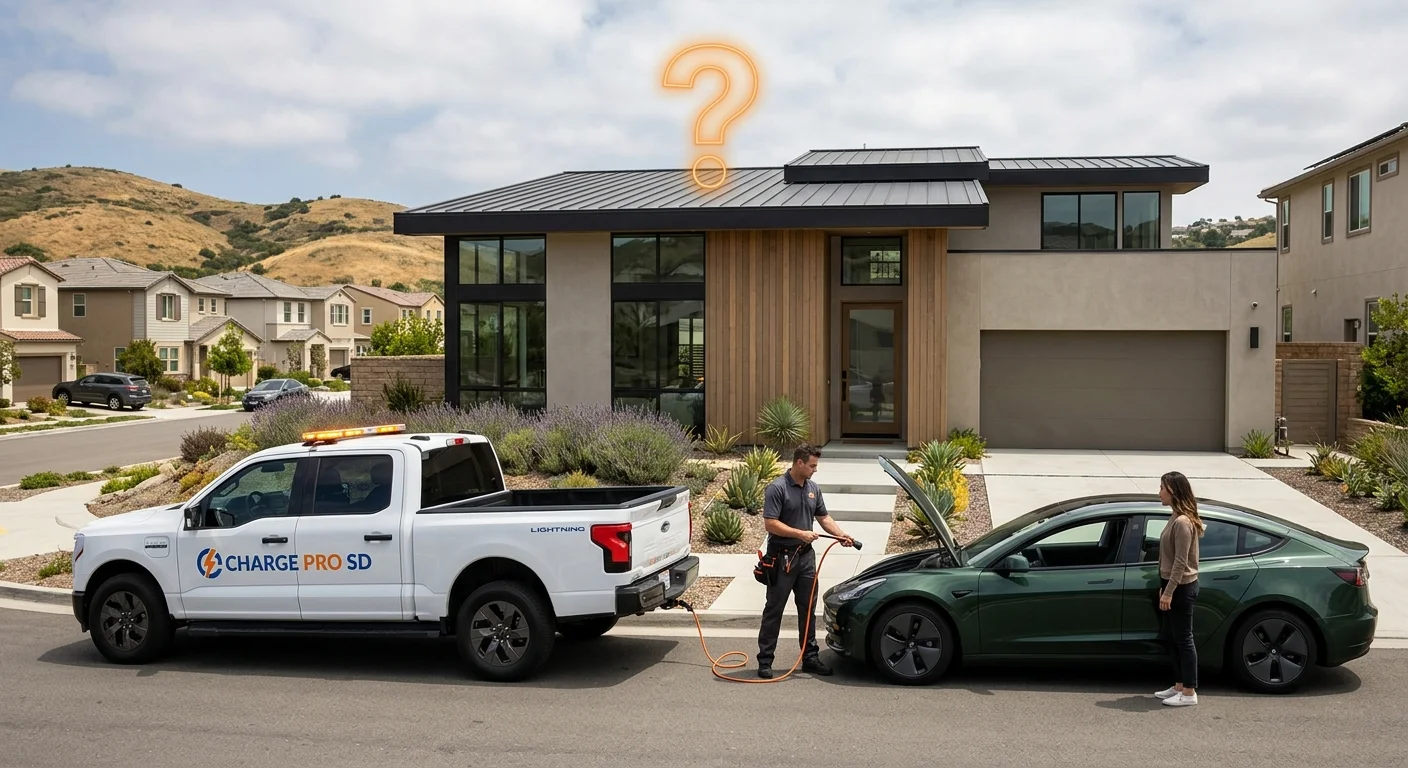
This city has two electric companies
Rancho Cucamonga is in San Bernardino County. It’s also a split-utility city. That fact decides who you call when the panel goes dark.
SCE covers most of town. That includes Alta Loma, Etiwanda, Terra Vista, and much of the Foothill Boulevard corridor. Foothill is historic Route 66 through this valley. RCMU is smaller. City pages say it serves over 3,900 metered businesses and residents in the southeast. Victoria Gardens is in that pocket. So are The Resort, Day Creek Square, and The Enclave.
Your meter in Haven View or along Archibald Avenue may still be on Edison. If you live or park by Victoria Gardens, check for RCMU first. Don’t report that outage to SCE by habit. Ask which utility a neighbor actually has before you tell them to call Edison.
If your bill says SCE
SCE publishes a residential EV plan named TOU-D-PRIME. Confirm the current schedule with Edison. Don’t trust an old printout. Don’t copy a rate from a friend in another city. A home battery on an SCE meter has to follow whatever Edison requires for storage. Confirm those rules with Edison. They weren’t pulled for this page. Then ask the licensed contractor who’d do the panel work.
If your bill says RCMU
RCMU sets its own residential power terms. No EV-specific RCMU rate was confirmed in the sources used for this page. Read the city utility’s residential service page before you assume Edison’s plan applies. Storage by Victoria Gardens, The Resort, or Day Creek Square is an RCMU job. It isn’t an SCE job. The installer has to work with the utility that actually serves the address.
Three reasons the car can sit there
A quiet dash in Caryn or Red Hill can mean three different things. The house lost power. The traction pack is empty. Or the 12-volt battery that wakes the car has failed. They feel the same from the driveway. They’re not the same fix.
If the kitchen is dark, the wallbox is dark too. A home Level 2 charger needs grid power. It can also run from a home battery wired to that circuit. A storage pack only feeds what it was designed to feed. If the EV circuit was left off that list, the car stays still. The fridge can still run. That layout couldn’t be verified as a default in Rancho Cucamonga. Ask whoever installed the storage. They can tell you what’s actually backed up.
If the house is fine and the car still won’t wake, you’ve left the utility story. You may have burned the margin on the climb into Alta Loma. You may have a 12-volt that died after a long stop at Victoria Gardens. A home battery won’t roll down Haven Avenue to fix either one.
Home backup stays on the house
Home battery backup is a fixed electrical install. It stores energy from solar, from the grid, or from both. When SCE or RCMU drops, it can carry selected circuits. Packs in the Tesla Powerwall class are one common example. Other residential storage brands exist too. They’re panel work, not roadside work.
Charge Pro IE doesn’t install home batteries. We don’t open panels, size solar, or quote storage. We’re a referral line. We match stranded EV drivers with independent local mobile rescue operators. The brand holds no contractor license. It owns no trucks and employs no technicians. For house storage, hire a licensed electrician. A solar contractor who does that trade works too. Confirm their license before anyone touches the panel.
Housing here is newer than much of San Bernardino County. About 29.3% of units were built before 1980, using ACS 2019-2023 figures. A lot of the newer stock sits north of Foothill. Home charging is common in Alta Loma and Etiwanda. It’s common on the alluvial-fan streets that climb toward the San Gabriel foothills. When calls here skew toward road strandings, that’s often why. The wallbox is usually already there. The car left home with a plan. Then the plan broke on the grade, at the mall, or on I-15.
Santa Ana winds funnel down the canyons hard enough to matter. Summers are hot and dry. Those are reasons people shop for home storage. They don’t let a house battery push an EV up Day Creek Boulevard. Compare storage with a mobile charge inland in mobile EV charging vs a home battery when the power is out.
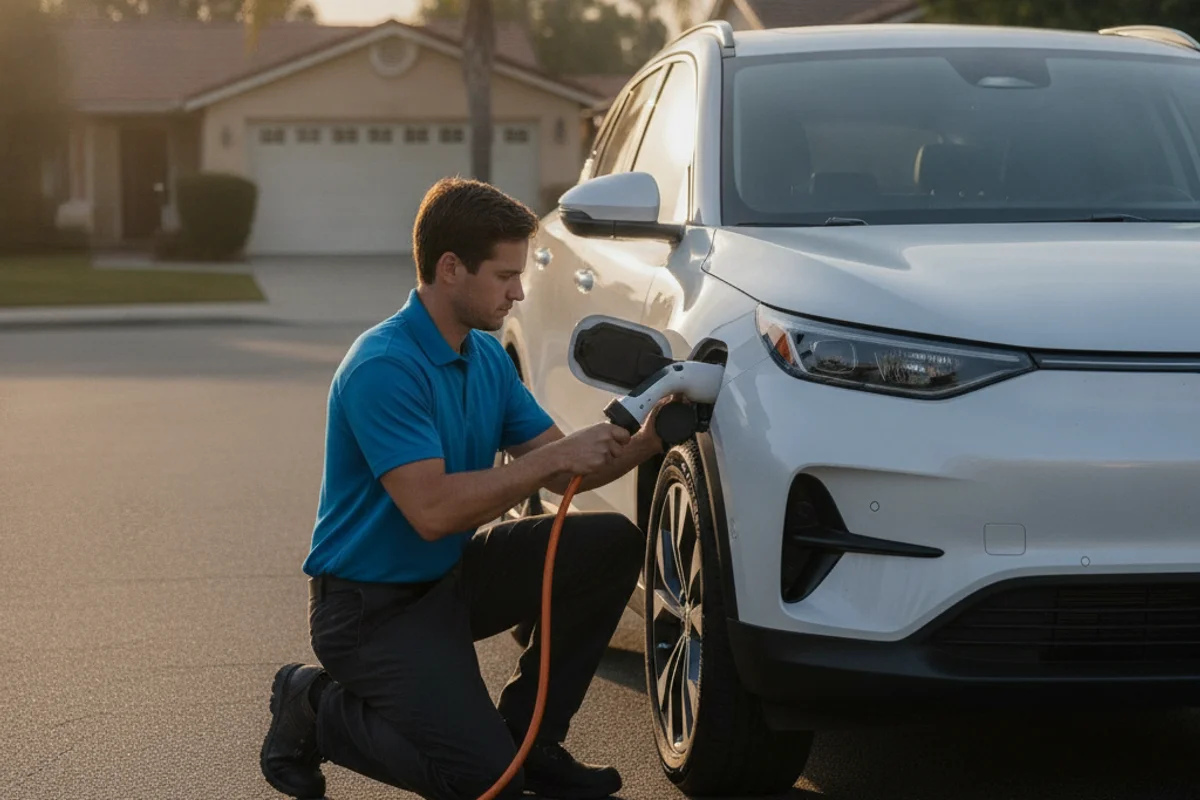
When the house is fine and the car still won’t move
This is the other reading of battery backup Rancho Cucamonga. You’re in the driveway on Base Line Road. Or you’re in a stall at Victoria Gardens after dinner. The house has power. The EV won’t go. A battery on the other side of the meter can’t help that car.
The operators we connect you with bring a 240-volt Level 2 source to the vehicle. Teslas get a native NACS plug. Other EVs get a CCS or J1772 adapter. A typical session adds about 10 to 20 miles of range. That takes 15 to 30 minutes of charging. That’s charging time. It’s not an arrival time. The operator quotes you before starting and bills you directly. We set no prices and promise no clock.
Those same operators can jump or replace a dead 12-volt battery on site. They handle Tesla and every major EV brand. The 12-volt is the small battery that boots computers, locks, and contactors. If it’s dead, a full traction pack still looks like a brick. If the pack is empty, you want mobile EV charging. If the dash is dark and the 12-volt is the suspect, start with a Tesla 12V jump. A local walkthrough is on EV roadside assistance in Rancho Cucamonga.
The climb home, the mall lot, and the I-15 launch
The city rises from about 1,100 feet in the south. Alta Loma and Etiwanda sit above 2,000 feet. That grade is gentle enough that you stop noticing it. It’s steep enough to eat range on every trip home. You can leave the I-10 edge or Ontario with a margin that looks safe. Reach Deer Creek or north Etiwanda and the number is smaller than the map promised.
Victoria Gardens is a long-dwell stop. You park, walk the open-air center, and eat. You come back to a car that’s lower than you left it. Sometimes it won’t wake at all. Heat soaks the pack in summer. If the car is sitting there and won’t move, you need a vehicle-side fix. You don’t need a new utility account.
Then there’s I-15. Rancho Cucamonga is the last comfortable staging point before Fontana and the Cajon Pass. Drivers stage here for the High Desert commute and for the longer north run. Launch from Milliken Avenue or Day Creek Boulevard with a thin buffer, and the climb does the rest. A home battery in Terra Vista does nothing for a car already on that shoulder. For that corridor, read out of charge on I-15 at the Cajon climb.
Longer stays happen on the Pacific Electric Trail, at Central Park, and at the Epicenter too. You come back to a lower pack. The home battery still sits on the house. Neighbors in Upland, Fontana, and Ontario share the freeways and the heat. They don’t share RCMU. That’s a Rancho Cucamonga-only split. A friend across the city line can have an Edison story that isn’t yours.
What this referral line is, and isn’t
We serve Rancho Cucamonga and the rest of the Inland Empire. We don’t carry a trade license. We don’t keep a yard, a warehouse, or a fleet. The pros we connect you with are licensed and insured. They do the charge or the 12-volt work. You talk to the operator about the quote. You pay that operator.
Don’t call this line to size a home battery. Don’t use it to argue an SCE bill or report an RCMU outage. Call the utility on your bill for grid problems. Call a licensed home-battery contractor for storage. Call us when the EV itself needs miles or a 12-volt wake-up. The city page at EV charging in Rancho Cucamonga maps the local context. A roadside Level 2 hookup isn’t a home 240-volt circuit. See home 240-volt charging vs a roadside Level 2 hookup.
If the car is empty or the 12-volt has dropped in Rancho Cucamonga, call (909) 250-2881. That’s the referral number. The operator you’re connected with quotes the job before any cable goes in.