The EV maintenance schedule by brand isn’t one shared calendar. Tesla, Rivian, Ford, Hyundai, and Chevy each print their own list. Those lists cover tires, filters, fluids, and inspections. They don’t cover a dead 12-volt on Cajon Pass. They don’t cover a pack that ran out on the 91. The glovebox is for the shop. The shoulder is a different job.
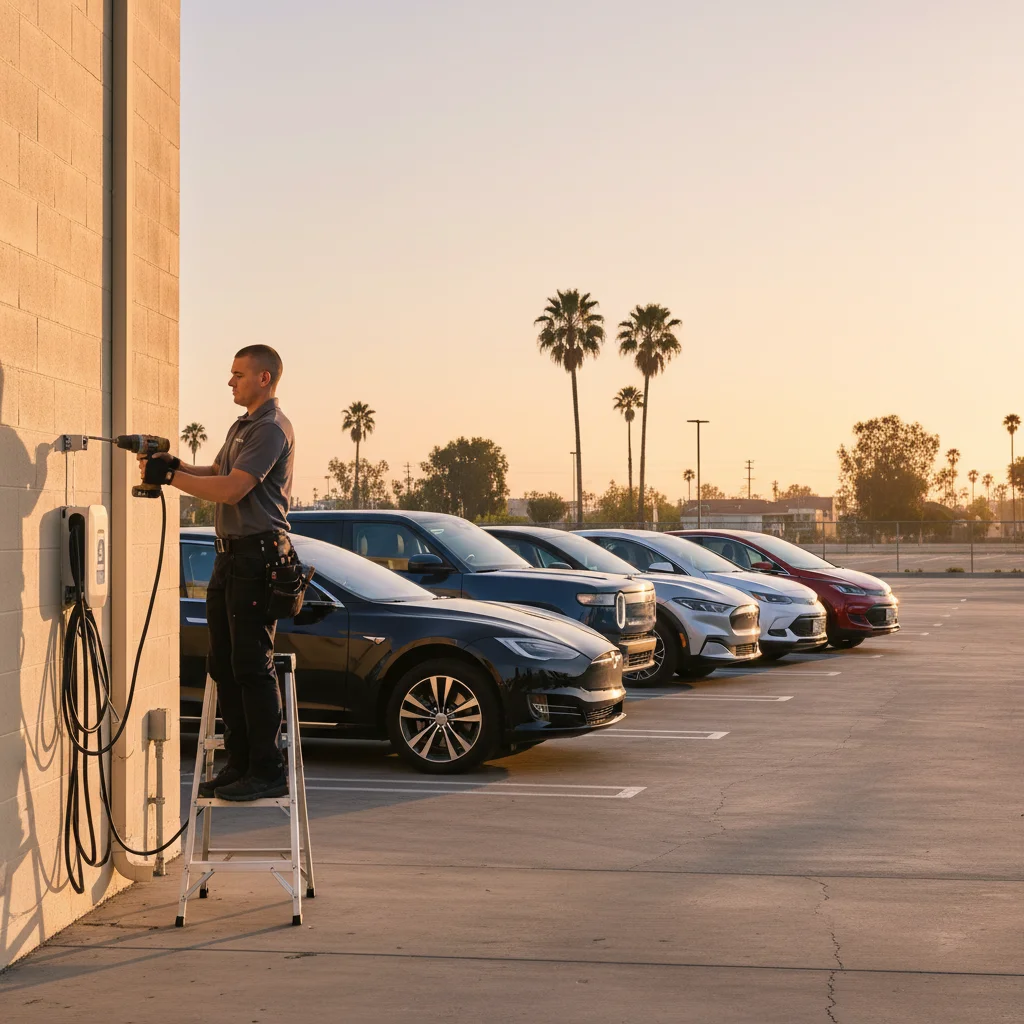
The manual isn’t a rescue plan
Your owner’s manual still sets the shop intervals. Tesla often surfaces the same items on the center screen. Ford, Hyundai, and Chevy still print a mileage checklist. Rivian adds drivetrain and air-suspension work the others skip. Confirm the current miles and years for your VIN. Forums go stale, and model years change. Charge Pro IE doesn’t set those intervals. We don’t perform that shop work either.
No brand schedules a stall on I-15 toward Victorville. They also skip an empty indicated range on the 91 through Corona. Inland grades and summer heat change how both failures show up. The paper calendar doesn’t name those roads.
For the generic owner list, start with our EV maintenance schedule for owners. This piece is the brand split. It’s also the gap those lists leave on local freeways.
Jobs that show up on every badge
You dropped oil changes, spark plugs, and an exhaust. You didn’t drop the rest of the car. A short set of jobs appears on every serious EV list.
Tires are the one you feel first. These vehicles are heavy, and torque hits at once. Check pressure on a cold morning. Rotate on the cadence printed for your size and axle. Cajon grades chew inner and outer edges unevenly. So do stop-and-go miles on SR-60 through Jurupa Valley. After a mountain descent toward Running Springs or Crestline, look at the tread. Don’t wait for a vibration on I-10 through Colton.
The 12-volt battery is the other universal. Every modern EV still uses a small 12-volt pack. It wakes computers, locks, and the high-voltage contactors. If that battery’s dead, a full traction pack won’t save you. The car won’t ready, and screens stay dark. That’s not an out-of-charge event. It’s a no-start. Tesla owners can start with Tesla 12V battery failure: when it hits. Rivian, Ford, Hyundai, and Chevy fail in the same pattern.
Brake pads often last longer because regen does the first bite. Brake fluid still takes on moisture. Rotors that rarely work can rust on cars that sit in Ontario warehouse lots. Cabin filters load up with valley dust. High Desert wind off Adelanto and Phelan does the same. Wipers still streak in the first rain on I-10 through Redlands. None of this is exciting. All of it is on the published lists.
Tesla: a short list, mostly flagged in the car
Tesla stepped away from a mandatory yearly service visit. The current published approach is a handful of timed items. Many of them appear as reminders on the screen.
The usual Tesla set starts with tire rotation and a brake-fluid health check. It also includes the cabin air filter and the A/C desiccant bag. Some Model S and Model X cars use a HEPA cabin filter. That filter uses a different interval. The desiccant interval also changes by model and year. Don’t borrow a number from a group chat. Open the service menu for that car. Or use the owner’s manual tied to the VIN.
Tesla’s list won’t jump a 12-volt on the Cajon shoulder. It won’t add miles if you started the climb with too little buffer. For that second case, see out of charge on I-15 at the Cajon climb. Those are roadside problems, not overdue cabin-filter problems.
Keep an eye on tire wear between flagged services. The car is good at nagging about filters. It’s quieter about a weakening 12-volt. That shows up after a hot week in San Bernardino. A dark dash after a grocery stop in Highland isn’t a missed desiccant bag. It’s the small battery, or it’s a pack that’s already empty.
Rivian: drive-unit fluid and air suspension on top
Rivian R1T and R1S trucks share tires, brakes, and cabin filters with everyone else. The extras are why the schedule looks longer.
Rivian publishes drive-unit fluid replacement at a high-mileage mark. That fluid lives in the motor gearsets. Air suspension gets leak and damage inspections. The compressor filter is a separate replacement. Alignment sits on a longer loop than rotation. Read the current Rivian maintenance guide for your configuration. Dual-motor and quad-motor trucks aren’t a copy-paste.
That guide still assumes the truck can wake. A dead 12-volt in a Fontana warehouse lane won’t wait for drive-unit fluid. An empty pack after High Desert miles toward Apple Valley isn’t an air-compressor appointment. The same is true after a day parked at a Cabazon lot. It’s true after a long idle at Glen Helen too.
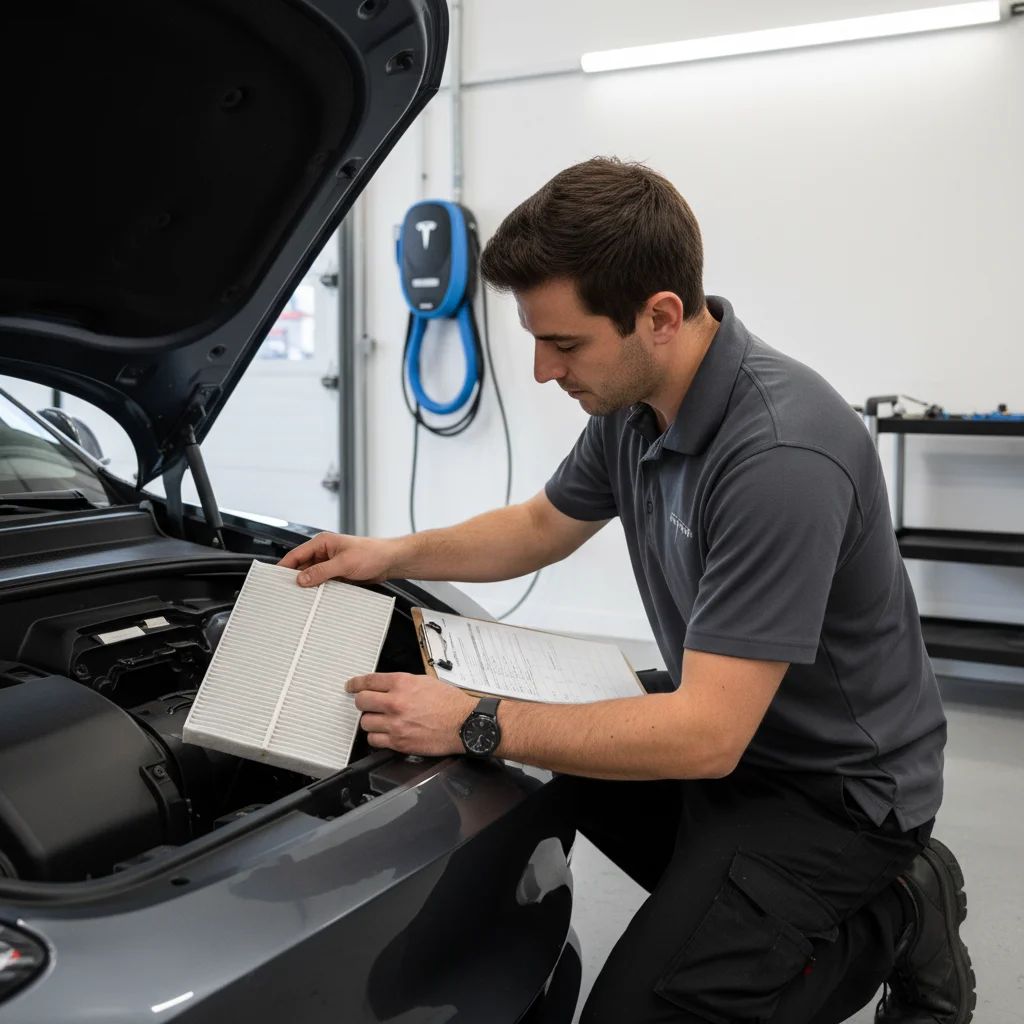
Ford Mach-E and Lightning: fewer items, still a checklist
Ford kept a periodic multi-point inspection for the Mustang Mach-E and the F-150 Lightning. It’s simpler than a gas F-150 schedule. It’s still a real visit.
The inspection set Ford describes includes tire rotation and a brake check. It also covers cooling-system hoses and half-shaft boots. Steering and suspension joints are on that list too. The cabin filter sits on a longer replacement interval. Lightning owners also have rear eAxle fluid at a high-mileage service. High-voltage battery coolant is a long-interval item, not an annual one. Use Ford’s scheduled-maintenance pages for your year and drivetrain. They’re the source, not a post like this.
A Lightning that won’t start in an Ontario airport lot is usually the 12-volt. It isn’t the eAxle fluid. A Mach-E that stopped on the 91 with zero range needs energy on site. That’s out of charge on the 91, not a hose inspection. Corona traffic doesn’t care that your last multi-point was on time.
Hyundai Ioniq 5 and Chevy Bolt: inspections on a repeating loop
Hyundai and Chevrolet lean on repeating mileage inspections more than unique hardware.
Ioniq 5 owners see tire rotation on a short loop. Brakes, steering, and suspension sit on a longer loop. The cabin filter and battery coolant have their own marks. Brake fluid is a time-based flush. Chevy Bolt and Bolt EUV owners see rotation on a repeating interval. They also get a multi-point inspection on that same loop. Later come the cabin filter and a brake-fluid flush. Chevy also services coolant loops for the battery, power electronics, and cabin heat. Pull the booklet that shipped with the car. Don’t copy a neighbor’s year.
Those calendars don’t mention I-215 through Moreno Valley and Perris. They don’t mention the I-10 climb past Beaumont toward Banning. Grades and heat still eat range. They also still finish off a weak 12-volt that nobody tested. An Ioniq 5 that won’t wake in Loma Linda is still a 12-volt story. A Bolt in a Rialto driveway fails the same way.
Inland Empire miles the PDFs never name
A schedule written for a national owner’s manual won’t describe this market. The Inland Empire isn’t one climate or one power company.
Valley heat in Riverside, San Bernardino, and Fontana cooks parked cabins. It cooks parked 12-volt batteries too. High Desert heat around Victorville, Hesperia, and Adelanto does the same. Then it adds longer desert miles between towns. Mountain runs to Big Bear Lake, Lake Arrowhead, and Crestline add altitude. You get regen on the way down and a cold soak overnight. South county miles through Temecula, Murrieta, and Menifee look gentler at first. Then you add the Ortega toward Wildomar after a long day.
Home power isn’t uniform either. Most cities sit on Southern California Edison. The City of Riverside is Riverside Public Utilities. Colton owns its electric system inside city limits. Banning runs a municipal utility. Big Bear Lake and Big Bear City sit on Bear Valley Electric Service. Rancho Cucamonga and Moreno Valley are split: SCE plus a municipal pocket. San Jacinto Power and Apple Valley Choice Energy supply generation while SCE still delivers. None of that changes your tire rotation. It does change how you think about home charging. That’s true when the car sits dark in the driveway. Heat and grades still matter more than the logo on the charge port. Start with how to care for an EV battery in Inland Empire heat.
Housing stock splits the same way. ACS 2019-2023 figures put Riverside over the half mark for pre-1980 homes. San Bernardino and Redlands sit in the same range. Eastvale, French Valley, Temecula, and Murrieta are far newer. An older panel is a home-charging problem. It isn’t a reason to skip the 12-volt test.
When the schedule is current and the car still won’t roll
Following those brand intervals lowers the odds of a shop surprise. It doesn’t erase two roadside failures the manuals never book.
The first is the 12-volt. The car looks fully dead, and doors might not cooperate. The traction battery can still hold a long trip’s worth of energy. A jump or an on-site 12-volt replacement is the usual path. A tow isn’t the default for that failure. Operators we connect you with handle Tesla and every major EV brand. They jump or replace that small battery at the curb when that’s the failure.
The second is an empty traction pack. The 12-volt is fine. The car just has no range left. Brand maintenance never scheduled that. Mobile EV charging brings a 240-volt Level 2 source to the car. Tesla uses a native NACS plug. CCS or J1772 adapters cover non-Tesla EVs. Charging time is typically 15 to 30 minutes. That typically adds 10 to 20 miles of range. That’s charging time, not a promise of when someone arrives. Read what a mobile EV charging visit actually is.
Charge Pro IE is a referral line. We match stranded drivers with independent local operators. We don’t own trucks, employ technicians, or set prices. The operator quotes you before starting and bills you directly.
If you’re already on the shoulder with a dark dash, skip the owner’s PDF. A zero on the display is the same call. Call (909) 250-2881 and we’ll connect you with a local operator. That operator quotes before any work starts.