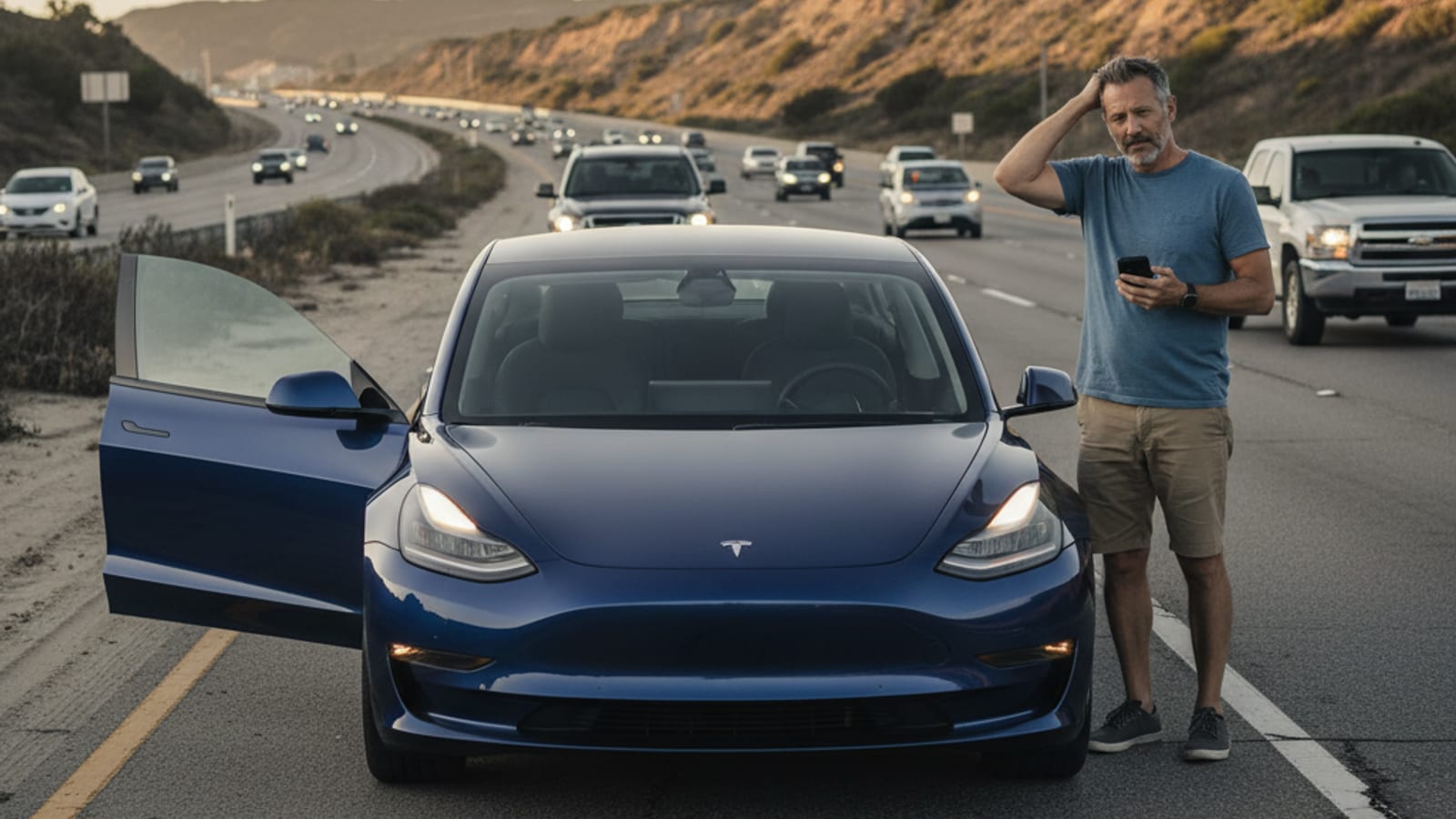
The climate’s still running and the pack already reads zero. If your EV runs out of battery on SR-91, start there. Kill the AC. Get onto the right shoulder through Corona. Stay in the car and line up a charge or a tow. Sitting still with climate on is the drain that makes the stop worse.
The climate load is the problem you can stop
Inland Empire heat makes a stopped cabin feel urgent. The compressor doesn’t care that you’re parked. It keeps pulling from whatever the pack still has. Screens can look fine while the motors already have nothing left.
Turn climate off the moment you stop. In daylight, kill the headlights too. Leave the hazards on. If the cabin gets harsh, crack a window. Don’t restart the AC for a minute of comfort. Those minutes are range you won’t have when a cable finally goes in.
A Tesla usually nags you for a long stretch before this. Rivian, Ford, Hyundai, Kia, and Chevy cars warn too. The number on the dash is a guess from recent driving. It isn’t a gas gauge. When it hits zero, some cars still creep. Others cut the motors almost right away. Don’t count on a hidden reserve. Treat zero as stopped.
Get fully right while you still have assist
Hazards go on as soon as the car starts to sag. Move to the right shoulder. Get past the white line. Use dirt if there’s dirt. Turn the wheels away from traffic once you’re stopped.
Stay in the car. Standing beside SR-91 traffic is the dangerous part of this stop. Stay buckled, doors locked, phone in the cabin. Step out only if you can cross a barrier onto a wide, protected space.
If you’re still in a live lane, call 911 first. Same if you’re on a bridge deck or inside a work zone. Ask for CHP. Traffic has to be controlled before anyone can park behind you. A mobile EV charging visit can’t start in an active lane.
Empty pack versus a dead 12V
These two failures feel the same from the driver’s seat. They’re different jobs for the operator.
Screens on, car won’t drive
You likely emptied the traction pack. You need energy into that pack. That’s an out-of-charge recovery call. The car may still show maps and radio. That doesn’t mean it can move.
Dash dark, handles dead
Start with the 12-volt battery. The big pack may still hold range. The operators we connect you with jump a dead 12V on site. They can add a Level 2 top-up after that. Do that if the pack is empty too.
Say what you see. Pack empty only. Twelve-volt dark too. Any warning lights. Any scrape, smoke, or fluid. Crash damage means a tow. Nobody should plug a wrecked EV on the shoulder.
Don’t chase an exit you can’t confirm
If you’re already in the right lane, you can try to roll. Do that only when you can see the ramp. An EV in neutral will coast. That’s the exception, not the plan.
At low speed, steering assist fades and the wheel gets heavy. Brake assist lasts a few pumps. Then the pedal goes hard. If the pack shuts down fully, the parking pawl can lock when you stop. After that you need a flatbed. A plug won’t help a locked car.
Pull off early. Work the problem from a stopped car that’s fully right and easy to see. Don’t spend the last of your assist hunting an exit. A Corona exit name you can’t read anymore isn’t a plan.
Club roadside is usually a tow when the pack is empty
Motor clubs cover EVs. The contractor who arrives is often still set up for gas cars. A 120-volt outlet on a service truck isn’t useful here. It won’t refill a depleted pack on a freeway shoulder. The usual next step is a flatbed to a charger. Then you wait. Then you drive.
That path can fit a tire. It can fit a simple 12V jump. For a pack that’s truly empty, it’s a tow plus a wait. AAA or mobile EV charging when the pack hits empty lays out that fork. Charge Pro IE doesn’t send a club truck. It matches you with an independent local operator who already does EV rescue.
A tow is still right when the car won’t roll. It’s right when the pawl is locked. It’s right when no van can park safely behind you. Mobile EV charging or a tow is the decision that matters on SR-91.
What the operator actually plugs in
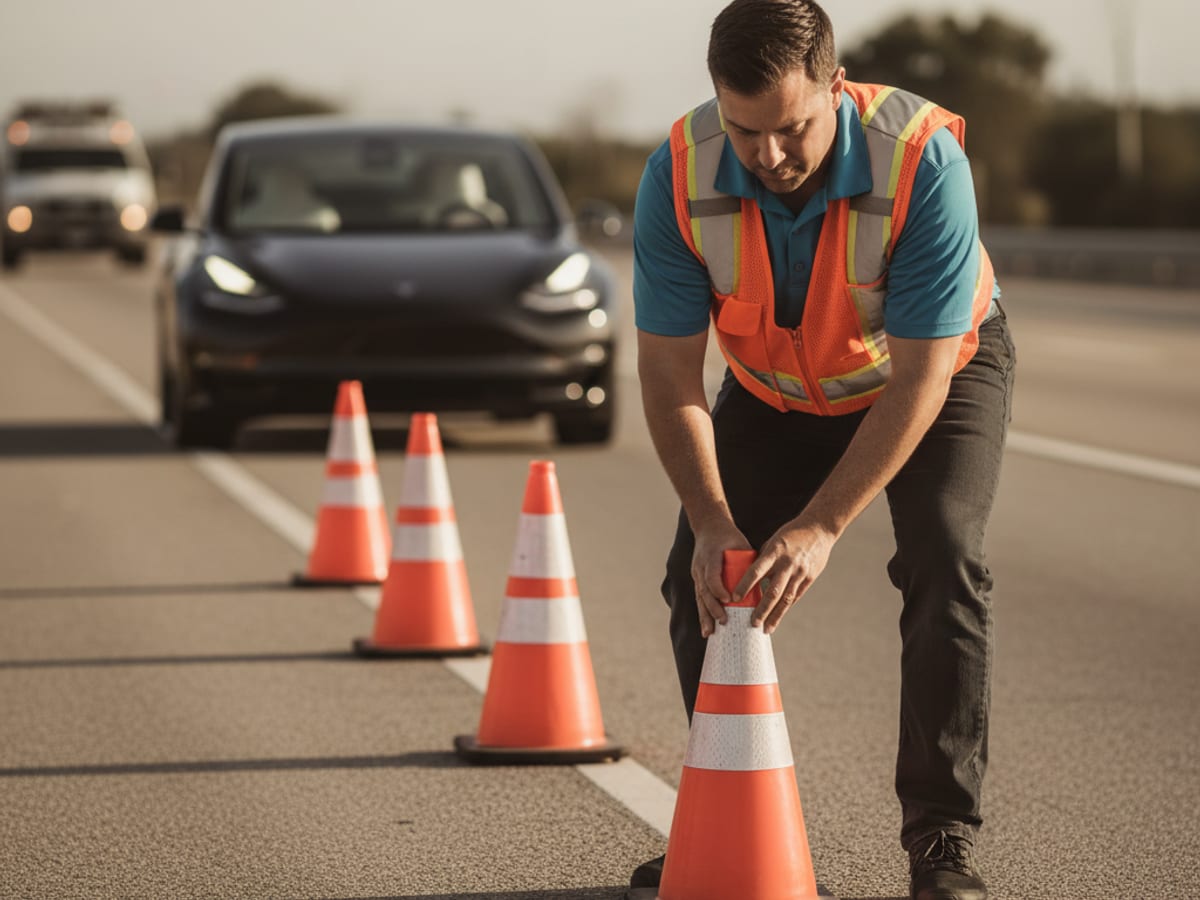
The pro who shows up brings a 240-volt Level 2 source. Teslas take a native NACS plug. CCS and J1772 cars use an adapter. Operators in this network handle Tesla and every major EV brand. This isn’t DC fast charging on the shoulder. It’s AC, in the same family as a home wall charger.
Charging for 15 to 30 minutes typically adds 10 to 20 miles. That’s charging time only. It isn’t an arrival time. Charge Pro IE doesn’t promise when someone shows. The operator quotes you before the cable goes in. The operator bills you directly.
Ten to twenty miles won’t redo your whole day. It can get you off the 91. Roll to a charger you’ve already confirmed in an app. It can get you home if home was already close. What a mobile EV charging visit actually is: a top-up so you can roll.
Drivers stuck on this freeway through Corona use the same matching path. The Corona 91 roadside page covers that stretch.
Three facts the operator needs
You’re on SR-91. Say eastbound or westbound. Give the nearest exit name or mile marker you can still read.
Then the car. Year, make, model. A Tesla Model 3, a Rivian R1S, a Ford Lightning, an Ioniq 5, a Mach-E. The plug changes with the car.
Then the state of the car. Pack empty only, or 12V dark too. Any warning lights. Any contact with another vehicle or a wall. That’s how the operator brings the right adapter in the right direction.
Charge Pro IE doesn’t perform the work. It’s a referral line. It owns no trucks, no yard, and no parts inventory. It connects stranded drivers with independent mobile rescue operators across the Inland Empire. Corona’s ACS 2019-2023 population is 159,670. The 2024 Census estimate is 161,540. Southern California Edison serves Corona. If you live inside the City of Riverside, your utility isn’t Edison. Riverside Public Utilities has served homes there since 1895. Riverside’s ACS 2019-2023 population is 319,069. None of that changes the shoulder. It does change which utility you plug into overnight once you’re off the freeway.
After you can roll again
Charge before you add errands. The dash range guess looked fine when you entered the 91. Heat, grades, and climate all make that guess look too kind. Inland Empire heat is hard on a pack that started the day already thin. Read up on battery care once you’re home, not while you’re still on the shoulder.
Next time you see a low-mile warning on this corridor, exit. Charge while you still can. Don’t keep the cabin ice-cold and hope the next city limit saves you.
If you’re already stopped on the 91 with an empty pack, call (909) 250-2881. Charge Pro IE will match you with a local operator. That operator tells you whether a Level 2 top-up fits. If you need a flatbed instead, they’ll say so.