A gas work truck that won’t crank at a Fontana warehouse isn’t a Tesla problem. Clamping your Tesla onto that truck can turn it into one. The truck wants a starter spike. Your Tesla 12V isn’t built to give it. That’s the whole risk in one sentence.
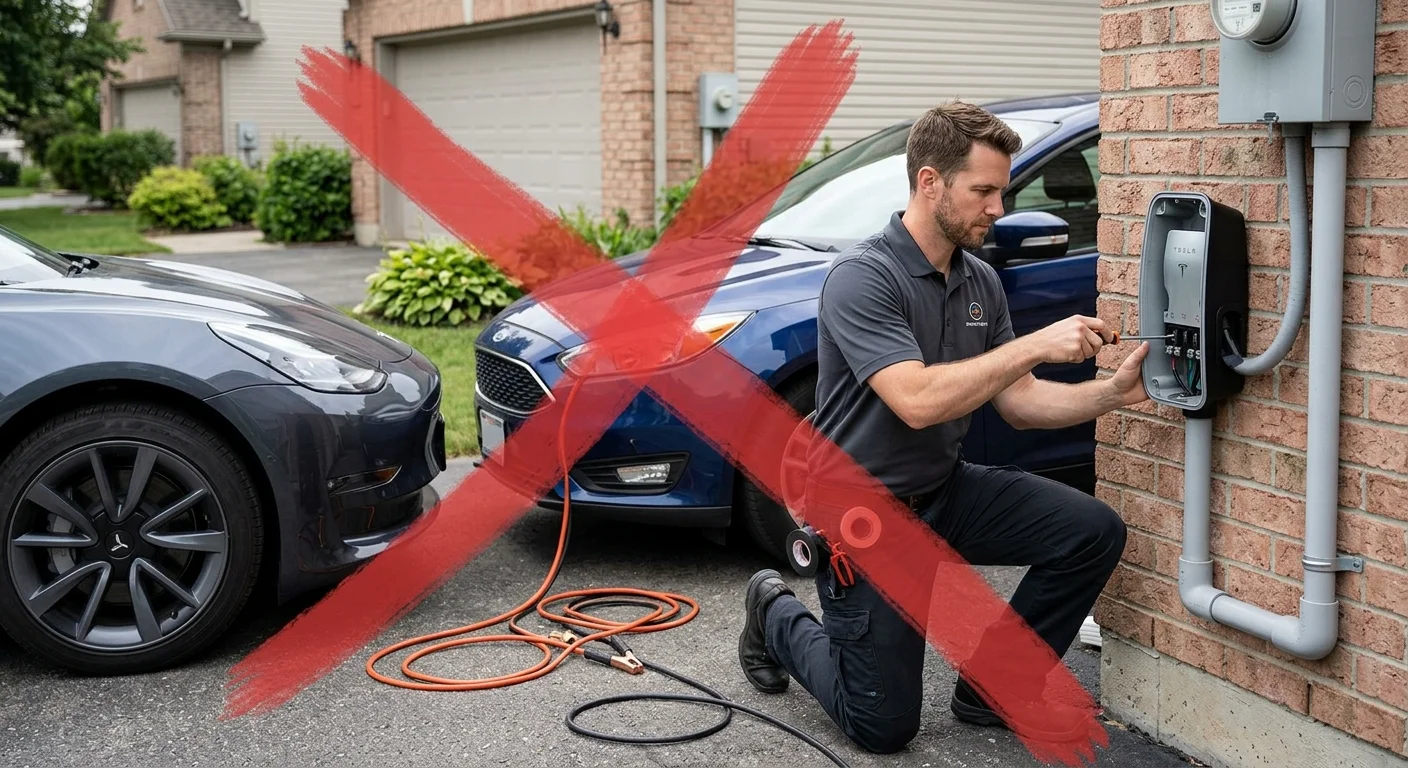
The Tesla 12V isn’t a donor battery
Teslas still carry a small 12-volt battery. It runs locks, screens, lights, and the contactors that wake the pack. When that 12V dies, the car can look fully dead. Start with the safe jump steps for a Model 3, Y, S, or X. That’s receiving a jump. It’s the direction Tesla designed.
Giving a jump is the opposite job. A gas truck’s starter yanks a short, heavy burst to spin a cold engine. A Tesla 12V circuit feeds Tesla electronics. The high-voltage pack tops up that 12V through a DC-DC converter. That converter isn’t an alternator. It doesn’t exist to crank someone else’s pistons.
The truck’s 12V is there to spin a starter. The Tesla’s 12V is there to keep modules and contactors alive. Sharing cables pretends those jobs are the same. They’re not. Can a Tesla jump-start another car? hits the same limit. Your car can take a 12V boost. It isn’t a booster pack on wheels.
A work truck is a harder pull than a sedan
Cables between two passenger cars are already a bad match for a Tesla. A work truck is worse. Starters on those trucks are sized for a large engine. They’re not sized for a Model 3’s 12V circuit.
You’ll see that mix all over inland freight lots. Fontana warehouse rows park Teslas next to gas fleet trucks. Ontario airport lots do the same. Eastvale and Jurupa Valley commuters roll into those lots every morning. Shift change is when the truck that’s sat all day fails to crank. Heat in those lots cooks a weak 12V. The starter still wants its spike. Your Tesla’s converter sees a sudden load it wasn’t sized for.
A heat-soaked truck battery makes the draw uglier. It wants more current before the engine catches. Your Tesla has no way to meter that. Jumper cables are a hard connection. You’re not sharing a trickle of current. You’re asking Tesla low-voltage gear to do a gas-engine job. Those designs don’t overlap.
What can fail on your Tesla
A fuse can open first. The DC-DC converter can take the hit next. Control modules that share that 12V rail can get stressed too. None of this comes with a friendly alert that says stop.
The truck may fire. It may not. Your Tesla can go dark either way. Handles, screens, and pack contactors all ride that same small battery. If it drops, you’re the stranded EV in the same row.
After a bad clamp you might see a low-voltage warning. Don’t keep retrying the cables. Each extra attempt is another load on a system that’s already unhappy.
We can’t publish a repair figure. Tesla Service quotes parts and labor locally, and those quotes move. A two-minute favor can leave your own car dead beside the truck.
Warranty coverage is another gap we won’t fill with a guess. We can’t confirm Tesla will deny a claim. We can’t confirm Tesla will pay for damage from donor use either. Tesla’s manuals walk you through receiving a 12V jump. They don’t walk you through giving one. If a converter fails after that clamp, you’re in a misuse argument. That’s Tesla Service’s call, not ours.
What Tesla’s manuals actually cover
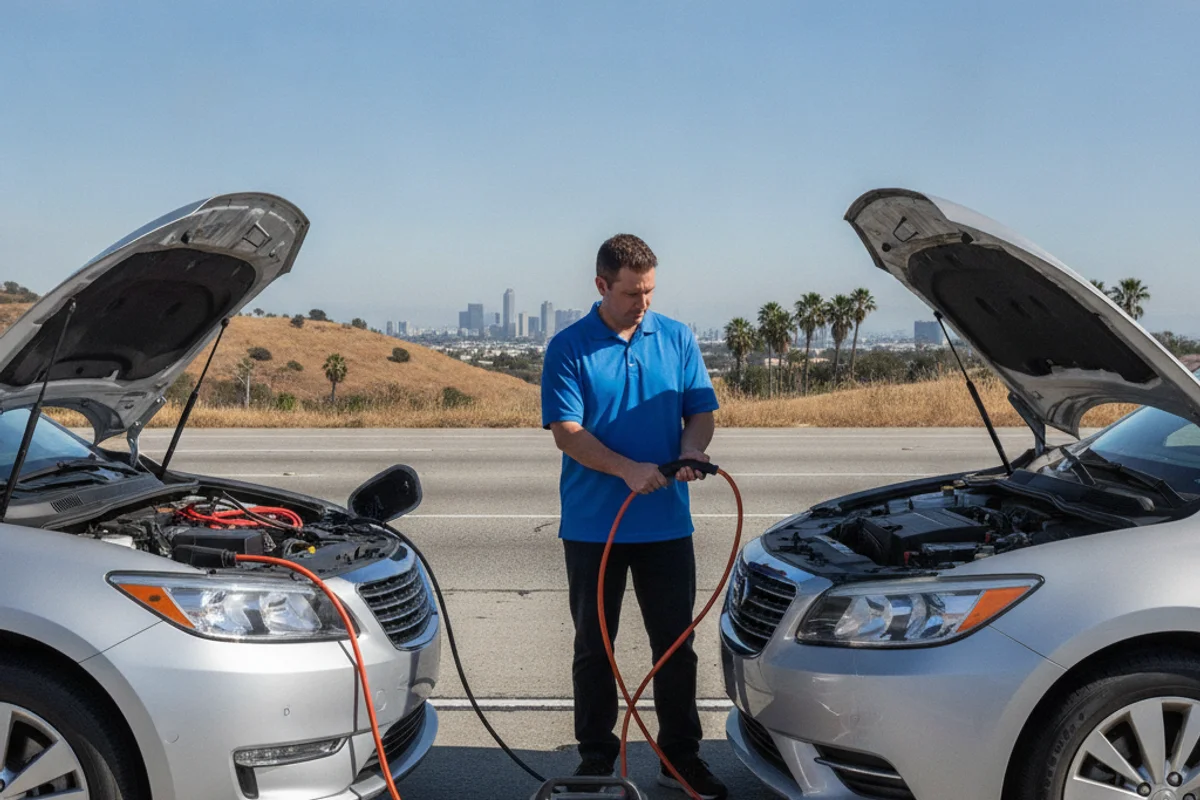
Open the manual for your model and year. Tesla tells you how to jump the Tesla 12V. That’s for when the small battery is dead. Tesla doesn’t give booster steps for a gas engine.
That silence is the policy. If Tesla wanted that clamp, the steps would be in the book. They’re not. Can an EV jump-start a gas car? covers the same physics on other brands. Tesla owners just hit this question more often in this market.
Model 3, Y, S, X, and Cybertruck all still depend on that low-voltage battery. Newer lithium 12V packs aren’t a jump box for a gas work truck. Stay on the receive side of the cables. Don’t push current the other way.
Where the favor shows up inland
Ontario airport lots mix Teslas with gas fleet trucks every morning. Fontana’s warehouse grid does the same after a long shift. Bloomington and Chino work lots see it at shift change. A truck that’s sat in heat often won’t turn over. Rialto and San Bernardino valley yards see the same pairing. That’s along the I-10 and I-215 freight spine.
Someone asks if you’ve got cables. Your Model Y is right there. That’s the moment to say no.
If the dead car is the Tesla, the job flips. A Tesla 12V battery jump from a local operator feeds current into the Tesla. That’s the direction the 12V system can accept. If the pack is empty instead, jumper cables won’t help. That’s mobile EV charging, a 240-volt Level 2 hookup at the car.
EV rescue around Ontario airport lots and warehouse rows is that pack-empty case, not a gas-truck jump. Don’t mix the failures. A dark Tesla can be 12V or pack. A dark gas truck is almost always its own 12V and starter.
A dead EV by a Fontana warehouse is the same split. Confirm what’s actually dead before anyone clips a cable. Screens that never woke point at 12V. A car that drove in, then sat to empty, points at the pack.
Better ways to help the truck
Leave the Tesla out of the circuit. Help the truck with gear meant for gas starters.
A portable lithium jump pack is the clean option. It’s built to crank an engine. It never touches your Tesla’s converter. Keep one in the glovebox if you share lots with fleet trucks.
Another gas vehicle is the old method. Positive to positive on the batteries. Negative to a solid ground on the dead truck. Your Tesla stays parked and asleep.
Conventional roadside for the truck is the third path. Insurance, a club plan, or a standard jump service can bring a pack. That’s their equipment. It isn’t your EV’s 12V rail.
Don’t jump the Tesla from the truck you just loaded. The truck’s battery was already the failure. It isn’t a clean donor for Tesla electronics.
If your Tesla is the one that won’t wake, use Tesla’s receive-a-jump steps. Or call for a 12V operator. Charge Pro IE is a referral line. We match stranded EV drivers with independent local operators. The pros we connect you with are licensed and insured. Those operators jump or replace a dead 12V on site. They also bring a 240-volt Level 2 source when the pack is empty. They use a native NACS plug. CCS or J1772 adapters cover non-Tesla EVs. Typical charging time is 15 to 30 minutes. That usually adds about 10 to 20 miles of range. That’s charging time on the car, never an arrival time. The operator quotes you before starting and bills you directly.
If your Tesla already went dark
You already clamped on. The truck maybe started. Your Tesla now looks dead. Treat it as a 12V event first. Don’t keep cycling the cables. Don’t try to jump the Tesla from the same truck you just loaded.
Note whether any screen woke, even for a second. Those clues help an operator tell a 12V sag from an empty pack.
A local operator can sort a 12V jump versus a replace on site. Charge Pro IE doesn’t own trucks and doesn’t employ technicians. We connect you. The operator on the other end does the work and sets the price.
Call (909) 250-2881 when you want that match. Have your model and the lot or road you’re on. Say whether any screens woke. That helps the operator quote the right job.
Frequently asked questions
What are the risks of using a Tesla to jump start a gas car?
The Tesla 12V and DC-DC converter aren’t built to crank a combustion starter. A work truck’s starter is a heavy spike. You can open a fuse or stress the converter. Then you’re the stranded car in the warehouse row.
Can jump starting another car damage my Tesla?
Yes. The 12V circuit is sized for Tesla electronics, not for a gas starter. Tesla’s manuals show how to receive a jump, not how to give one. We can’t confirm a repair cost or a warranty outcome here. Tesla Service quotes the parts and decides coverage.
What should I use instead of my Tesla to jump a gas car?
Use a portable jump pack, another gas vehicle, or conventional roadside for the truck. Keep the Tesla out of that circuit. If your own Tesla 12V is dead, ask a local operator for a 12V jump. Don’t reverse-jump from the work truck.