Polestar roadside assistance in the Inland Empire is the factory line in your app. That dispatch isn’t a 240-volt Level 2 truck. If the high-voltage pack is empty, you still need miles. A local operator quotes a CCS charge at the car.
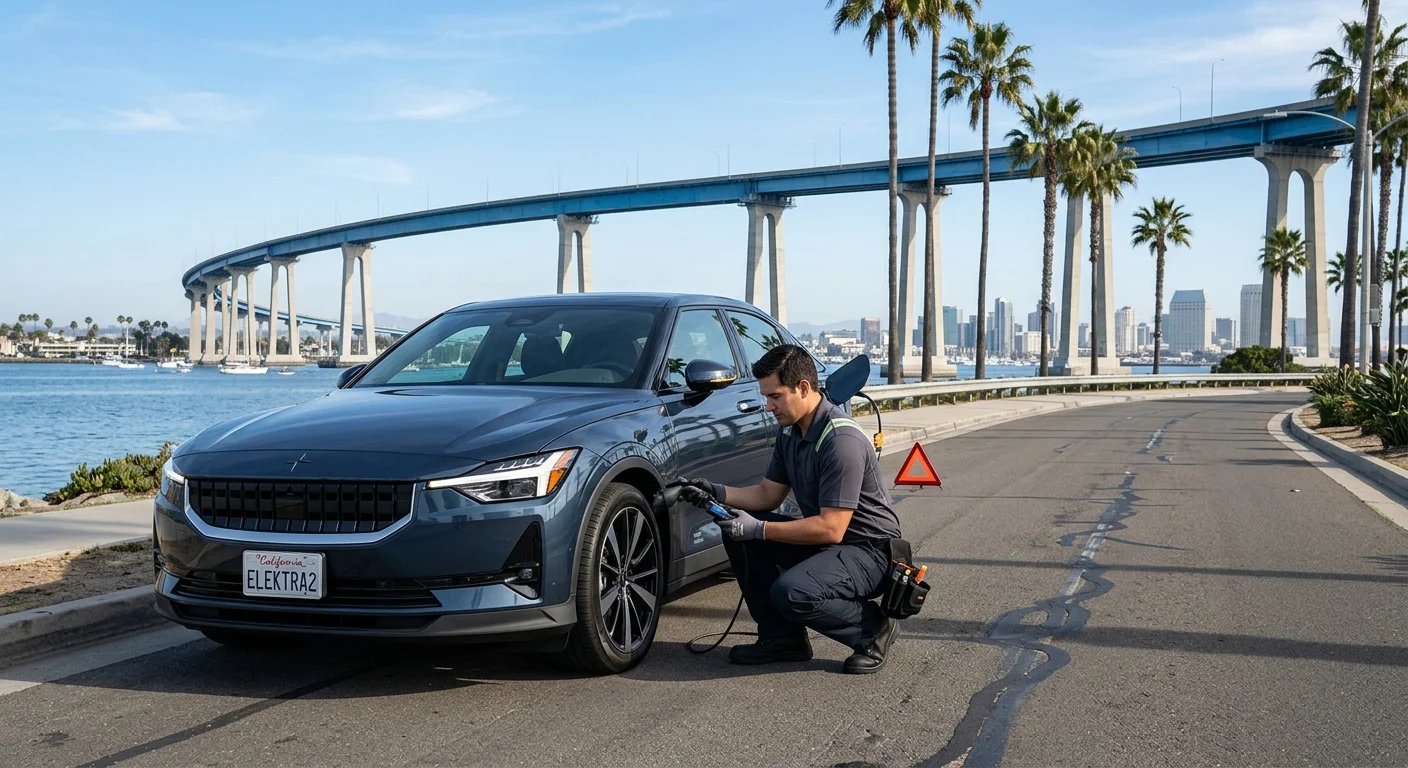
Factory roadside isn’t a Level 2 truck
Polestar’s live roadside menu couldn’t be confirmed for this page. Open the Polestar app, or the packet that came with the car. Read the current list before you assume a truck type. Coverage years, tire rules, and tow distance change. This page won’t invent them.
What we can say inland is practical. Ask what the truck is before it rolls. A jump, a tire change, and a tow are common roadside tools. A 240-volt CCS plant on a truck isn’t in that kit. A published list of Inland Empire Polestar service points couldn’t be confirmed here either. Ask Polestar Support which site they’d send you to. Do that before you accept a hook.
A mobile EV charging visit is a different job. The operators Charge Pro IE connects you with bring a 240-volt Level 2 source. They bring it to the car. They carry a CCS adapter for non-Tesla inlets. That’s the plug a US Polestar uses. They quote before they start. They bill you directly. Charge Pro IE doesn’t own the truck. It doesn’t set the price. It doesn’t promise when anyone arrives.
That CCS session is charging time, never travel time. Operators typically add 10 to 20 miles of range in 15 to 30 minutes of charging. That window is the plug. It isn’t a clock on I-10.
Inland grades drain a Polestar harder than a map suggests
The I-15 climb toward Victorville through Cajon Pass asks more of a pack. A flat Fontana mile doesn’t. I-10 through Colton and Redlands into Banning does the same on a hot afternoon. So does the Ortega Highway near Wildomar. SR-60 through Jurupa Valley stacks traffic on a grade. The 91 through Corona does it with brake lights.
Cabin cooling in inland heat pulls energy a mild evening wouldn’t. Drive a Polestar 2 from Ontario warehouse rows out toward Hesperia and you feel it. Coming down from Lake Arrowhead or Big Bear Lake is the easy half. The return climb is where the estimate gets honest.
This page won’t claim a named lot or stretch has no public plug. It won’t guess the next stall either. Once the car is sitting, the real choice is a CCS charge on site or a factory tow.
Non-Tesla EV rescue is the CCS path. Polestar sits there with Ford, Hyundai, Kia, and the rest of the CCS and J1772 fleet. The operator seats the CCS adapter. That’s the inlet your Polestar expects.
A public stall that says connected but won’t charge is a separate problem. You already found a plug. The car still won’t take power. Factory roadside might still answer with a tow. Ask them. A local Level 2 visit is the other quote.
Your utility won’t roll a rescue truck
Southern California Edison serves most inland cities. That list includes Fontana, Corona, Temecula, Menifee, Upland, and San Bernardino. Riverside isn’t on it. Riverside Public Utilities has served the city since 1895. Colton owns the electrical infrastructure inside city limits. Banning runs a city electric utility. Big Bear Lake and Big Bear City sit on Bear Valley Electric Service. Moreno Valley and Rancho Cucamonga are split. SCE covers most of each city, plus a municipal pocket.
Victorville residential power is SCE. The city’s municipal utility serves only the Southern California Logistics Airport and Foxborough Industrial Park. It doesn’t serve homes. A Polestar in a Victorville driveway is still on SCE. A Polestar that died on the Cajon climb is still a CCS problem, not a utility dispatch.
None of those utilities sends a Level 2 truck to a stranded Polestar. They sell power to a meter. They don’t meet you on I-215 through Moreno Valley. They don’t meet you in a Rialto warehouse aisle. If the wall box at home is dark, that’s a panel and a utility problem. The car on the shoulder is still a CCS charge or a 12-volt jump.
A dead 12V looks like a dead Polestar
If the dash stays dark with a healthy pack, start with the 12-volt battery. That small battery wakes the computers. It also closes the high-voltage contactors. When it sags, locks, screens, and the ready state all fail. The propulsion pack can still be full.
Jump-point steps belong in the owner’s manual, not in a guess on a blog. If you don’t have the manual, wait for the operator. For the Polestar 2 sequence we already published, read Polestar 2 won’t start: the 12V fix to try first.
Operators we connect you with jump or replace a dead 12V on site. They handle Tesla and every major EV brand, Polestar included. If the 12V takes a charge and then dies again, treat that as a battery at the end of its life. Get it tested. Don’t keep jumping it on the shoulder of the 215.
A 12V failure and an empty pack can look identical from the sidewalk. The tell is the last thing the cluster showed. A shrinking range number points at the pack. A dark car after it sat locked overnight points at 12V. When you can’t tell, say both when you call. The operator on site can sort it.
What the CCS visit actually puts in the car
What a mobile EV charging visit actually is, and isn’t is the fuller walkthrough. Short version: the operator parks, confirms the quote, seats a CCS adapter, and runs Level 2 into the inlet. You’re not getting a DC fast-charge stall on a truck. You’re getting enough miles to roll to a public CCS site, or home if that’s closer.
What’s actually on a mobile EV charger truck at the roadside covers the gear. Native NACS on the truck side is common. CCS or J1772 adapters cover Polestar and the rest of the non-Tesla fleet. The operator, not Charge Pro IE, sets the price. Charge Pro IE is a referral line. It matches stranded EV drivers with independent local mobile rescue operators. It holds no license, owns no equipment, and employs no technicians.
Warehouse rows around Ontario airport, downtown Riverside lots, and wine-country miles out of Temecula and Murrieta are the same mechanical problem. A CCS car won’t move. The operator quotes. You accept or you decline.
Eastvale’s new streets and a Chino Hills hillside driveway don’t change the plug. Hemet in-town miles and a Perris I-215 shoulder don’t either. Non-Tesla EV rescue in the Inland Empire: who helps CCS and J1772 walks the CCS and J1772 case if your household also has a Kia, a Ford, or a Hyundai.
Call Polestar first, then decide if you still need CCS
If the car still talks to the app, start with Polestar Support. Ask what they’ll actually send. If they offer a tow, ask where it goes. If they offer a jump, ask whether the person they send has EV 12V procedures. If the pack is empty and you need miles, say that in one sentence. Factory roadside isn’t a Level 2 CCS truck just because you asked for one.
If you want that on-site quote instead, Charge Pro IE serves the Inland Empire. Call (909) 250-2881. The operator quotes before starting and bills you directly. No arrival window is published here, because Charge Pro IE doesn’t control the truck.