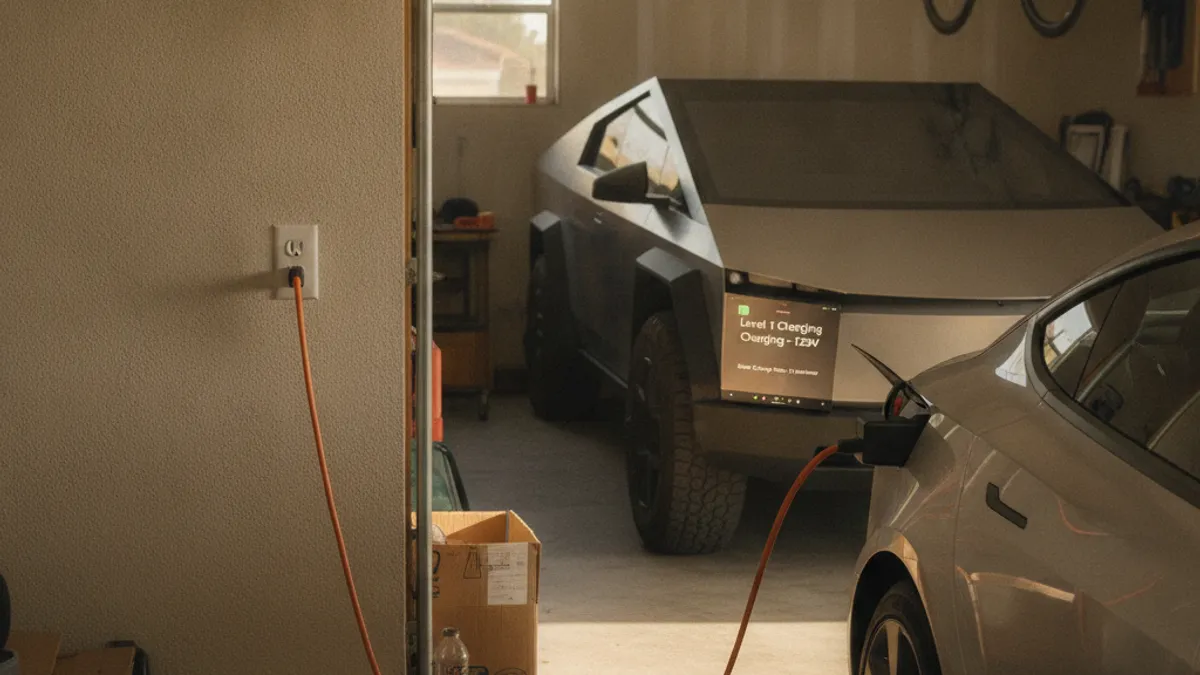
A Level 1 EV charger is the 120-volt cord in your trunk. You plug it into a regular household wall outlet. It adds about 3 to 5 miles of range per hour. That’s too slow for inland heat and highway grades. A wall outlet won’t save a car that’s already stranded.
What that trunk cord actually does
You’re not shopping for a separate Level 1 box. Almost every new EV already ships with the cable. One end fits the charge port on the car. The other end is a standard household plug. Some kits add a dryer-style 240-volt adapter. That’s a slow 240-volt hookup, not Level 1. Check the owner’s manual for the adapters you got.
The 120-volt cord doesn’t need panel work. A household lamp circuit can only push so much power. From near empty, a full Level 1 charge can take two to three days.
Why inland miles outrun a wall outlet
Inland Empire driving isn’t a flat neighborhood loop. The Cajon climb on I-15 toward Victorville works the motor hard. So does I-10 through Colton and Redlands toward Beaumont. SR-60 through Jurupa Valley stacks that load in traffic. The 91 through Corona does the same on hot afternoons. Cabin cooling pulls from the pack while you sit there.
A night on a 120-volt outlet can cover a short local day. It won’t cover a High Desert loop through Hesperia or Adelanto. It won’t cover a mountain run toward Lake Arrowhead or Big Bear Lake. Skip one overnight plug, and you’re already behind. That same outlet has no fast way to catch up. We cover inland heat and grades in our battery care guide.
Older outlets and newer streets still share 120 volts
San Bernardino County’s housing is older than Riverside County’s. ACS 2019-2023 figures put 43.8% of San Bernardino County homes as built before 1980. Riverside County sits at 30.2% on the same vintage. In the city of San Bernardino, 60.9% of units predate 1980. Ontario is 50.7%, Riverside city is 56.4%, and Montclair is 68.5%.
Those older garage outlets may share a circuit with a fridge or freezer. A Level 1 cord on a shared outlet can stop if the breaker opens. Eastvale and Temecula skew newer, at 2.2% and 6.5% pre-1980. A new wall outlet is still 120 volts. New drywall doesn’t make Level 1 any faster.
If you charge every night, plug straight into the wall. Skip extension cords and power strips, as your owner’s manual will say. A dedicated circuit helps, and a shared one doesn’t. A 240-volt home setup is a different circuit, not a better lamp outlet. We walk through that split in home 240-volt charging versus roadside Level 2.
Who supplies that home power isn’t the same everywhere. Southern California Edison covers most of the Inland Empire. Riverside Public Utilities serves the city of Riverside. Colton Electric Utility owns the system inside Colton. Banning has its own municipal electric utility. Bear Valley Electric Service covers Big Bear Lake and Big Bear City. Rancho Cucamonga and Moreno Valley are split, with municipal pockets beside SCE. None of that changes the 120-volt math on a wall outlet.
When the wall outlet is still useful
Level 1 isn’t junk if your day stays short. It can cover a short daily loop if you plug in all night. Plug-in hybrids have smaller packs than a full EV. They often top off on the same household cord. A work car in a Fontana warehouse lot may sit all day. The next run still needs more than a 120-volt trickle.
Don’t treat it as a rescue tool on I-215 through Moreno Valley. Don’t treat it as a rescue tool on the Ortega near Wildomar. You can’t wait on a household outlet for hours on the shoulder.
What operators bring instead of 120 volts
Charge Pro IE is a referral line for stranded EV drivers. We match you with independent local mobile rescue operators. We don’t own trucks, and we don’t run a yard. The operator brings a 240-volt Level 2 source to the car. A Tesla takes a native NACS plug, and other EVs use CCS or J1772.
That visit is charging time, not a clock on arrival. Operators typically add 10 to 20 miles in 15 to 30 minutes of charging. That’s enough to roll toward your next stop. A wall outlet’s 3 to 5 miles per hour can’t do that on a stall.
If the dash is dark, start with the 12-volt battery, not the pack. Operators can jump or replace a dead 12V on site. They handle Tesla and every major EV brand. For the visit itself, read how a mobile charging visit works. For charger levels while you’re already stuck, see charging levels when you’re stranded.
A dark home charger is a separate problem from a stall. See older Inland Empire panels and EV chargers. A mobile charge is for the car that’s already sitting.
If the pack is already empty
Stay with the car if you’re on a freeway shoulder. Call for a mobile charge instead of leaving the car. Mobile EV charging is the service for an empty traction pack. The operator quotes you before starting, then bills you directly. Charge Pro IE doesn’t set the price they quote. The operator who takes the job is the one who does the work.
Frequently asked questions
How many miles per hour does a Level 1 EV charger add?
About 3 to 5 miles of range per hour, depending on the car. From near empty, a full charge can take two to three days.
Is a Level 1 charger enough for Inland Empire driving?
It can cover a short local day with a full night on the outlet. Heat, Cajon grades, and mountain miles usually spend more than that trickle returns.
What’s the difference between Level 1 and Level 2?
Level 1 is a 120-volt wall outlet and the cord in your trunk. Level 2 is 240 volts, and operators bring it to a stranded car. They typically add 10 to 20 miles in 15 to 30 minutes of charging.
If a slow wall outlet left you short, call (909) 250-2881. We’ll connect you with a local operator.