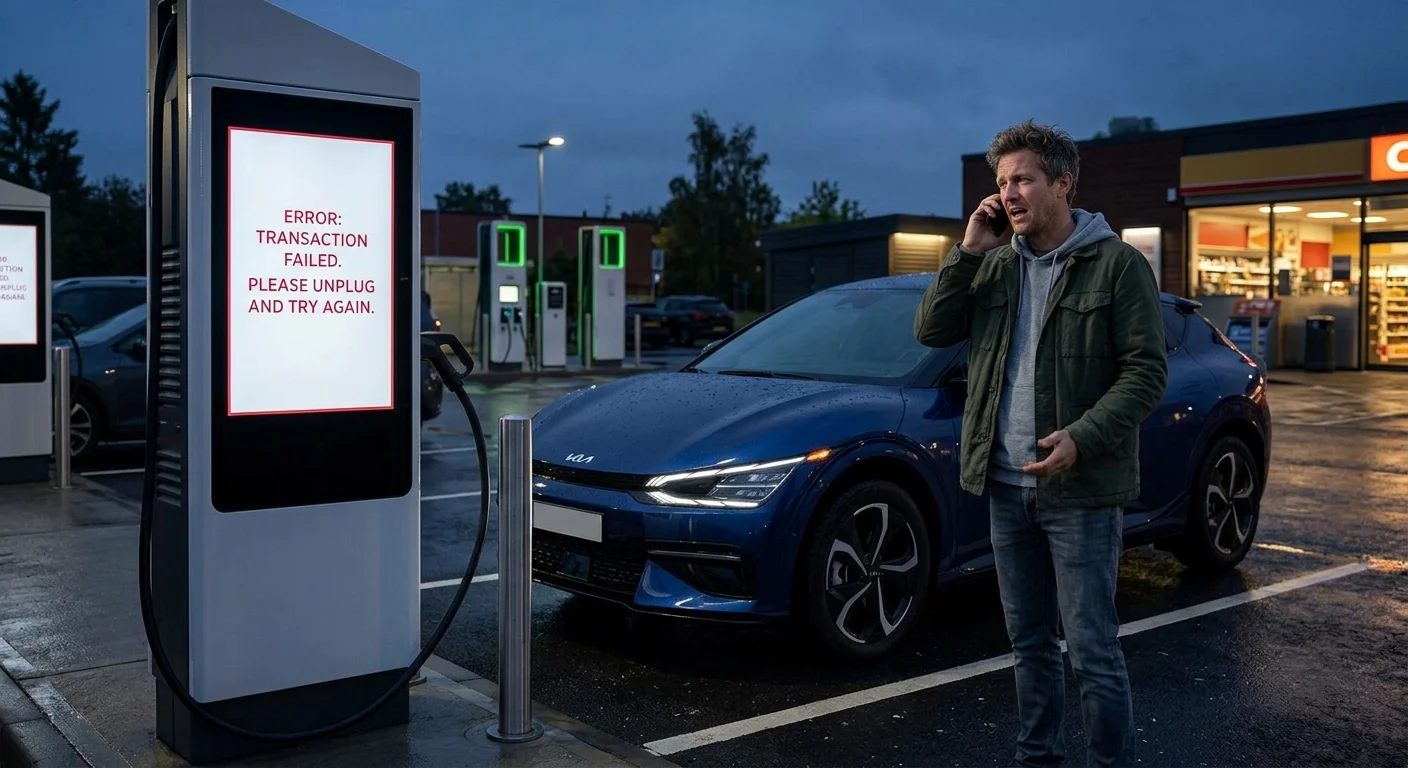
Your Kia EV6 is on a CCS stall and it won’t take a charge. Across the Inland Empire valleys, that fault often isn’t a dead pack. The post failed the handshake, or the 12V never woke the car. Check the plug lock and a second stall. Then check the 12V before you assume the traction battery is empty.
Why valley CCS posts make an EV6 look dead
The EV6 takes DC on a CCS connector. The stall and the car have to agree first. When that handshake fails, the session never starts. The dash can freeze, and the port can stay silent. From the sidewalk it looks like a brick.
It often isn’t a dead traction pack at all. A dirty pin or a payment glitch can dump the handshake. A stalled session timer can do the same. So can a 12V that’s too low to run the charge computer. The traction pack can still hold range you can’t see.
Heat along I-10 through Colton and Redlands makes this worse to read. The battery-management system can slow or stop a session to protect the pack. That’s a safety choice, not a failed pack. The EV6 still needs a live 12V to show you that choice.
The same pattern shows up on I-215 through Moreno Valley and Perris. It shows up on the 60 through Jurupa Valley. It shows up on the 91 through Corona. One CCS island and one bad stall can make the EV6 look done.
If home Level 2 still works later, the pack was never empty. The DC stall was. Keep that split in mind before you call a tow.
Walk the stall before you blame the car
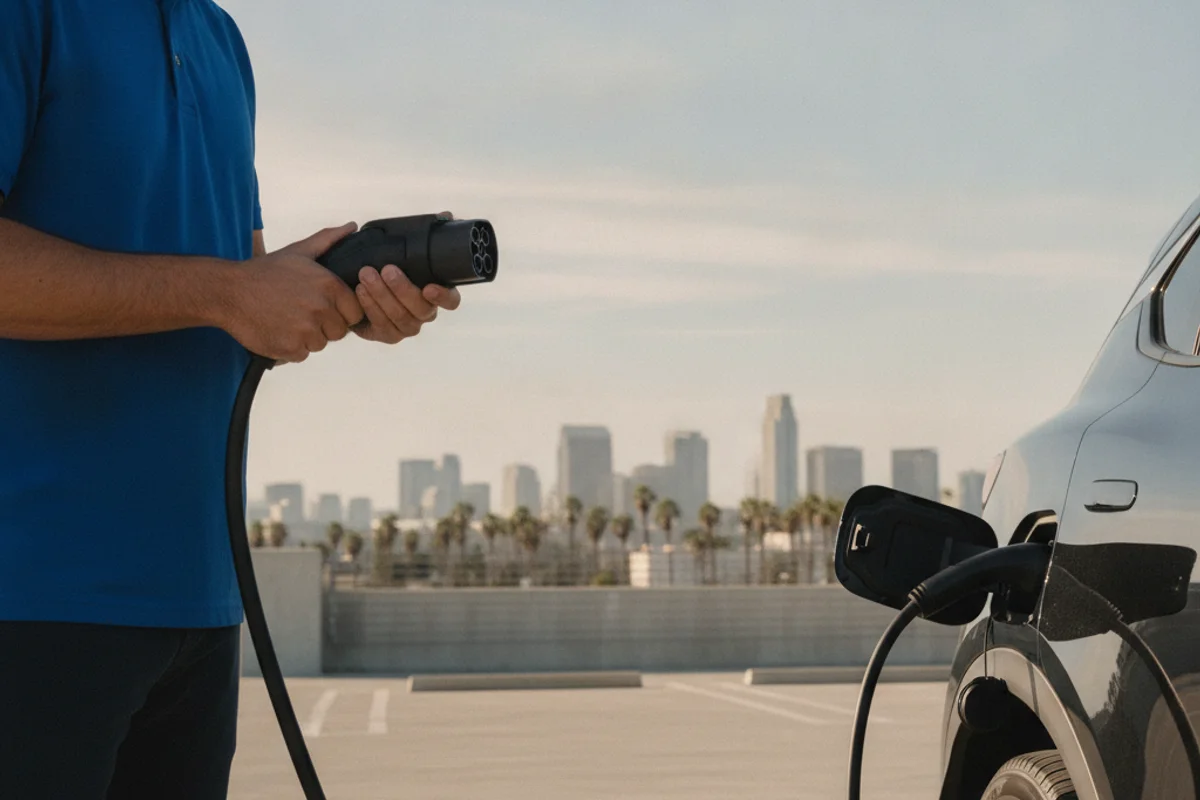
Park so the cable reaches without a side load. Open the charge door all the way first. Push the CCS handle in until it locks. A half-seat is a common miss on this port. The EV6 won’t start a session on a loose pin.
Then look at the stall, not at the car. A dark stall screen is a station problem. An error on the screen is the station. A payment loop that never finishes is the station. Move one stall over before you blame the EV6.
If the second stall fails, try a different network already in sight. Don’t plan a long hop on a car that won’t charge. Stay where you already parked, and stay safe. A charger that says connected but never charges is usually the post. The EV6 itself can still be fine on a good stall.
Fontana warehouse rows and Ontario airport lots stack this traffic at shift change. One failed CCS handle can burn a whole lunch break. Then the car’s still on the same painted stall. That’s a stall problem until a second post proves otherwise.
Dust from those lots also fouls CCS pins. Irrigation overspray in office parks does the same. Wipe the port dry and look for bent pins. Don’t jam a wet CCS handle home and hope.
If the cable won’t release later, stop pulling. Use the EV6 manual release with a calm hand. Forcing the latch is how charge ports break.
Home Level 2 that sits there and does nothing
Public CCS isn’t the only no-charge story here. The EV6 will sit on a garage Level 2 and wait on purpose. A schedule or a charge cap can look like a failure. Open the charge menu and set it to charge now. Confirm the charge limit isn’t already met.
Most valley cities sit on Southern California Edison. Fontana, Ontario, Corona, and Temecula are on that list. Riverside isn’t on SCE for city homes. Riverside Public Utilities has run that city grid since 1895. Colton owns its electric system inside city limits. Moreno Valley splits SCE and Moreno Valley Utility on newer tracts. Rancho Cucamonga splits SCE and a municipal pocket that includes Victoria Gardens. Your utility name doesn’t charge the car by itself. It does explain a timer you set for off-peak hours.
If you’re on SCE’s TOU-D-PRIME plan, the EV6 may wait for off-peak. That’s a setting, not a hardware fault. Turn the schedule off and retry the plug. Riverside’s EV rate has its own off-peak window. Don’t copy a neighbor’s SCE menu if you’re on RPU.
A tripped breaker is the other home miss. Walk to the panel and find the charger circuit. If that breaker is off, reset it once. If it trips again, stop and leave it off. That’s load or wiring, not a stubborn EV6. Older Inland Empire panels trip this way first.
Housing age isn’t the same in every city. ACS 2019-2023 puts 60.9% of San Bernardino housing before 1980. Riverside city is 56.4% on that same vintage. Ontario is 50.7%, and Upland is 55.9%. Eastvale is 2.2% pre-1980 on that vintage. French Valley is 2.3%, and Temecula is 6.5%. A 1970s San Bernardino panel and a new Eastvale garage aren’t the same circuit. Don’t borrow a fix from a different city’s housing stock.
The 12V that keeps the CCS talk from starting
The big pack is what moves the car. The 12V runs the computers that manage charging. Those computers have to greet a CCS stall. If the 12V is low, the EV6 won’t wake. The port may not unlock, and the dash may stay black. That’s what a dead EV 12V looks like.
Flickering interior lights and a slow center screen are early tells. Door locks that hesitate point the same way. A cable the car never notices does too. Those point at 12V, not an empty traction pack.
A jump on the 12V can restore the handshake. Use a pack meant for a 12-volt system. Clamp only where the EV6 manual shows. Roadside help can jump that 12V. It can’t jump the high-voltage pack at all. If the car wakes and then charges, you’ve found the block. Plan a 12V replacement, because a jump isn’t a repair.
Cajon heat on I-15 toward Victorville cooks a weak 12V. So does I-10 through Beaumont and Banning before the pass. Accessory load on a Lake Arrowhead day trip does the same. The pack can still hold the downhill miles. The 12V may not last that same trip.
Dash lamps you should actually read
Don’t clear a warning and just roll on. Read the message before you unplug anything. A charging error right after one CCS try often names the stall. A check-EV-system style lamp after several stalls points at the car. Your owner’s manual maps each lamp in plain language. Use that page, not a screenshot thread.
Some faults never make a friendly sentence on the dash. An OBD-II reader can pull stored codes. Some parts counters offer a code read. A charger-communication code still needs a real cause. Clearing it without a fix brings the same stall tomorrow.
Lamps that stay after a good 12V jump aren’t a parking-lot project. High-voltage work belongs at a Kia shop. A mobile operator can add enough range to get you there. That’s non-Tesla EV rescue, not a dealer diagnosis.
If home Level 2 works and CCS posts fail, suspect the DC path. That’s a shop visit once you can roll. If neither Level 2 nor CCS works, stay on the 12V checks. A silent dash is still a 12V story until you prove it isn’t.
A 12V reset, only if the manual agrees
A software glitch can freeze a charge session. Disconnecting the 12V can reboot those modules. It’s the same idea as restarting a computer. It won’t rebuild a failed traction pack.
Park on level ground and set the parking brake. Power the EV6 all the way off first. Your manual shows the 12V location for your year. Don’t guess a bay under the hood. Loosen the negative clamp first, every time. Keep that cable from snapping back onto the post. Wait until residual clicks stop, as the manual directs. If you only pulled negative, it goes back last. If you pulled both, positive returns first, then negative. Snug the clamps, then try a charger you already trust.
Skip the reset on a live freeway shoulder. The 91 in Corona and I-215 in Moreno Valley aren’t benches. If terminals look white and crusted, stop there. Call instead of forcing a bad clamp.
When you’re already stuck in the valley
You’ve tried two stalls and the 12V still won’t wake the EV6. Or you’re on a shoulder and can’t reach another CCS post. That’s the moment for a mobile Level 2 visit.
Charge Pro IE is a referral line, not a shop. We match stranded EV drivers with independent local operators. We don’t own trucks, and we don’t employ technicians. We don’t hold a license, and we don’t set the price. The operator quotes you before any work starts. The operator bills you directly after that quote.
The pros we connect you with bring a 240-volt Level 2 source. They use a CCS or J1772 path for non-Tesla cars. A typical session adds about 10 to 20 miles of range. That’s 15 to 30 minutes of charging time. It isn’t an arrival time of any kind. The point is enough range to leave a Fontana warehouse row. A Riverside curb or an I-215 shoulder counts the same.
They can also jump or replace a dead 12V on site. If the EV6 then takes a charge, you drive out. If it still refuses, you’re looking at a shop tow. More CCS retries won’t help a car that won’t wake.
Mobile EV charging is that Level 2 visit, not a high-voltage repair. It isn’t a promise the next valley post will behave. For a map of the roads we serve, start at EV charging across the Inland Empire.
Call when the checks run out
Stop after the stall, the schedule, the breaker, and the 12V. Repeated CCS faults plus a black dash are enough. Don’t keep cycling the same dead post.
Call (909) 250-2881 and we’ll connect you with a local operator. Ask for the quote before they start. Then you decide if you want the work.