If your EV won’t move in Rialto, you need roadside help. Charge Pro IE connects you with independent local operators. They bring a 240-volt Level 2 source to the car. They can also jump or replace a dead 12-volt battery. Rialto sits on the last valley floor before the Cajon climb. A pack that looked fine on Foothill Boulevard can still strand you here.
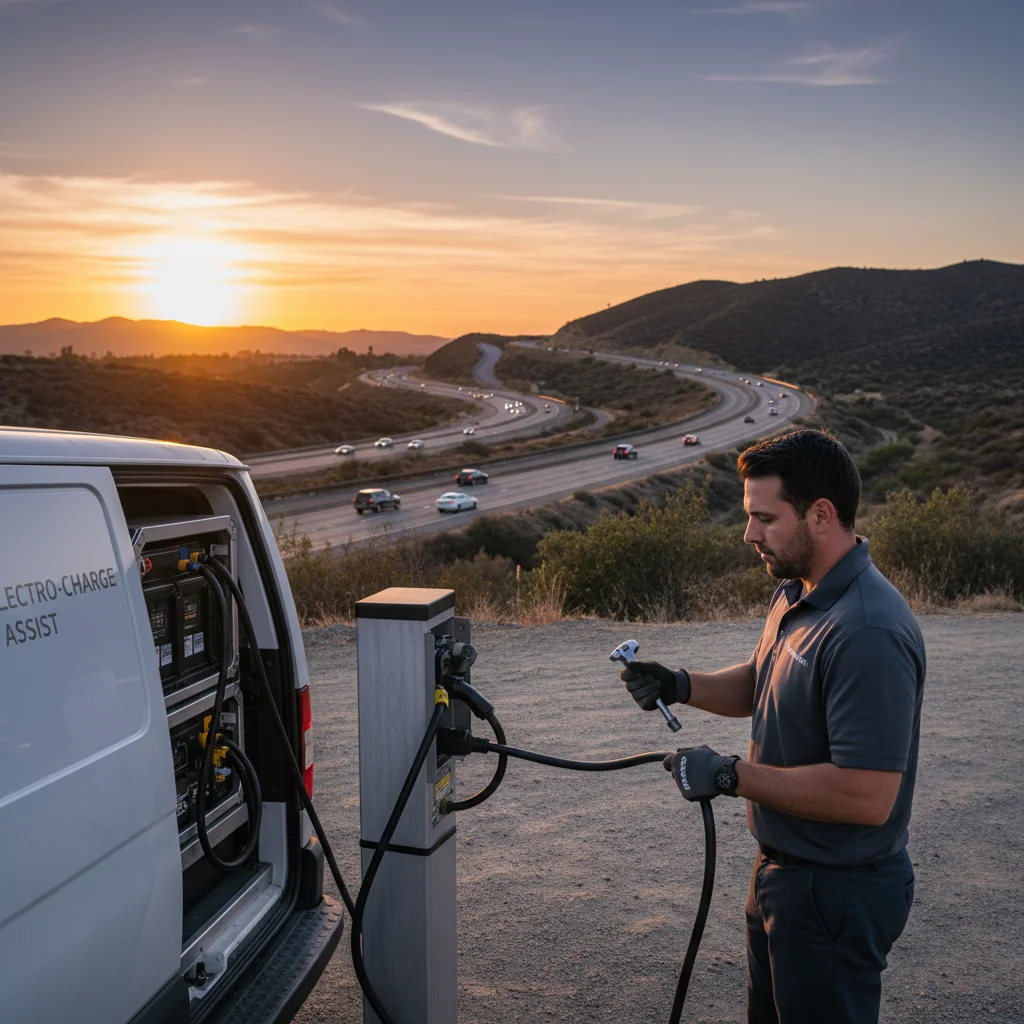
The last flat miles before the Cajon climb
Census ACS 2019-2023 puts Rialto at 104,143 people. It’s a San Bernardino County city on the valley floor. The city covers 24.09 square miles. Fontana sits to the west. San Bernardino sits to the east. Bloomington runs along the southern boundary. Colton and Muscoy close the remaining sides.
This is warehouse country with a working-class residential base. The logistics belt along I-10 and Riverside Avenue runs delivery fleets all day. Behind those yards, the housing is dense. Census figures say 44.9 percent of housing was built before 1980. Recurring calls here are fleet EVs and commuters with no home plug. When the last planned charge doesn’t happen, the car stops on this floor.
North Rialto sits under SR-210 along the foothills. Those blocks pick up a little elevation and a little more wind. Downtown Rialto and the Renaissance area sit on the hotter floor. So does the Foothill Boulevard strip. Summer heat here has no coastal relief. Fontana next door sits in the same heat. Cabin cooling, warehouse idling, and stop-and-go on Baseline Road all tax the pack.
The Cajon climb is the next problem, not a Rialto street. Leave this floor for I-15 toward Victorville and grade starts to eat range. Drivers who meant to add miles before the pass often stall on local ramps. Those ramps are I-10, I-210, and Riverside Avenue. If you’re already on the climb, use this Cajon Pass empty-pack guide.
Census overlap ZIPs for Rialto include 92376 and 92377. Shared codes also spill into Fontana and San Bernardino. A caller might name any of those. That list isn’t a map of the city limit.
Where Rialto EVs actually stall
The city’s own pattern is three places, not a generic inland map.
Warehouse rows on I-10 and Riverside Avenue
Riverside Avenue and the I-10 frontage hold the big distribution yards. So does the Alder Avenue industrial belt. Vans and work EVs sit through a shift. At punch-out the dash is dark or the range is gone. A lot cable that never started will do that. So will a 12-volt that ran accessories all day with the traction pack asleep. Cactus Avenue and Ayala Drive feed those yards from the neighborhoods. If you’re between trailers, stay visible and stay out of truck paths. Give the operator a gate name, a dock number, or the closest cross street.
Long dwell at the Metrolink station
The Rialto Metrolink station is a specific 12-volt trap. Cars park before dawn while owners ride into Los Angeles. The same cars sit until after dark. A 12-volt that was already tired doesn’t like that. The traction pack can still show miles. The car still won’t unlock, wake, or roll. That stall is next to the rails, not on the pass. Bring the year and model when you call. A 12-volt jump is a different kit than a Level 2 cable.
I-10, I-210, and quieter city lots
Shoulder calls stack on I-10, I-210, and the Riverside Avenue interchange. Baseline Road and Foothill Boulevard dump local traffic onto those ramps. If you’re on an active freeway shoulder, stay in the vehicle. Keep the hazards on and don’t walk the lanes. A mile marker or exit name is enough for dispatch. The last cross street works too.
Downtown lots near the historic Rialto Theatre and Fergusson Park look calmer. The car is still stuck. Named public charging sites for Rialto weren’t in the research for this page. This article won’t invent a charger location, a network, or a distance. Check your own charging app for what’s actually online. Then decide whether you can roll there after a short Level 2 visit.
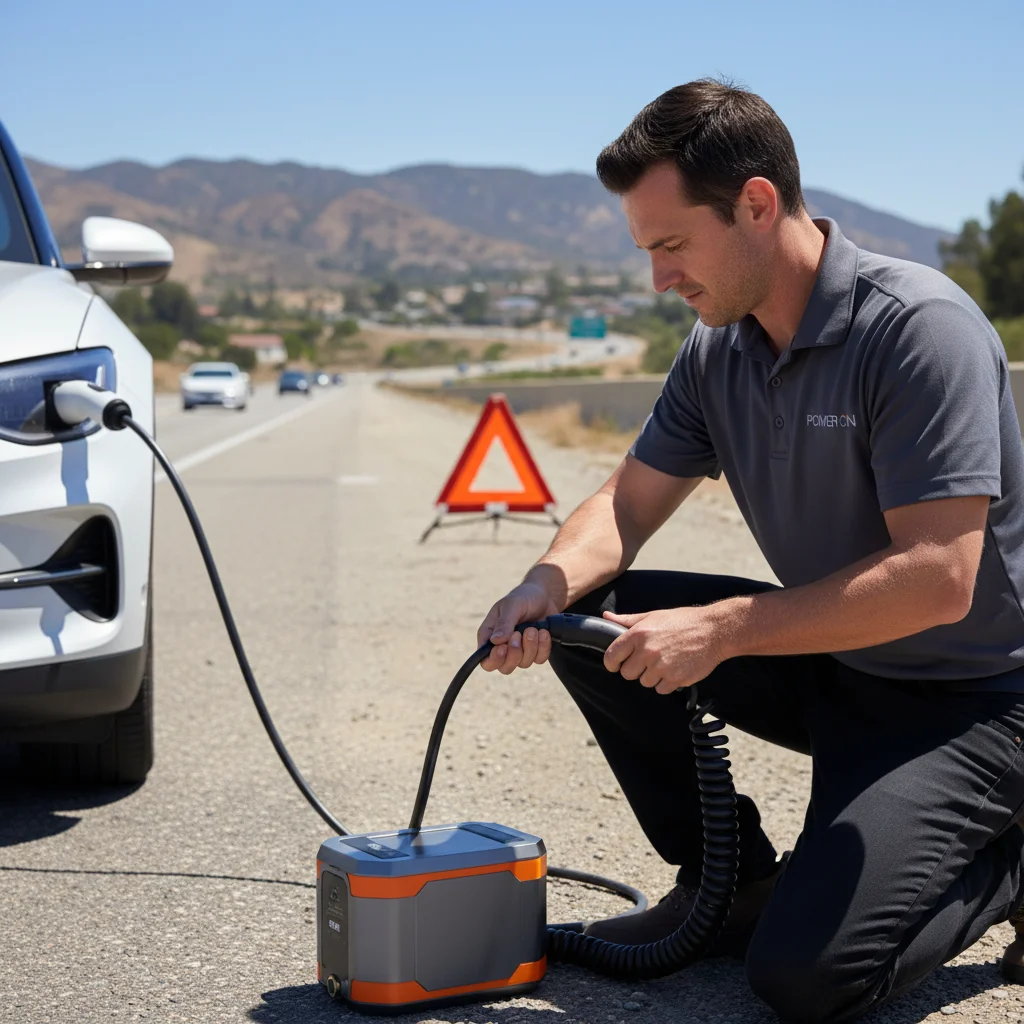
What the operator brings, and what this referral line is
Charge Pro IE doesn’t own trucks, yards, or equipment. It employs no technicians and doesn’t do the work. It’s a referral line for the Inland Empire. Independent operators take the call, quote you before they start, and bill you directly. The pros we connect you with are licensed and insured. They handle Tesla and every major EV brand.
The truck brings a 240-volt Level 2 source. Teslas get a native NACS plug. Other EVs get a CCS or J1772 adapter. The point isn’t a full fill. Typical charging time adds 10 to 20 miles of range. That takes 15 to 30 minutes at the bumper. It isn’t a promise of when the truck arrives.
Those miles are usually enough to leave a warehouse row. They also cover a Metrolink space or a freeway shoulder. You can then reach the charger you already planned to use. What a mobile EV charging visit actually is spells out the limits. The shorter version lives on our mobile EV charging page.
A silent EV is often the 12-volt, not the pack. The small battery runs the computers, locks, and contactors. When it dies, the car looks completely dead. That can happen even with range left in the traction battery. Operators can jump that battery on site. They can replace it when a jump won’t hold. If the dash is dark, start with the 12-volt. The charge port may not open either. Read Tesla 12-volt failure when it hits for the sequence. The same 12-volt logic applies to most other EVs.
Charge Pro IE doesn’t install wall units and doesn’t pull permits. Southern California Edison serves Rialto. A tripped home breaker isn’t a roadside visit. An electrician handles the panel. The operator recovers the car in the driveway, the lot, or the shoulder.
Charge it, jump it, or tow it
If the car will drive once it has power, you want a mobile charge. A 12-volt jump is the other common fix. If a wheel or a port is broken, you want a tow. A damaged drive unit is a tow too. Say what you see on the dash. A dark dash, a zero-mile pack, or a mechanical noise are different jobs.
This page won’t quote a wait or a fee. Charge Pro IE sets neither. The operator gives both numbers before work starts. Mobile charging or a tow is the decision guide without invented prices. Towing a Tesla with no power has its own rules. Drive wheels shouldn’t drag on the pavement. If you already know you need a hook, say that on the phone.
EV roadside assistance here means the rescue. That’s Level 2 at the bumper, or a 12-volt jump. It isn’t a shop repair.
When to call from Rialto
Call when the pack won’t move. Call when the 12-volt won’t wake the car. Call if you’re already on I-10 or I-210. Call from the Metrolink lot if the car sat all day. A fob that does nothing is a 12-volt clue. Call from a Riverside Avenue yard if the van won’t leave the row. Neighboring streets in Fontana, San Bernardino, Bloomington, and Colton are in the same service area. We serve every city in the county.
Have the year, make, and port ready. NACS, CCS, or J1772 is enough. Tell them whether the dash is dark or the range hit zero. Those two facts change what the operator loads.
Charge Pro IE doesn’t publish hours and doesn’t promise arrival. The operator on the line gives you the quote and the plan. For plugs and rescue context in town, use the Rialto EV charging page. If you need the referral line, call (909) 250-2881. An independent operator quotes the visit, then comes to the car.