When your charging plan fails in Ontario, you need EV roadside assistance. Airport parking often kills the 12-volt battery. Warehouse routes often run the traction pack down. Start by reading what the car still shows. Then match the help to that failure, not to a guess.
Airport parking at ONT usually means a dead 12V
Ontario International Airport sits in the City of Ontario, San Bernardino County. It’s the only major airport in this coverage area. The Ontario International Airport Authority reported 7,116,735 passengers in 2025. Cargo hit 835,129 tons the same year. That volume is why this stall keeps repeating.
A traveler parks, flies for a week, and comes back. The dash stays dark and the app stays silent. Door handles may not present. The main pack is often still fine. The 12V quietly died in the heat. Jumping it or replacing it on site is the usual work. A flatbed is what people imagine first.
Free EV charging sits on the south side of Lots 2 and 4. Those premium lots sit in front of the terminals. Parking fees still apply on those stalls. Confirm that on the airport’s current EV FAQ before you rely on it. Port counts, plug types, and the network name couldn’t be confirmed. Check flyontario.com yourself for those details.
A week-long trip isn’t an hour at the terminal curb. Long-stay cars sit in economy surface lots, in the open sun. All ONT lots are surface lots today, per the airport FAQ. There’s no parking garage at this time. A garage is proposed under the ONT BOLD program. Confirm the live parking pages, because layouts change.
The 12V still supports alarms and telematics while you’re gone. Valley-floor heat does the rest. Ontario has no marine influence and no elevation to cool the cabin. Summer afternoons run hot from May through October. A parked EV can look completely dead after seven days.
If the car won’t boot, treat it as a 12V problem first. Tesla owners can start with our Tesla 12V battery jump referral. Other brands fail the same way. Native NACS, CCS, and J1772 cars all use a 12V system.
Tell the operator the lot you can actually see. Name the lot number painted on the signs. Valet sits at the Terminal 2 or Terminal 4 center curb. The Cell Phone Waiting Lot is on John Bangs Drive. Add a dropped pin. Mention a shuttle if you used one. Saying you’re at the airport isn’t a location.
Warehouse fleets run packs down on the clock
The South Ontario industrial belt is the other repeating stall. Guasti and the airport district turn over last-mile vans all day. The rows south of Mission Boulevard do the same. I-10, SR-60, and I-15 to the east box that freight in. The surface grid is Euclid, Archibald, Milliken, Haven, Vineyard, Holt, and Fourth.
Shift changes on Milliken and Haven are stop-and-go. Air conditioning fights the valley floor. Range leaves with time, not only with miles. A route that runs long strands the van at night. The driver meant to plug at the yard. The yard window is gone.
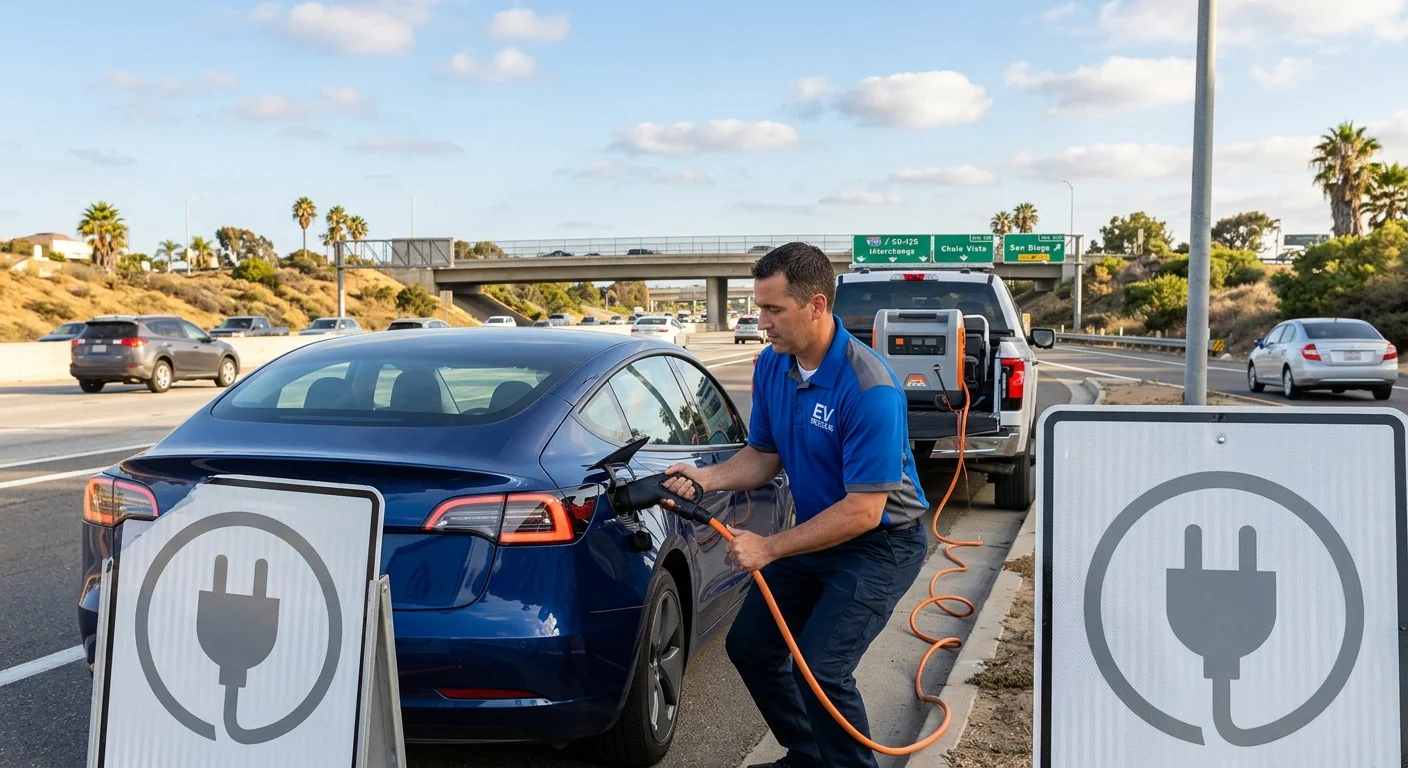
The van may still talk to you. A low percentage isn’t the same as a dark dash. That’s a traction-pack problem. Independent operators can discuss a mobile EV charging visit if the car is reachable. They bring a 240-volt Level 2 source to the vehicle. Tesla gets a native NACS plug. Other EVs use a CCS or J1772 adapter. Typical charging time adds 10 to 20 miles in 15 to 30 minutes. That’s time on the plug, never an arrival time. We don’t promise when an operator gets there.
Don’t assume a mapped charger is reachable from this row. Gates, height bars, and private lots change the math. Verify the live listing in your car or the network app. Then compare that full drive, including the entrance, with the energy still shown. If the margin is too thin, stay put.
For wider EV roadside assistance in this city, use that service page. Then describe the actual warehouse or street.
Holt renters, older houses, and I-10 through-traffic
Ontario isn’t only the airport. Downtown Ontario, the Holt Boulevard corridor, Creekside, Rosewood, and Countryside have older housing. Ontario Ranch is newer and farther south. ACS 2019-2023 data shows 50.7% of housing units were built before 1980. Many of those buildings never got a home EV plug. Renters live on public charging and leave little margin.
Through-drivers on I-10 and SR-60 can lose the plan they started with. A listing can go offline. An entrance can be wrong. Don’t keep rolling toward a pin you haven’t verified today. Check Tesla’s current official tools, or your network’s app, before you move. Charge Pro IE doesn’t run those stations. We don’t confirm Tesla’s listings.
Name nearby landmarks only as location clues. Ontario Mills, Toyota Arena, and the Ontario Convention Center help an operator aim. Euclid Avenue’s historic median is another useful landmark. Neighbors sit close: Montclair, Chino, Rancho Cucamonga, Upland, Fontana, and Eastvale. City limits don’t matter as much as the pin.
Ontario’s electric utility is Southern California Edison. SCE rate names and rebate pages won’t wake a car already stopped. Save that for later if you need a home charger.
First minutes at the car
Park legally and use hazards on a shoulder. If traffic is an immediate danger, call emergency services first. A referral line isn’t a crash response.
Then write down what you can see:
- Brand and model, Tesla or otherwise
- Remaining charge the display still shows
- Exact warning text, copied not rewritten
- Whether the car powers on and shifts
- Whether handles present and the charge port opens
- Whether a cable is stuck or a session never started
- Lot name, gate, height bar, or warehouse access
- The stop you had planned, and whether you verified it today
Don’t force damaged charging gear. Don’t crawl into equipment for a photo. If the operator wants a screenshot, send the full message.
Keep people out of travel lanes. A passenger can read listings. If you’re alone, park first, then use the phone.
Our note on Ontario airport lots and warehouse EV rescue covers these two stalls. When an EV 12V battery dies on the road explains the dark dash.
Stay put if the next stop isn’t honestly reachable
Sometimes the car still drives. The original plan just failed. You need a destination that’s live in the official tool. You need the real property entrance, not only a pin. You need enough energy on the display for every turn. You need a backup if that site fails too.
If any of that is fuzzy, stop hunting new listings. Driving to zero makes the roadside job harder. After seeing the car, an operator can talk through a mobile charge versus recovery. Out-of-charge recovery is the referral when charging at the vehicle isn’t practical. The operator makes that call. Confirm the work, the price, and the destination with that operator before you agree. We don’t set those terms.
If you’re still planning, use the Ontario EV charging city page. Live station details still belong in Tesla’s tools or your charging app.
Details that actually help the operator
Say Ontario, then get smaller. Airport district, Guasti, and the South Ontario industrial belt change access. So do the Holt corridor, Euclid Avenue, Ontario Ranch, and the Mills area. On a freeway, add direction and the nearest exit. In a lot, add the visible property name and a pin.
Say whether the dash is dark or the pack reads low. Then let the operator confirm 12V versus energy. Charge Pro IE connects you with licensed, independent local operators. You contract with the operator. You pay the operator. We own no trucks and we employ no technicians.
Use this line when the ONT lot car won’t wake. Use it when a warehouse van can’t make a verified next stop. Use it when more driving isn’t an honest plan. Call (909) 250-2881 and we’ll connect you with a local EV rescue operator.