EV roadside assistance in Beaumont is the call at the San Gorgonio Pass. Pass winds and the I-10 climb spend miles you thought you still had. The city sits at about 2,600 feet, at the western crest. I-10 climbs in from Calimesa, then drops hard toward the desert. Sustained crosswinds cost range no trip computer fully counts. If you’re already on empty, EV roadside assistance connects you with a local operator. Charge Pro IE is a referral line. We don’t send our own truck.
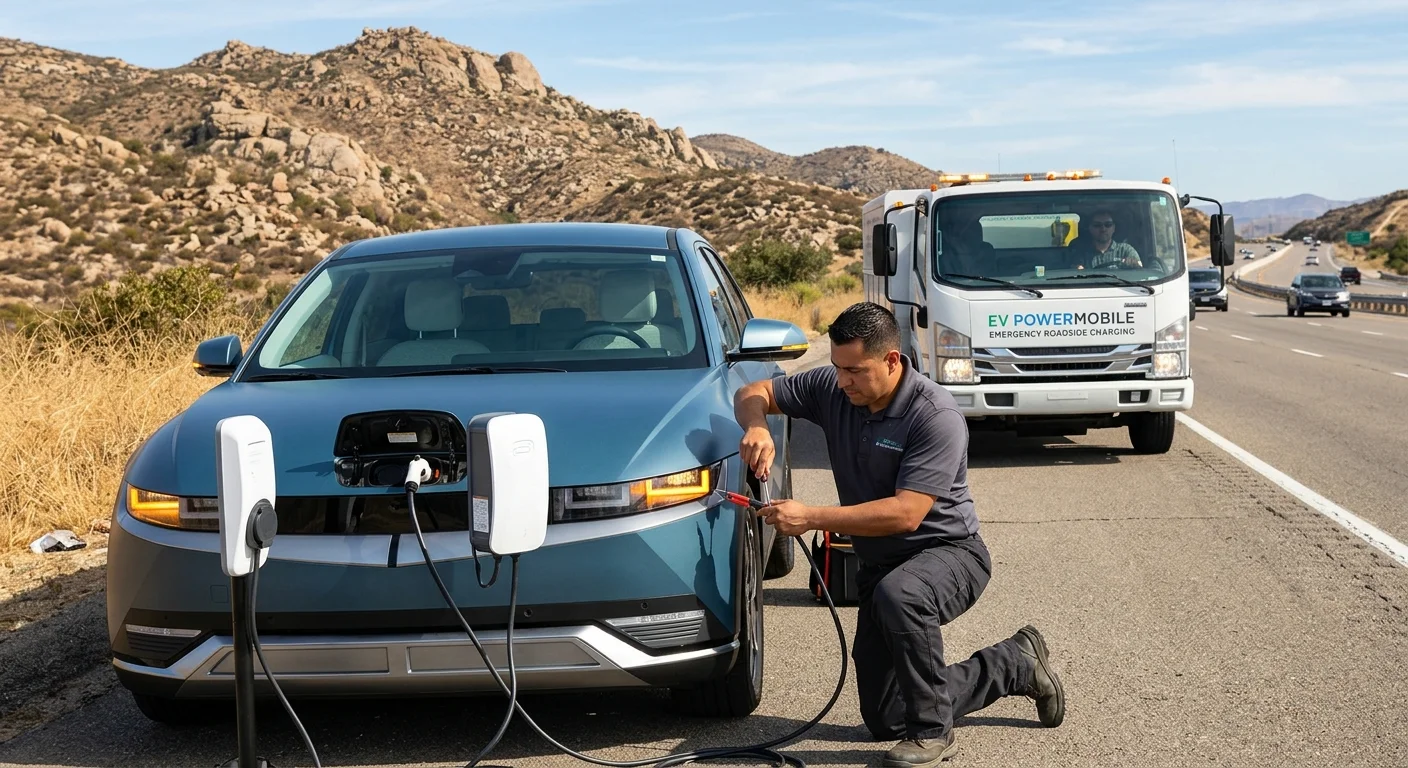
Beaumont is the top of the climb
Treat this city as a decision point, not a blur on I-10. Westbound drivers coming out of the desert have been climbing for twenty miles. They often roll in lower than they expected. Eastbound drivers leave thinking the leftover percent is plenty. Then the grade and the wind keep taking from the pack.
Mount San Gorgonio stands to the north, and Mount San Jacinto stands to the south. The wind farm visible east toward Cabazon is the same weather that hits the car. Beaumont Avenue and Oak Valley Parkway feel calm after the freeway. The pass already spent the buffer, and it doesn’t give it back.
Census counts put Beaumont at 56,266 people in the 2019-2023 ACS. The 2024 estimate is 59,502. It’s one of the fastest-growing cities in this market. Only 16.8% of housing was built before 1980, per that same ACS vintage. Oak Valley, Sundance, Solera, Tournament Hills, Fairway Canyon, and Seneca Springs are mostly this century. Most of those hillside homes have a charger in the garage. Resident calls here skew toward road strandings, not a dark garage.
Downtown Beaumont still has short trips that go wrong. An errand on Sixth Street after a long I-10 day can finish the pack. Pennsylvania Avenue does the same after a detour. Noble Creek Regional Park and Oak Valley Greens look close on the map. So does the Beaumont Cherry Festival when the lots fill. Close isn’t the same as charged.
Pass wind spends miles the map doesn’t show
This is one of the windiest inhabited places in California. The National Weather Service names the San Gorgonio Pass specifically. The load is a sustained crosswind, not a single gust at a light. Your car leans into it the whole time you’re on the ridge.
An EV fighting that wind uses energy that never appears as a hill. The display was built on recent driving. If that driving was the valley floor, the pass won’t match. Cabin heat on a cold Beaumont morning adds another draw. Winter here is genuinely cold by Inland Empire standards. The higher edges of town can see snow. Cooling on a hot I-10 afternoon does the same job in reverse.
None of that means the car is broken. It means Beaumont isn’t a flat commute with a pretty backdrop. Neighbors feel the same weather. Banning shares the Highland Springs corridor. Calimesa sits on the climb from the west. Cabazon sits downwind of the turbines. Cherry Valley, Yucaipa, and San Jacinto sit off the main pass lanes. They still send drivers through this junction.
If the traction pack is actually at zero, you want out-of-charge recovery. If the dash is dark, the pack may still have life. Start with the 12-volt. That’s a different failure.
I-10, the SR-60 merge, and SR-79
SR-60 merges into I-10 at Beaumont. That merge is one of the most important junctions in the eastern half of this market. Valley traffic and pass traffic share pavement here. A stall on that merge is a freeway problem. Get right, hazards on, and stay in the vehicle if you can.
SR-79 is the other trap. It runs north toward San Jacinto and south toward Hemet. It’s the rural connector into the San Jacinto Valley. Once you leave town, you don’t get Beaumont’s services at the next light. If the estimate is falling on SR-79, turn back while you still can.
Local operators who do mobile EV charging still need a pin drop that makes sense. Somewhere on the 10 isn’t enough. Give a direction, a mile marker if you have one, and the last exit you saw. Tesla or not Tesla matters for the plug. Native NACS covers Tesla. CCS or a J1772 adapter covers the rest.
The next city east on this grade is a different pin. If you died on the climb toward Banning, say that. Don’t call it Beaumont out of habit. Highland Springs is shared. The freeway pins aren’t the same.
Two Superchargers, and a plan that still failed
Beaumont has two verified Supercharger sites. One has 20 stalls, and the other has 24. The charging is in this town. The variable is the driver. People roll past the stalls. People arrive with too little left to reach them. People leave a hillside garage on a weekday and never used the wall unit.
A stall you can’t physically reach doesn’t help you. If you’re already at empty, get out of the travel lane. Pull as far right as you can, then call. Don’t sit hoping a cable frees up while traffic is still moving.
Sometimes the miss started one town west. Drivers who counted on a Calimesa Supercharger that was packed or offline find that out here. The stalls are still in Beaumont. The plan failed, not the town’s charging.
Home power is usually Southern California Edison in Beaumont. Next door in Banning, the city runs its own electric utility. That split doesn’t charge the car on I-10. It does explain why two neighbors can have different home-charger stories. Roadside, both of you still need an operator at the pin.
New streets keep opening on the hillsides. Fairway Canyon and Sundance still dump onto the same pass. Tournament Hills and Seneca Springs still catch the same wind. A wall charger at home doesn’t help once you’re already on Oak Valley Parkway.
Empty pack, or a 12-volt that only looks like one
A lot of dead-EV stops on this corridor aren’t a traction pack at zero. They’re a 12-volt battery that took the computers down. Locks, lights, and the ready state all fail together. The big pack may still have range left. You can’t know that from the shoulder without a check.
Heat, short trips, and sitting at a festival lot all wear a 12-volt. So does a cold start on a windy morning above downtown. If the car was fine yesterday and silent today, think 12-volt first. Don’t assume you need a flatbed until someone tests it.
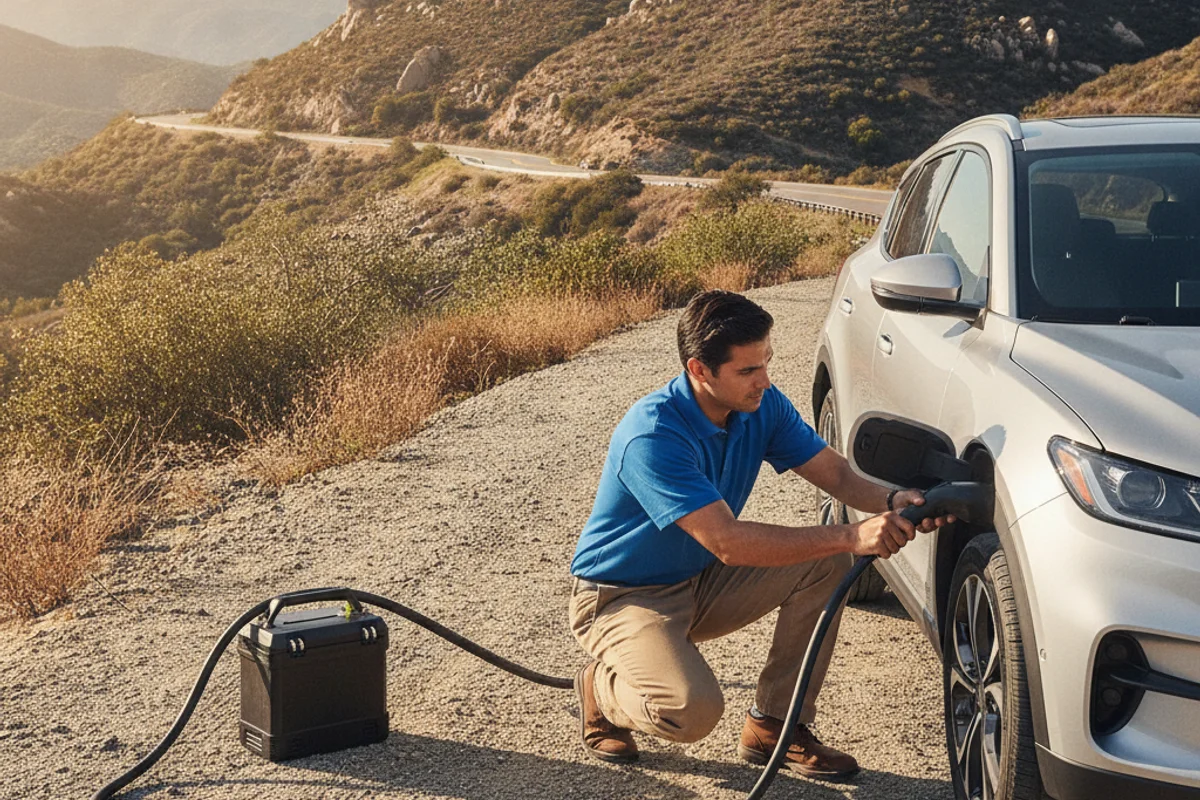
Operators we connect you with can jump or replace a dead 12V on site. They handle Tesla and every major EV brand. If the pack is truly empty, they bring a 240-volt Level 2 source to the car. That typically adds 10 to 20 miles of range in 15 to 30 minutes of charging. That window is charging time. It isn’t a promise about when someone arrives.
Charge Pro IE matches stranded drivers with independent local operators. We don’t own trucks, employ technicians, or set prices. The operator quotes you before starting and bills you directly. For the shape of that visit, read what a mobile EV charging rescue actually is.
Charge on the shoulder, or tow off the pass
A mobile charge is the right tool when the car will accept power. You only need enough miles to reach a stall or home. You stay with the vehicle. You don’t add a second handoff at a yard. The operator isn’t repairing anything. They’re putting energy in so you can roll.
A tow is the right tool when the car won’t go into the mode a flatbed needs. It’s also right when the 12-volt won’t hold. It’s right when something besides energy is wrong. Towing a silent EV the wrong way can hurt the drive unit. Don’t let the first wrecker guess. Ask how they tow an EV with no power before the hook goes on.
We don’t quote that work. Confirm the number with the operator in front of you. Price isn’t something this page can invent. The person at the pin sets it.
From a new hillside street, the usual miss is a freeway run that used more than the leftover bar. SR-79 does the same thing on the Hemet leg. From downtown, it’s often a short errand after a long I-10 day. Same physics, different driveway.
If you’re already stopped
Creep to an exit or a lot while the car still moves. Oak Valley Parkway and Beaumont Avenue beat a live I-10 lane. If you’re already on the shoulder, stay belted unless you’re in immediate danger. Hazards on, if the 12-volt allows it.
Then say you’re in Beaumont and give direction of travel. Give the nearest exit or cross street. Say Tesla or another plug. Mention SR-60 if that’s how you arrived. Mention SR-79 if you’re on the Hemet or San Jacinto leg. ZIP codes people quote here include 92220, 92223, and 92583. Those ZIPs also spill into neighbors, so a pin still beats a ZIP.
Charge Pro IE covers the Inland Empire, and Beaumont is inside that area. East of here the freeway drops toward desert this site doesn’t treat as home turf. Charge while you’re still at the crest if you can. Don’t spend the last bar proving the computer wrong.
Call (909) 250-2881 and we’ll connect you with a local operator. They quote before they start. You decide whether to proceed. That’s the whole handoff.