A Tesla Supercharger that’s packed or offline in Calimesa leaves you at the foot of the I-10 climb into the San Gorgonio Pass. If your battery’s already in the single digits, stay in the lot. Check Tesla’s live map, then wait, reroute, or call for a mobile charge.
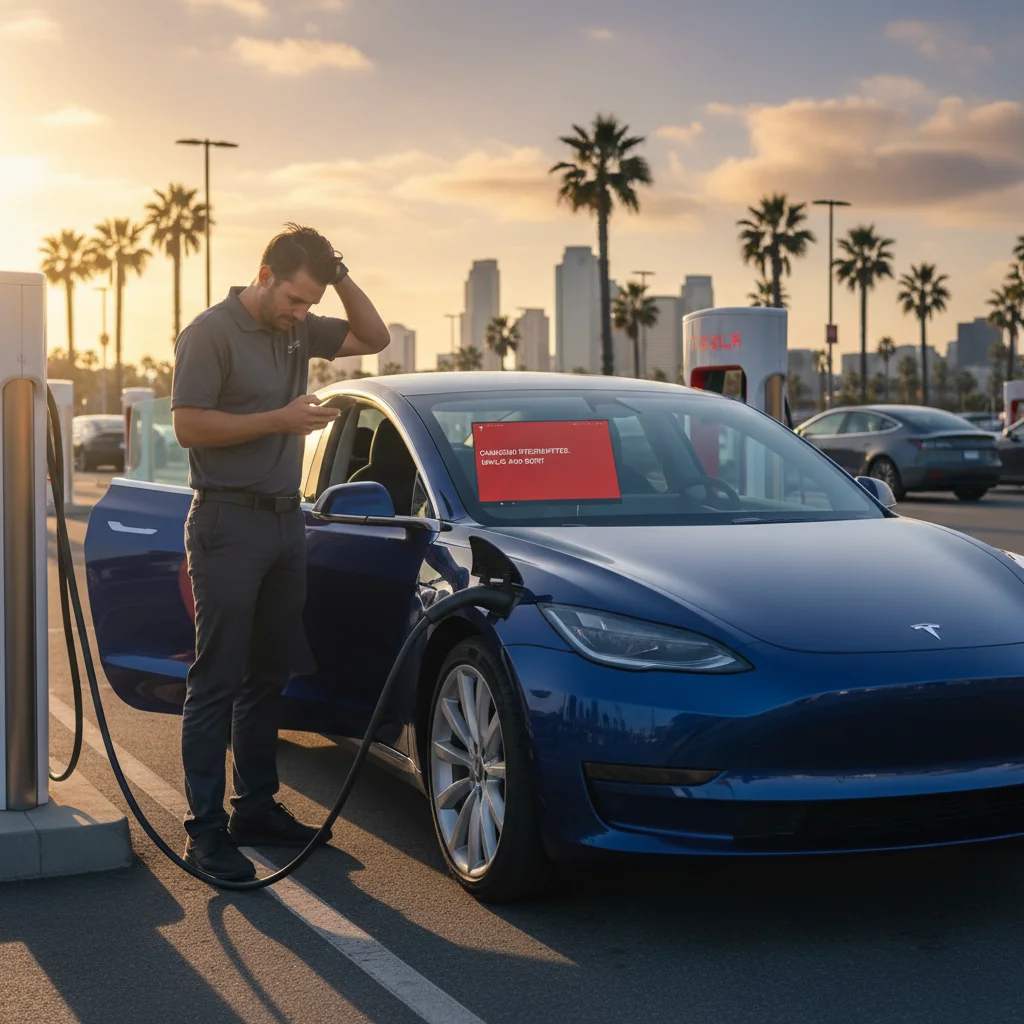
This page can’t quote a stall count or a street address for Superchargers in Calimesa. Those details weren’t in the sources behind this article, and Tesla changes hardware. The car’s navigation and the Tesla app are the live map. Use them for site pins, open stalls, and outage notes. Do that before you leave the pavement you’re on.
The Pass starts here, not later
Calimesa sits at about 2,300 feet on the western approach to the San Gorgonio Pass. The town’s cooler than the valley and windier than Redlands. Eastbound I-10 starts the real grade on this stretch, heading toward Beaumont. Westbound traffic is coming off that same climb. A dead Supercharger here is a grade problem, not a shopping-center delay.
The city’s small and still growing. Census ACS 2019-2023 puts the population at 10,902. About 44.1 percent of housing predates 1980. Much of that older stock sits along the historic Calimesa Boulevard corridor. Newer hillside streets sit in Mesa Grande, JP Ranch, and Summerwind Ranch. Through-traffic on the 10 doesn’t care which neighborhood you live in. The climb spends the same electrons either way.
Calimesa Boulevard is the old highway through town. County Line Road, Sandalwood Drive, Singleton Road, and nearby Cherry Valley Boulevard are the local grid. Downtown Calimesa, Singleton, and the Mesa Grande area all sit in the same thin-range math. If you dropped off the freeway to hunt a plug on the boulevard, stop. Confirm a live stall first. A pretty stretch of the old road isn’t a charging plan.
For corridor context, use the Calimesa charging page. It’s a place page, not a live stall board.
County Line Road is the real border
Calimesa’s in Riverside County. Yucaipa, which looks like the same town from I-10, is in San Bernardino County. County Line Road isn’t a decorative name. A stranded driver on this stretch can sit two hundred yards from a different sheriff. County services change at that line too.
When you call anyone, say the city on your pin. Calimesa or Yucaipa. Riverside County or San Bernardino County. Eastbound or westbound. Nearest named road: Calimesa Boulevard, County Line Road, or an I-10 exit. Guessing the city because the hills look the same wastes the first minutes of a rescue.
Neighbors include Beaumont, Redlands, Cherry Valley, and Oak Glen. Beaumont is up the eastbound grade. Redlands sits west. Oak Glen is a canyon trip, not a backup you should assume. This article doesn’t estimate miles to any of those pins. Let the car do that job with a charger it marks as working.
If you already burned the last miles toward Yucaipa, read out of charge on the climb toward Yucaipa. Stay on this page if you’re still in Calimesa.
Check the lot, the app, and the remaining range
Stand in a safe spot in the lot. Don’t block stalls you can’t use. Don’t idle in a travel lane on the 10.
Open Tesla navigation. Look for a compatible charger the car says you can reach. Demand a real buffer, not a 1 percent arrival. The computer doesn’t know about a new queue. It also misses a stall that just failed, or Pass wind. If the arrival number is a sliver, treat it as a no.
Open the Tesla app next. Some outages carry a note. A brief reboot is a different call than a dark site with no return time. If the app says nothing useful, plan as if the site will stay down.
Then open a second map. Charging apps to check before you strand covers Tesla, PlugShare, and the CCS networks. Logins should already be on your phone. You don’t want to create an EVgo or Electrify America account with 6 percent left.
First, decide if the lot is safe to wait in. Next, see if the car names a working charger you can actually reach. Then decide whether that charger being busy still leaves you a margin. Two no answers means you stop hunting. Follow the low-battery steps only while you still have a choice. Single-digit SoC at the bottom of the Pass is often past that.
A public charger that isn’t charging is worth a stall swap and a cable swap. Try an adjacent stall. Reseat the handle. Check the charge-port latch. If every stall throws the same error, the site is the problem.
What takes Superchargers offline on this corridor
Full stalls are mostly volume. I-10 through Calimesa funnels weekend and holiday traffic toward the Pass and the desert. Commute hours stack westbound in the morning and eastbound in the evening. The in-car map can show open stalls, then a line, before you clear the ramp.
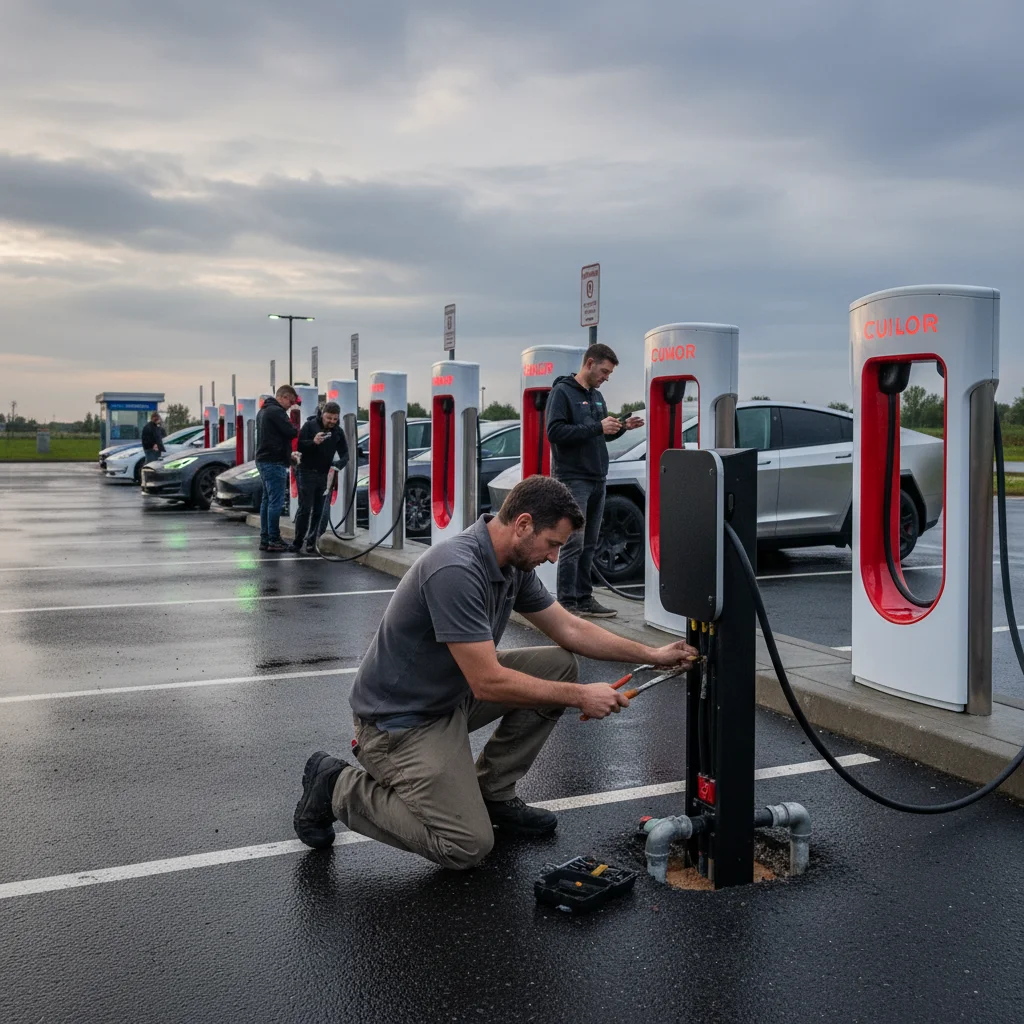
Offline is a separate list. Cabinets, cooling, cables, and connectors fail. The site still has to talk to Tesla’s servers. That’s how it authorizes your car and bills the session. A network drop can leave powered stalls that won’t start. A hit cabinet or a cut cable stays down until Tesla repairs it. This page doesn’t guess repair times.
Power sits with the utility. Southern California Edison serves Calimesa on SCE’s published city list. A Supercharger doesn’t replace the grid. SCE maintenance or an outage can darken the whole row. If the cabinets have no lights, check SCE’s outage map and Tesla’s app. Don’t quote a restoration hour from memory. Use the live utility page.
Parking-lot collisions and vandalism take public hardware down too. You won’t diagnose that from the driver’s seat. Move to a working stall if one exists. If none do, stop spending range on experiments.
Shared Superchargers and the CCS adapter
Tesla’s been opening Superchargers to other brands. Some sites use Magic Dock, a CCS adapter built into the cable. A Ford or Hyundai can sit in a stall that used to be Tesla-only. New models from several automakers also ship with NACS, Tesla’s plug. More cars share the same cabinets. Pass travel days get tighter.
Keep a CCS adapter in a Tesla. It turns Electrify America, EVgo, and ChargePoint into backups. Other CCS fast sites count too, when Tesla stalls are full. No non-Tesla DC fast address for Calimesa turned up in the sources for this page. Confirm live sites in PlugShare and in the car. If they show a CCS site you can reach with margin, that’s a real option. If they don’t, it isn’t.
Magic Dock also means a non-Tesla may already occupy the stall you wanted. Plan more buffer into an I-10 trip through Calimesa. Arriving at 4 percent and expecting an empty Tesla-only row is a trap. That’s how people end up sitting in this lot.
NACS access doesn’t restore a site with no utility power. Sharing is about plugs. It’s not a workaround for an SCE outage.
When you shouldn’t roll toward Beaumont
Waiting makes sense in a lit lot. You need a real chance the stall returns. You also need enough cabin comfort to sit. It fails when you can’t reach the next working charger the car can name.
Stay put and call if the Supercharger’s down. Stay put if the next live pin is past your honest range. That’s especially true eastbound up the grade. Stay put if you have a clock you can’t miss. A queue with no end isn’t a schedule. Stay put if it’s late, the lot feels wrong, or Pass wind is hitting the car. Stay put if the Tesla’s already cutting power.
Don’t try to just make Beaumont on the last bar. Don’t roll onto I-10 to think. Parking-lot range estimates go soft once you’re in the grade and the wind. The Calimesa Country Club, Cherry Valley, and Oak Glen are local geography, not implied charger pins. If the car doesn’t name a working plug there, don’t drive there to look.
A 12-volt failure can mimic a charging dead end. Dark screens, stubborn doors, and a pack that still shows miles point to the 12-volt battery. Say that when you call. A Supercharger won’t wake a car that can’t close contactors.
Mobile Level 2 versus a tow
A flatbed is one way off a dead Supercharger. It needs the right EV towing setup. It also dumps you at another site, which may be full too. The operators we connect you with bring a 240-volt Level 2 source to the pin. Tesla uses the native NACS plug. Other EVs use a CCS or J1772 adapter. Drivers typically add about 10 to 20 miles of range in 15 to 30 minutes of charging. That window is charging time. It’s not an arrival time, and this brand doesn’t publish one.
Charge Pro IE is a referral line. It holds no contractor license for the work, owns no trucks, and employs no technicians. It doesn’t set prices. The independent operator quotes you before starting and bills you directly. The pros we connect you with are licensed and insured. The brand isn’t the crew.
If you still have a car that will accept a charge, start at mobile EV charging. If the pack’s at zero and the car won’t roll, use out-of-charge recovery.
Home Level 2 in an older Calimesa Boulevard house doesn’t help until the car can reach that panel. A Supercharger failure on I-10 is still a roadside call.
Make the pin boring and specific
The useful move is usually to stay in Calimesa. Keep the car in the Supercharger lot or in legal parking. Give a clear pin: I-10, Calimesa, Riverside County, nearest cross street. Mention Calimesa Country Club, Mesa Grande, or Singleton only if that’s actually where you sit.
If you call in Spanish, the pin still has to be Calimesa, Riverside County.
When you’re ready to call, use (909) 250-2881. That number reaches Charge Pro IE, which matches you with an independent mobile rescue operator. You’ll get a quote before work starts. You won’t get a promised clock time on this page.