Late afternoon on Rancho California Road is when the tasting rooms thin out. A visitor from Orange County still has one more stop on De Portola Road. The pack looked fine at lunch. It doesn’t look fine now. EV roadside assistance in Temecula is the call for that stall. A local operator brings a 240V Level 2 source to the car. They can also jump a dead 12V on site.
Charge Pro IE is a referral line. We match stranded EV drivers with independent local mobile rescue operators. We don’t perform the work. We don’t own trucks or equipment. The operator quotes you before starting, then bills you directly.
Wine country roads are not the same as town streets
Temecula is a Riverside County city of 111,167 people in the 2019-2023 ACS count. The 2024 Census estimate is 112,431. Only 6.5 percent of housing predates 1980 in that same ACS vintage. This is a young city on a valley floor. Old Town Temecula, the Promenade Temecula, Harveston, Redhawk, and Vail Ranch sit on that floor. Cool marine air still pushes inland most evenings along the Santa Margarita corridor. That air is part of why the vines work.
East of the city, the land climbs into rolling hills. The Temecula Valley AVA follows Rancho California Road and De Portola Road. The appellation was established in 1984 as Temecula. It was renamed Temecula Valley in 2004. Those are rural two-lane roads with vineyards on both sides. Days run considerably hotter up there than on the valley floor. Day-trippers move between wineries the way they’d move between shops. They don’t always treat it like a grade, a heat load, and a long return.
The city itself is well plugged for Tesla drivers. Temecula has three Supercharger sites. Electrify America lists a Level 2 site on Madison Avenue. Electrify America does not list a DC fast station inside the city. If your afternoon is the AVA, the useful habit is to charge in town first. Then drive east. A stall on De Portola Road is a pretty place to sit. It’s also a poor place to invent a plan after the fact.
That wine-country day trip is the Temecula pattern. The car is often not from here. The driver planned pours, not plugs. The roads are rural. The hour is late. We serve every city in the county. This is the stall that’s specific to this valley.
Old Town, the Promenade, and the east hills are three different stalls
Old Town Temecula is walkable and in the city. A stall there is still a stall. You can name a cross street. The Promenade Temecula is a destination lot. Cars sit through shopping hours. That can be a 12V sit if the visit runs long. It can also be a pack that was already low when you parked. The east hills are the third map. Rancho California Road and De Portola Road don’t behave like Ynez Road or Jefferson Avenue. Tell the operator which of those three you’re in.
Locals in Harveston, Paloma del Sol, and Meadowview usually charge at home. So do owners in Chardonnay Hills, Roripaugh, Temeku Hills, and De Luz. Their strandings happen away from the garage. Visitors don’t have a garage here. They also may not realize the Supercharger sites sit in the city. Charge in town before you head east on Rancho California Road. That mismatch is why this search exists.
I-15, SR-79, and the local names operators actually use
Temecula is the southern anchor of the Inland Empire on I-15. Through-traffic strands on that freeway. A driver leaving town south with a thin pack has already committed to a long stretch. Northbound traffic feeds Murrieta, French Valley, and the rest of Riverside County. Say the direction. Say the nearest interchange you can read. Don’t wait in a live lane.
SR-79 has two separate legs here. Winchester Road runs north. Temecula Parkway runs east toward Aguanga and Anza, then toward open desert country. Rancho California Road is the wine-country spine. Ynez Road, Jefferson Avenue, and Margarita Road are in-town names. Pechanga Parkway is the south-side name people use for the resort approach. De Portola Road is the other AVA road. Murrieta Hot Springs Road is how a lot of north-side traffic arrives.
If you can still creep the car, get it out of the travel lane. Hazards on. Then name what you can see. Vail Lake is a usable pin. Old Town is a usable pin. Temecula Parkway heading east is a usable pin. Wine country by itself is not a pin. Operators work off a road and a landmark.
A thin pack on Temecula Parkway heading east is a real commitment. That leg runs toward Aguanga and Anza through open country. Treat it like a highway decision, not a shortcut. If the number is already low in town, don’t add that eastbound run.
A long sit at Pechanga is often a 12V problem
Pechanga Resort Casino sits on the south side of town. The property is owned by the Pechanga Band of Indians. Hotel parking means cars sit for two days, or three. The high-voltage pack can still show a healthy number. The 12V battery is the one that goes quiet after a long dwell.
Every EV still has a 12V. It runs locks, lights, the screen, and the computers that close the contactors on the main pack. When that small battery dies, the car can look completely dead. Doors may not pop. The display stays dark. People call it a brick. A flatbed is the wrong first move if the pack still has range.
The operators we connect you with jump or replace a dead 12V on site. That holds for Tesla and for every major EV brand. If you’ve been parked at the resort since Friday, start with the 12V. The sibling writeup on a stalled EV in Pechanga parking covers that dwell pattern.
Long sits happen in driveways too. Harveston, Paloma del Sol, Meadowview, and Redhawk all have cars that sit through a weekend. Same 12V physics. Different street. The Temecula Valley Balloon and Wine Festival also parks out-of-town cars for long days. Festival lots combine a dwell with a later hop into the AVA. Watch the 12V after a parked day. Watch the pack before you leave town.
What a mobile charge is, and what it is not
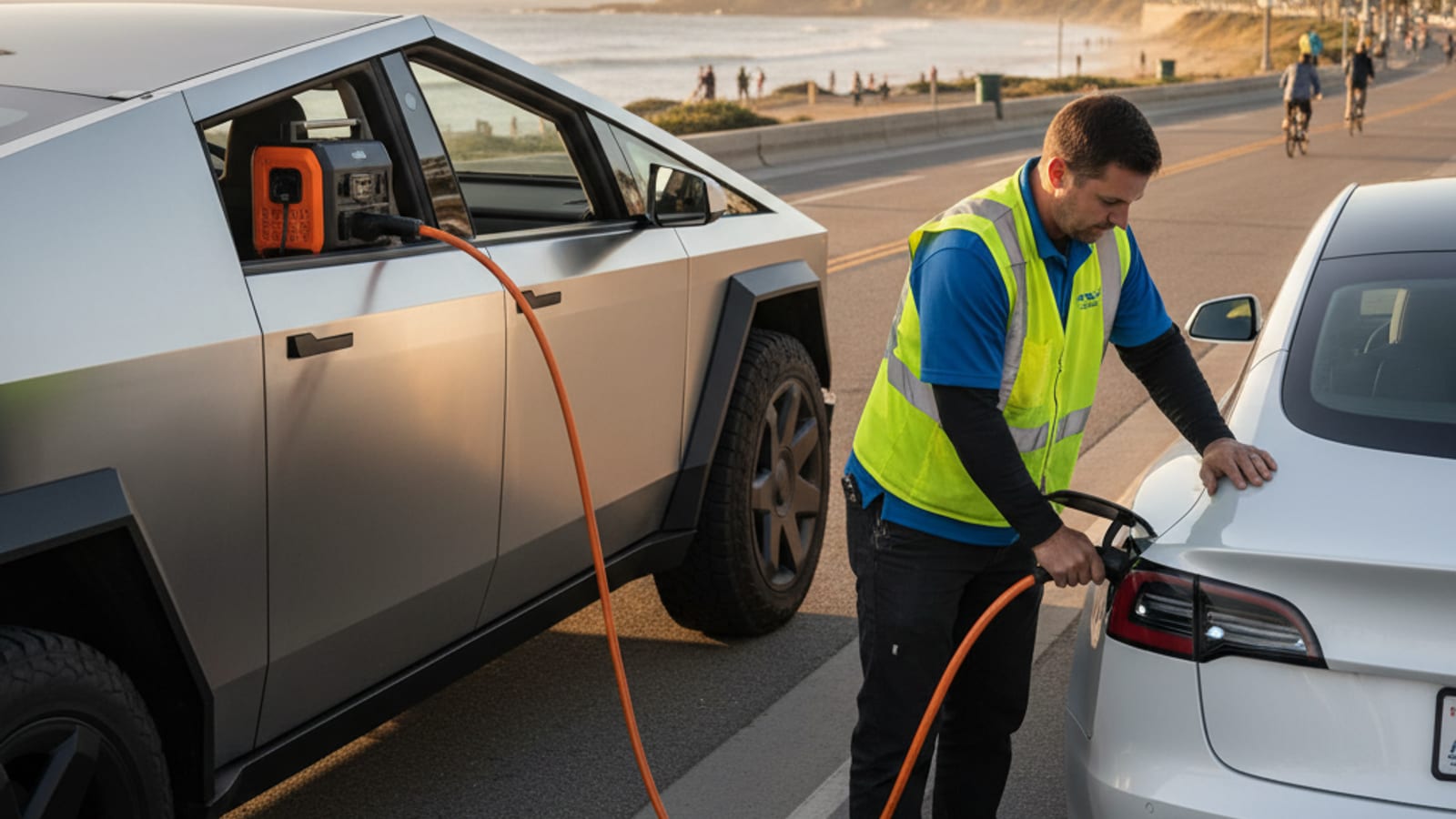
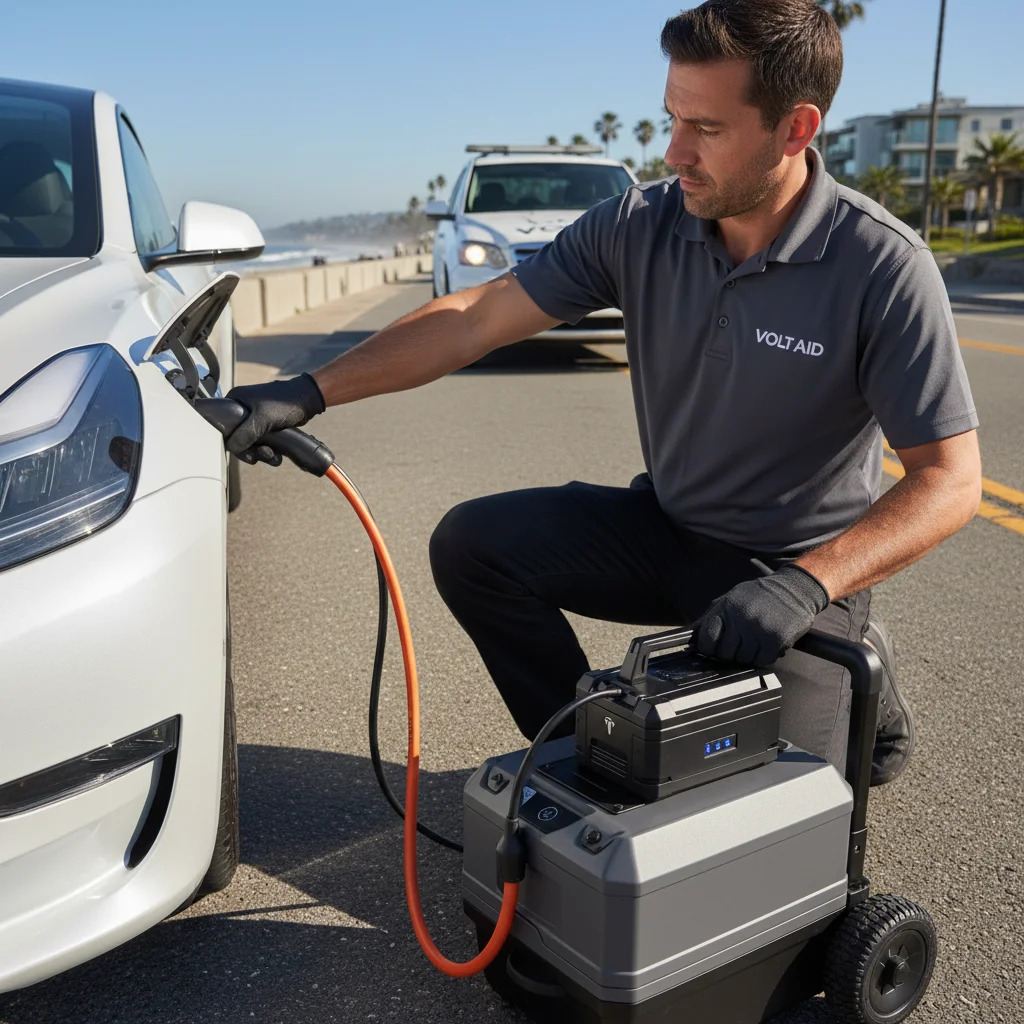
A mobile EV charge isn’t a Supercharger that drives to you. The operator brings a 240V Level 2 source to your bumper. Tesla cars take a native NACS plug. Other EVs take a CCS or J1772 adapter. Typical charging time adds about 10 to 20 miles of range in 15 to 30 minutes. That window is charging time. It isn’t a promise about when someone arrives.
Those miles are meant to reach a Supercharger in the city, a home plug, or a planned next stop. They aren’t a full pack. The point of mobile EV charging is enough range to roll. EV roadside assistance is the broader label for the same network: empty pack, dead 12V, Tesla, and everything else.
Towing is a different job. Many EVs need a flatbed so the drive unit isn’t dragged. A Level 2 hookup leaves the car where it sits. You stay with it. The operator quotes the visit before any cable goes in. You accept or you don’t. Charge Pro IE doesn’t set that price. Confirm the figure with the operator before they start.
If the car still moves a few feet, your first job is the shoulder. If the screen is dark, treat it as a 12V symptom until someone proves otherwise. You don’t have to jump it yourself. Naming that symptom helps the operator. If the range number hit zero and the car rolled to a stop, don’t keep pressing forward in a live lane. Get it stable. Then call.
Tesla rescue, plus every other plug on the road
Tesla owners here have more than one phone tree. Tesla runs its own roadside path. A local mobile operator is a separate option. They aren’t the same truck. They aren’t the same checklist. An empty pack on Rancho California Road needs energy in the high-voltage battery. A car that won’t wake with miles still showing often needs the 12V. Tesla roadside rescue is how we label that mix.
Model 3, Model Y, Model S, Model X, and Cybertruck all still depend on that small 12V. A jump on site is often enough to wake the car. A pack at zero still needs a Level 2 hookup.
Non-Tesla EVs strand the same way. Rivian, Ford, Chevy, Hyundai, Kia, BMW, Mercedes, Lucid, and the rest still use CCS or J1772 on the road. The adapter on the operator’s lead is the difference. Non-Tesla EV rescue is the page for that plug question.
The pros we connect you with are licensed and insured. Charge Pro IE isn’t a contractor. We hold no trade license. We stock no parts. We own no yard.
Murrieta, French Valley, and Winchester sit right next door
Murrieta is the city immediately north. If your pin is closer to Murrieta than Old Town, start with the Murrieta EV roadside assistance note. The roads don’t care about the city limit. Wildomar sits northwest. The same I-15 corridor ties those names together.
French Valley and Winchester are unincorporated. They’re Census designated places in Riverside County, not cities. They have no city council. The Riverside County Board of Supervisors governs them. Mail can read Murrieta, Winchester, Temecula, or French Valley for the same house. Say the road. The name on the envelope is less useful than Auld Road, Briggs Road, Leon Road, Pourroy Road, or Benton Road.
French Valley has 45,269 residents in the 2019-2023 ACS count. Only 2.3 percent of its housing predates 1980. The landmark people recognize is French Valley Airport, the county-operated general aviation field. Cars sit in airport parking while owners fly. That’s a 12V pattern again. The commercial strip is Winchester Road, which is SR-79.
Winchester the place is small. The 2019-2023 ACS count is 4,555 people. Winchester the road is not small. SR-79 is the north-south connector between Temecula, Murrieta, French Valley, Menifee, and Hemet. Domenigoni Parkway is the east-west cut toward Hemet past Diamond Valley Lake. Drivers use it as a shortcut. If you stall there, name the parkway. You’ll describe it by name when you’re on it.
For charging context inside Temecula itself, use the Temecula EV charging city page. That page is the local hub. This post is the stall.
Home power is SCE, and the shoulder isn’t your garage
Temecula electric service is Southern California Edison. SCE publishes a residential EV rate called TOU-D-PRIME. Published amounts change. Confirm the current rate with SCE before you plan around it. A home Level 2 plug in Redhawk or Harveston is how most local owners charge. It doesn’t travel to a winery driveway on De Portola Road.
If the house panel is dark, a home battery is a separate problem. That unit keeps lights on. It doesn’t roll east into the AVA. The operator who meets you on the shoulder is charging the car, not your kitchen.
Insurance roadside and automaker roadside are different paths too. Those lines may send a tow. A tow is a different job from a Level 2 hookup. Ask what they’re actually sending before you wait for the wrong truck.
Heat, hills, and a day that isn’t a loop around Old Town
Temecula is genuinely different from the rest of the Inland Empire. Cool marine air still reaches the valley floor most evenings. Days still run hot. The wine-country hills east of town run hotter still. Air conditioning spends pack. Climbing those grades spends pack. A morning at the Promenade and an afternoon on De Portola Road isn’t a flat errand loop.
Vail Lake sits in that same east country. The Santa Margarita Ecological Reserve does too. Outings that look short on a map still climb. If you started the day from Orange County, you also have a return. Build the return into the pack before you leave the Superchargers in the city.
Locals feel this on guest days. Friends come in, you do the AVA loop, and the car that lives in Paloma del Sol didn’t start the afternoon at 100 percent. Visitors feel it harder. They don’t have the garage at the end of Jefferson Avenue. They have a hotel, a lot at Pechanga, or a long freeway run home.
What to do when the car has already stopped
Get the car out of the travel lane if it will still roll a few feet. Turn the hazards on. Then stand in a safe spot.
Name the road and a landmark. Rancho California Road and a winery gate. Pechanga Parkway. An I-15 shoulder. Jefferson Avenue near Old Town. Temecula Parkway heading east.
Decide empty pack versus dead 12V. A car that slowed to a stop after the range number fell is a pack story. A dark cabin after a long parked sit is often a 12V story. Tell the operator which one you think it is. Also give the make and model. Tesla versus CCS versus J1772 changes the lead they pull.
Call Charge Pro IE at (909) 250-2881. We connect you with an independent local operator. That operator quotes the visit before any work starts. They bill you directly. We don’t publish an arrival window on this page. The operator speaks for their own schedule.
Stay with the car unless you’re unsafe. Keep the hazards on. If an officer is already on the shoulder with you, tell the operator that too.
Frequently asked questions about EV roadside assistance in Temecula
What EVs can an operator help in Temecula?
Operators in this network handle Tesla and every major EV brand. The lead is a native NACS plug for Tesla. CCS or J1772 adapters cover the rest. Rivian, Ford, Chevy, Hyundai, Kia, and BMW are in that set. Mercedes and similar cars are too. Give the make and model when you call so the operator brings the right adapter.
How much range does a roadside Level 2 visit add?
Typical charging time adds about 10 to 20 miles of range in 15 to 30 minutes. That depends on the car and on the state of the pack. The goal is enough miles to reach a Supercharger in the city, a home plug, or your next planned stop. It isn’t a full charge. The operator quotes you before they start.
What if the car won’t start, but the main pack isn’t empty?
That’s the 12V battery more often than the pack. The small battery wakes the computers that connect the high-voltage system. A jump or a 12V replacement on site is the usual first step. It’s common after a long sit at Pechanga. It’s also common in a driveway in Harveston or Redhawk, or in airport parking at French Valley. An empty pack still needs a Level 2 hookup instead.
A stall in Temecula is usually a wine-country afternoon, a long sit at Pechanga, or a thin pack on I-15. The city has Superchargers. The east roads are rural and hot. Charge Pro IE connects you with a local operator who can put 240V on the bumper or wake a dead 12V. That’s the help that matches this search.