A non-Tesla EV that dies in San Jacinto needs a CCS or J1772 adapter. The native NACS plug won’t seat in a CCS inlet by itself. Charge Pro IE is a referral line for the Inland Empire. We match stranded drivers with independent local operators. We don’t own trucks, employ technicians, or set prices. The operator quotes you before starting and bills you directly. Operators bring a 240-volt Level 2 source to the car. They typically add 10 to 20 miles of range in 15 to 30 minutes of charging. That window is charging time, never an arrival time. They can also jump or replace a dead 12-volt battery on site. San Jacinto Power supplies generation on many meters here. Southern California Edison still delivers the power on the wires. Neither one puts an adapter in your charge port. A CCS stall still needs a local adapter that fits.
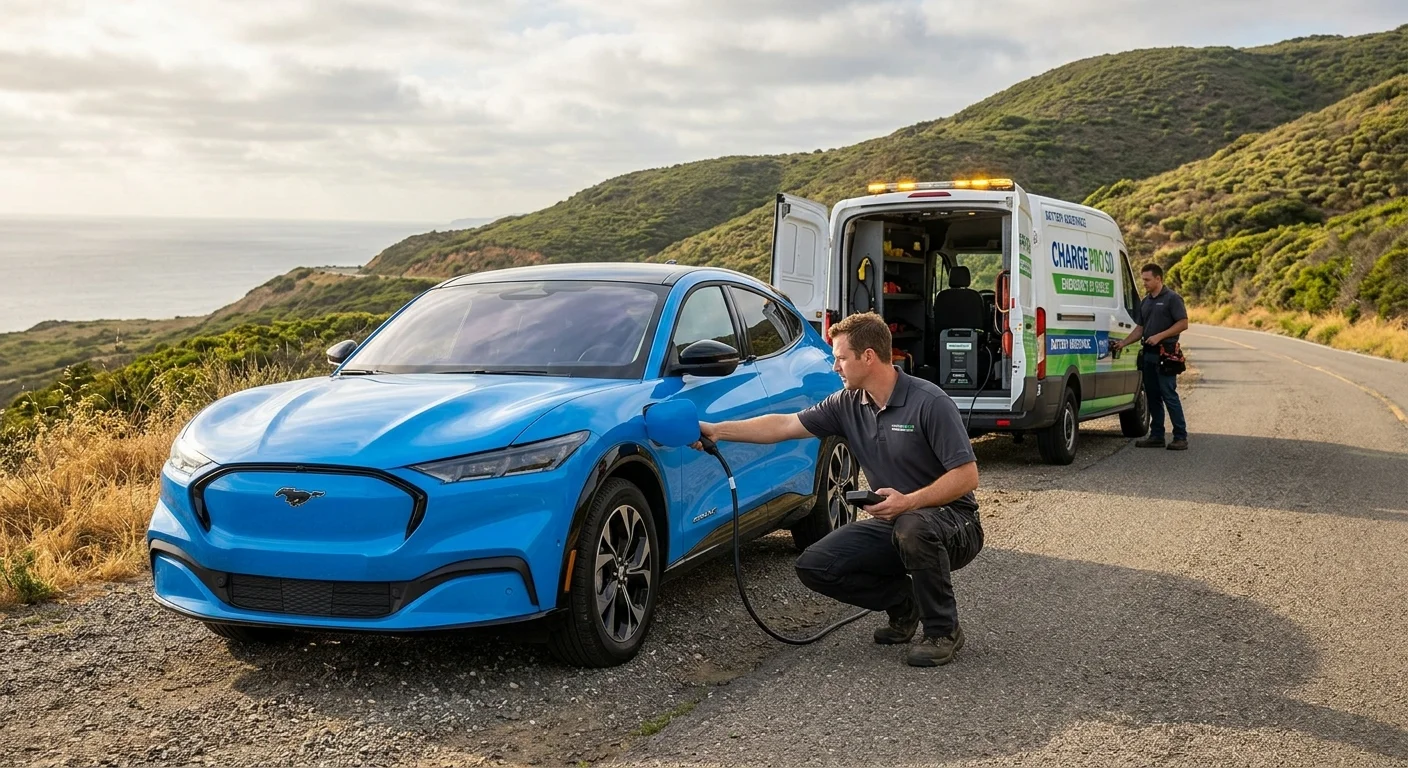
San Jacinto Power is generation, not a plug
San Jacinto is a Riverside County city covering 25.87 square miles. The 2019-2023 ACS counts 55,180 residents, and the 2024 estimate is 55,515. Callers often give ZIP 92567, 92582, or 92583. Those ZIPs overlap neighbors, so they’re not a city-limit map. Historic downtown, Park Hill, Soboba Springs, and the Sanderson corridor are the names people actually use.
Southern California Edison delivers electricity in San Jacinto. San Jacinto Power is the community choice aggregator that supplies generation. You may see both names on a bill. You won’t see either one roll a CCS adapter to State Street. Home rates, time-of-use windows, and CCA enrollment live on the meter. Confirm current programs with San Jacinto Power or SCE. A stalled Ioniq 5 on Esplanade is a hardware problem. The generation brand on the bill doesn’t change the inlet on the bumper.
For place-level charging context, use the San Jacinto EV charging page. For CCS and J1772 across the market, read non-Tesla EV rescue in the Inland Empire.
SR-79, the Ramona Expressway, and overnight lots
There’s no interstate in San Jacinto. Driving here sits on SR-79 and the Ramona Expressway. Sanderson Avenue, Esplanade Avenue, State Street, and Main Street fill in the grid. SR-79 is the spine. South, it runs toward Hemet and Valle Vista. North, it’s the way toward Beaumont and I-10. That north leg is the shortcut between the Pass and the valley. Drivers use it constantly. It’s long, rural, and light on services. It’s also the only reasonable north exit. It doesn’t send you back through Hemet and Menifee.
West, the Ramona Expressway heads toward Perris. Nuevo and Lakeview sit on that connector. It’s another long, open run with few reasons to stop. Mount San Jacinto stands immediately east. The San Jacinto Wildlife Area sits in the same basin. This valley traps heat the same way Hemet does. Summer temperatures are brutal, and air conditioning plus grades cut range. That’s climate and terrain. It’s not a claim about charger counts.
Soboba Casino Resort, on the Soboba Band of Luiseño Indians reservation, is the long-stay pattern. Overnight and multi-day parking drain 12-volt batteries. The traction pack can still show miles while the car won’t wake. Mount San Jacinto College’s San Jacinto campus has the same dwell after class. If you came up from Hemet and died on the south edge, EV roadside assistance in Hemet is the neighbor write-up. The referral match works the same from either side of the line.
Beaumont is the north hatch on SR-79. People take that road because it skips the Hemet and Menifee loop. Services thin out once you leave the city grid. If the pack is already low on Sanderson, say so. Don’t try the rural stretch on a guess. A 12-volt jump in a casino lot is one job. An empty CCS car on the open north run is another. Tell the dispatcher which one you’re sitting in.
Empty pack, dead 12-volt, or a failed handshake
Three failures look the same from the curb. The car won’t start, doors may stay locked, and the dash may stay dark. One cause is an empty traction pack. Another is a dead 12-volt battery. The third is a charging handshake that never starts.
The 12-volt runs computers, locks, lights, and the high-voltage contactors. If it dies, a full traction pack won’t help, and the car stays inert. A jump or a replacement on site is often the whole job. Operators in this network jump or replace that battery at the car.
An empty pack is a different call. The car needs energy in the port. A mobile EV charging visit is a 240-volt Level 2 hookup. Typical added range is 10 to 20 miles after 15 to 30 minutes of charging. That’s enough to reach a public CCS stall or home once you can roll. It isn’t Supercharger speed, and the truck isn’t a DC fast-charge cabinet.
Handshake failures sit between those jobs. The pedestal says connected, but the car never takes power. A latch won’t release the connector. A pack sitting very low may refuse a session. A Level 2 lead at the bumper bypasses a dead pedestal. It doesn’t repair the pedestal. For the visit without the brochure language, read what a mobile EV charging visit actually is.
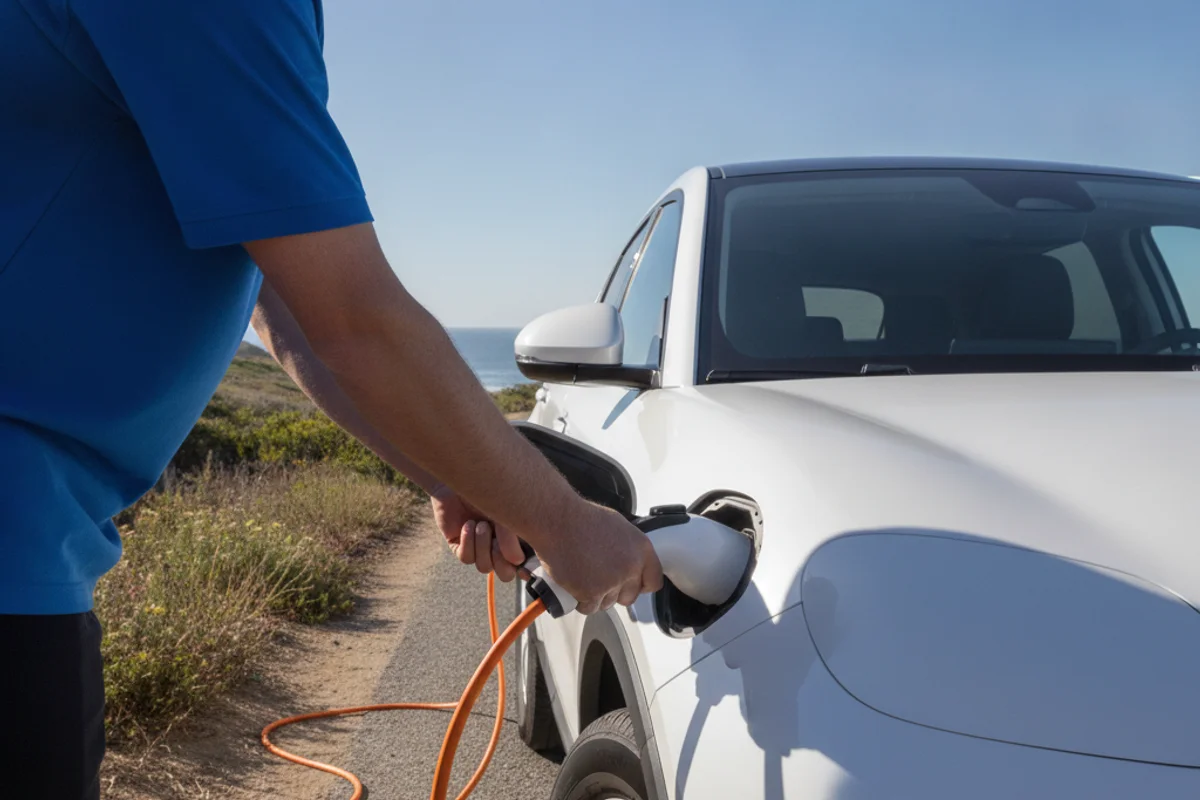
What gets plugged into a CCS or J1772 port
Most non-Tesla EVs in this valley still use CCS for DC and J1772 for AC. That includes Rivian, Mustang Mach-E, F-150 Lightning, Ioniq 5, Ioniq 6, Kia EV6, and Polestar. Some newer cars ship with NACS instead. Confirm the inlet on your bumper. Don’t guess from a photo online. The operator’s truck typically carries a native NACS plug. Non-Tesla work depends on the CCS or J1772 adapter they bring. That’s the local adapter point. A public CCS stall doesn’t help if you can’t reach it. A NACS-only lead doesn’t help if your port is CCS. The adapter has to arrive with the operator.
Charge Pro IE doesn’t stock those adapters. Independent operators carry them. Non-Tesla EV rescue is the service page for that match. Tell the dispatcher the make and model. Describe the port if you can see it. Say whether you’re empty, or the car is dark with miles still showing. Those two facts pick the job: Level 2 energy, or a 12-volt jump.
A CCS cabinet you can actually reach still needs the right lead. Some NACS cars need an adapter at a CCS stall. CCS cars need an adapter on a NACS-native truck. San Jacinto Power doesn’t settle that hardware match. The operator’s adapter bag does.
A tow truck is a different job
A gas-car tow outfit might not be set up for an EV. Many electric cars need a flatbed so the drive unit doesn’t spin. Wrong towing gear can damage motors. If the pack is empty and a Level 2 top-up will roll you, start there. If the 12-volt is dead, jump it before anyone hooks the car. If the car still can’t move, a flatbed is the remaining path. The operator quotes before starting. You’re not hiring Charge Pro IE to perform the work.
Don’t sit on a pedestal that already failed. Don’t assume Tesla roadside will treat a CCS Hyundai like a Model Y. Brand programs differ, and they change. A local operator who carries the adapter is the match in this valley.
What to tell the referral line
Give a road, not a mood. On SR-79, say whether you’re north toward Beaumont or south toward Hemet. On the Ramona Expressway, say whether you’re west toward Perris. In town, Sanderson, Esplanade, State, and Main all parse. Downtown, Park Hill, Soboba Springs, and the college campus all parse too. If you’re in a Soboba Casino Resort lot, name the lot. San Jacinto has no interstate mile markers, so cross streets matter more here.
Name the EV: Rivian R1T, Mach-E, Ioniq 5, Lightning, EV6, or whatever you drive. Say CCS, J1772, or NACS if you know it. Say empty pack versus a dark car. Say if a public stall already failed. We use that to match you with an operator who has the adapter.
When the car won’t start, call. A dim dash, silent locks, or a charge that never starts is enough. Charge Pro IE connects you with a local operator. Call (909) 250-2881 and the operator quotes you before starting.