The climb into Big Bear Lake already spent a large share of your pack. Weekend visitors from the Inland Empire learn that on the way up. So do drivers from the Los Angeles basin. Then the lake sits at about 6,750 feet, in real alpine cold. Getting down SR-18 or SR-38 is the part that strands people.
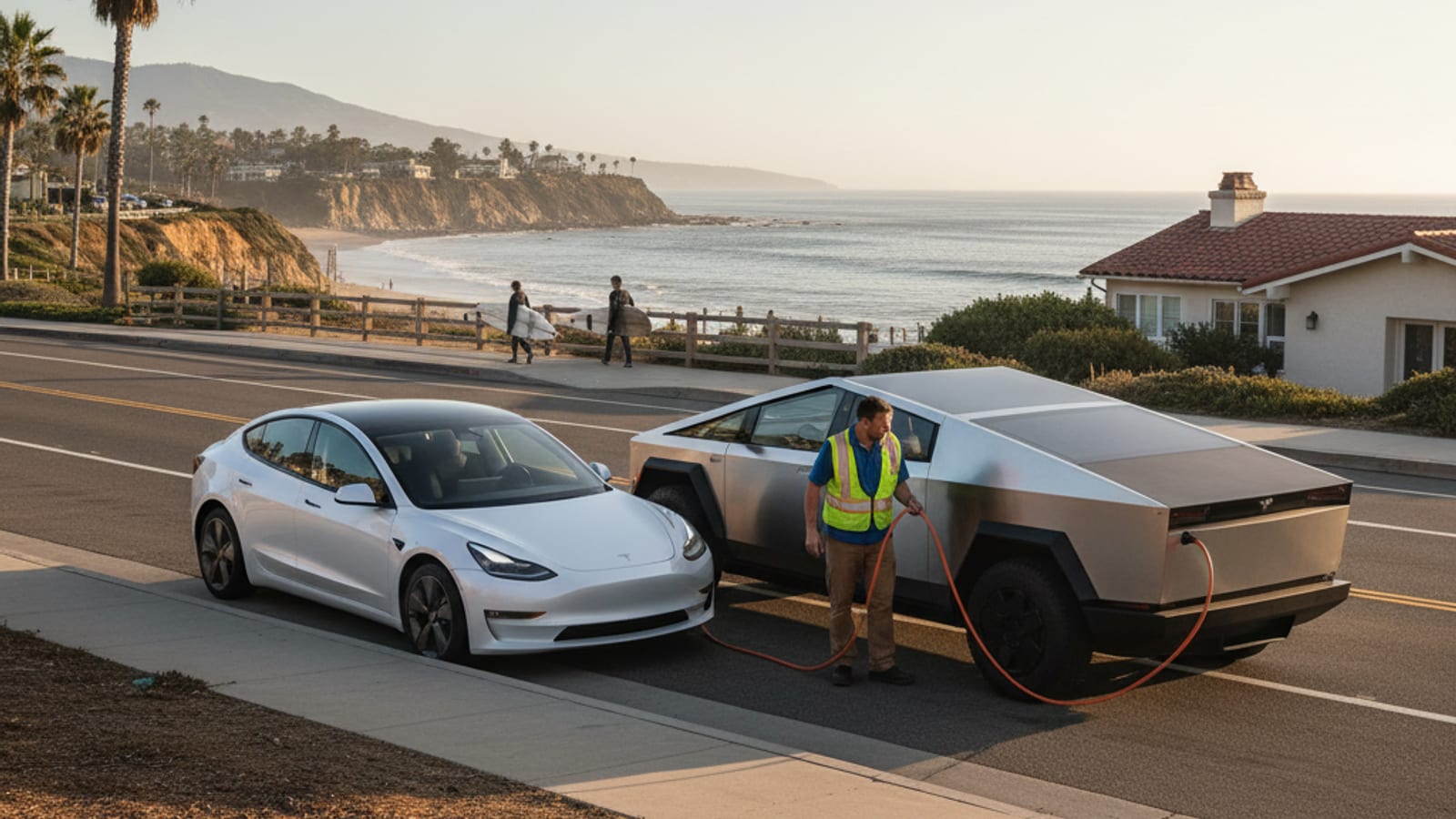
That’s the search behind ev roadside assistance big bear lake. A home rate from the wrong electric company won’t move a dead car. Bear Valley Electric Service isn’t Southern California Edison. An empty traction pack still needs a mobile visit. That’s how some cars get enough range to roll down.
Getting down is the real mountain problem
Big Bear Lake is an incorporated city in San Bernardino County. It’s not a valley suburb with a lake postcard. 5,041 people lived here in the ACS 2019-2023 count. The 2024 estimate is 5,044. The land area is 6.25 square miles. The ZIP you’ll hear on the phone is 92315.
Housing is old. 59.6% of units were built before 1980, ACS 2019-2023 vintage. Cabins and lodges sit empty for weeks at a time. Then someone drives up, opens a frozen door, and expects the car to wake. That’s a 12-volt story as often as a pack story.
Winter isn’t a backdrop. It’s snow, sustained freezing, and chain controls on every road in. AAA measured a 39.0% decrease in calculated driving range at 20 degrees Fahrenheit. Recurrent’s fleet data shows cars averaging about 70% of their maximum range at 20 degrees. Plan with those numbers. Don’t plan as if the lake were a mild valley night.
The climb from the San Bernardino Valley floor costs a very large share of a battery. Drivers arrive thinner than the dash promised on flat miles. They spend the weekend in the freeze. Then they have to get home.
The descent does return energy through regeneration. It doesn’t return all of it. A cold pack regenerates less than a warm one. You can feel the car take energy back as you drop on Big Bear Boulevard. You shouldn’t treat that as a full refund of the climb.
Visitors ask whether they can make it up. The better question is whether they can make it down. Residents with a second home already know the freeze. First-timers from the valley usually don’t.
Regen on a long descent can look like free range. In the cold it isn’t free. The pack is less willing to take energy back when it’s freezing. You still spend climate control. You still spend the last miles to a cabin. Then you still have to go down.
Bear Valley Electric isn’t SCE
Valley habits follow people up the hill. Southern California Edison is the name most Inland Empire drivers know. Big Bear Lake isn’t on SCE’s list.
Bear Valley Electric Service is the utility here. Its service-area page names Lake Williams, Erwin Lake, and Sugarloaf. It also names Big Bear City, Big Bear Lake, Moonridge, Fawnskin, and Boulder Bay. If you live in town, don’t call SCE about an EV rate. You’re asking the wrong company.
Bear Valley publishes its own EV time-of-use tariffs. Confirm the current schedule on Bear Valley’s site before you copy a valley off-peak habit. No verifiable cents-per-kilowatt-hour figure turned up for those Bear Valley EV tariffs. Bear Valley Electric Service is the company that sets them. Confirm the current rate with the utility before you plug in at home.
Lake Arrowhead and Crestline sit on a different wire. They’re Southern California Edison territory. A weekend can start with out of charge after Lake Arrowhead and end on Village Drive. That trip has already crossed utilities. That matters at a cabin panel. It doesn’t add a single mile to a pack that’s already empty in a ski lot.
An EV rate, even the right one, only prices power at a meter. It can’t push electrons into a car on Moonridge Road. A dark panel at a Fox Farm cabin is a utility problem. A dead pack in the Snow Summit lot is a roadside problem. Don’t mix them up.
Roads, lots, and the places people actually stall
SR-18 is the Rim of the World Highway from the west. It comes through Running Springs, then becomes the Big Bear Boulevard spine. SR-38 arrives from Redlands via Angelus Oaks and Onyx Summit. After that it can carry you along the north shore. Give the operator Big Bear Boulevard, Village Drive, Moonridge Road, or Knickerbocker Road. Those are the local names that actually help.
The west approach on SR-18 feels like one long ridge after Running Springs. The SR-38 approach from Redlands is a different day. Angelus Oaks and Onyx Summit sit on that eastern climb. People who came up that way often have even less left. They still have to go back down one of those same roads.
The Village is where visitors cluster. Moonridge sits under the ski hills. Boulder Bay is on the west end of the lake. Fox Farm, Eagle Point, and Castle Glen are in the mix. The north shore along SR-38 is a quieter, colder drive. Sugarloaf and Fawnskin sit next door.
EV roadside assistance in Big Bear City when you cannot get down is a separate place on the map. Big Bear City is an unincorporated CDP, not the incorporated city. People mix the two names on the phone. Say which one you’re in. Help that starts with the wrong town name is a mess.
Snow Summit and Bear Mountain parking is a long, cold sit. The car is off. The pack is already tired from the climb. Cabin driveways off Knickerbocker Road sit darker still. The Big Bear Alpine Zoo, the Big Bear Solar Observatory, and trailheads near the Pacific Crest Trail are real local destinations. They’re also extra miles you may not have budgeted after the grade.
Chain controls can hit every road in. They’re a constraint on you. They’re a constraint on the operator too.
The Supercharger you can actually name
Tesla has one Supercharger site in Big Bear Lake. It has six stalls. The address is 40568 Village Drive. It opened in October 2023. Lake Arrowhead has one Supercharger with eight stalls. That’s 14 Supercharger stalls for the mountain resort area. Baker, on the Vegas run, has a 96-stall Supercharger site. Those are named stall counts. They’re not a story about every other plug on the hill.
If Village Drive is packed or offline, sitting in the lot doesn’t add range. Mapping a public stall you can still reach is useful. So is a mobile EV charging visit that comes to the car. Don’t wait for a ski-day stall to open if the pack is already at the edge.
What a mobile visit is, and what Charge Pro IE isn’t
Charge Pro IE is a referral line. It matches stranded EV drivers with independent local mobile rescue operators. It doesn’t perform the work. It doesn’t own trucks or equipment. It doesn’t employ technicians. It doesn’t set prices. It doesn’t publish business hours. It doesn’t promise an arrival time. It doesn’t hold a license. The operator quotes you before starting and bills you directly.
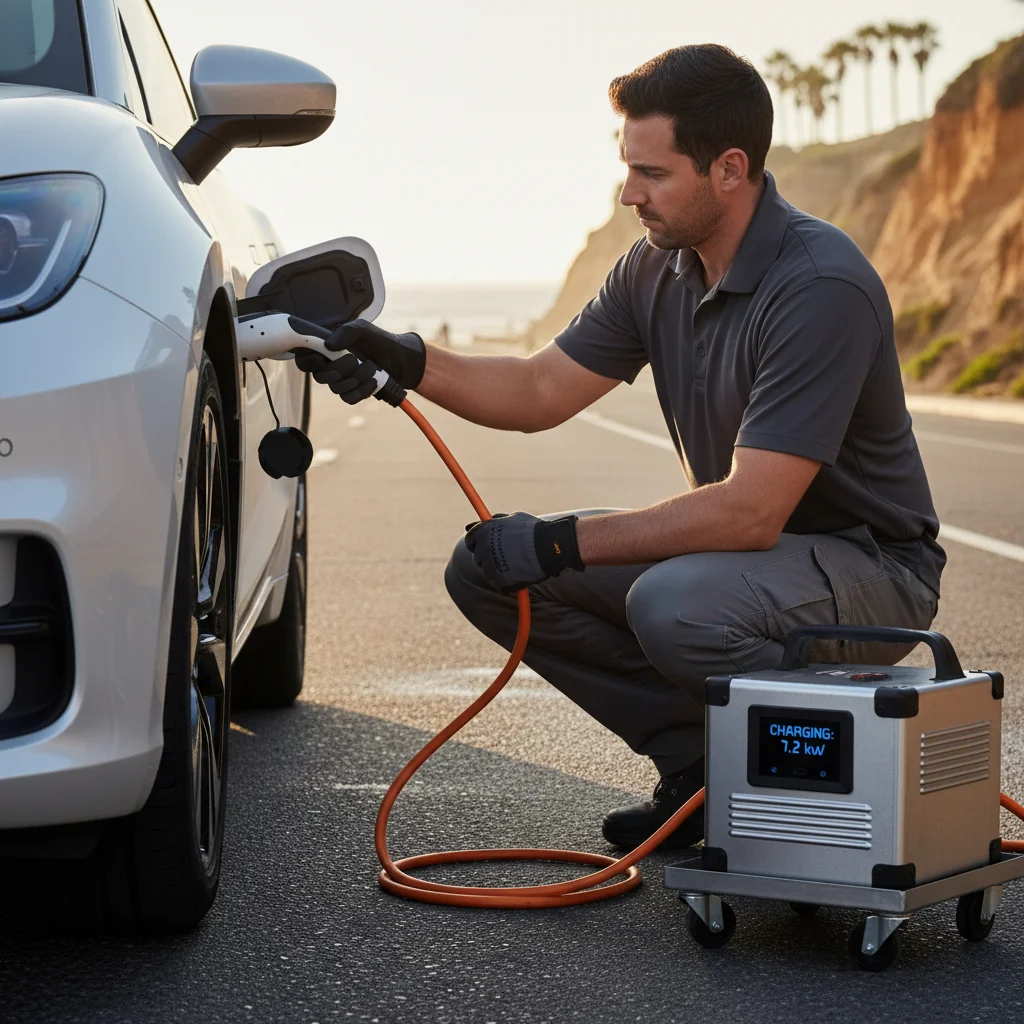
The work the operators do is narrow and specific. They bring a 240V Level 2 source to the car. Teslas get a native NACS plug. Other EVs get a CCS or J1772 adapter. They typically add 10 to 20 miles of range in 15 to 30 minutes of charging. That number is charging time on the cable. It isn’t an arrival time.
Ten to twenty miles is often enough to roll to 40568 Village Drive. It can also cover a Level 2 you’ve already mapped. Or it can cover the start of the descent with a little margin. Cold weather will spend some of that bump. The operator on scene quotes what they can actually deliver for your car.
What a mobile EV charging visit actually is, and isn’t walks through the sequence. It doesn’t pretend the brand owns the truck.
The pros we connect you with are licensed and insured. That’s a claim about the network, and it’s true. Charge Pro IE serves the Inland Empire, including Big Bear Lake. The brand in the middle is the match. The person at the charge port is the independent operator.
Dead pack or dead 12-volt
A car that won’t wake in a frozen cabin isn’t always out of traction energy. Most EVs, Tesla included, use a separate 12-volt battery to boot the car. Door latches, screens, and the high-voltage contactors lean on it. If that small battery is dead, the pack can still hold a weekend’s charge. The hatch just won’t cooperate.
Empty second homes in the freeze are the textbook case. The place sat dark. The 12-volt aged in the cold. You arrived after dark on Village Drive or a Moonridge spur. The car looks finished. It may only need a jump, or a 12-volt replacement on site.
Watch for a silent dash, a hatch that won’t release, and a car that ignores the app. Those are 12-volt clues. A car that still boots and still reports a near-zero pack is the other problem. That one needs energy at the port.
Operators we connect you with can jump or replace a dead 12V battery on site. They handle Tesla and every major EV brand. Tesla 12V battery jump is the Tesla-shaped version of that call.
A pack that’s truly at zero after the climb is a different job. Don’t guess which failure you have if the dash is dark. Tell the operator what the car is doing. They’ll sort pack versus 12-volt when they’re on scene.
Chain controls, and why nobody should gloss over them
CHP can require chains on SR-18, SR-38, and the boulevard spine. When that happens, your EV has to meet the control. The operator’s vehicle has to meet it too. A referral can’t override a chain requirement. If the road is closed or chained, the visit waits on the same rule you do.
Stay out of the travel lane. Use hazards. If you’re in a Snow Summit or Bear Mountain lot, staying with the car is usually the sane choice. Don’t wait on a blind curve of the Rim of the World Highway. Those are safety habits. They aren’t a clock.
Give a precise pin. Village Drive isn’t Moonridge Road. Boulder Bay isn’t Fawnskin. The north shore along SR-38 isn’t The Village. Operators lose time when the name on the phone is Big Bear and the car is actually in Big Bear City.
If you’re still rolling, even slowly, say so. A car that can creep into a lot is easier to work than a car in a travel lane. If you’re not rolling, say that too. Don’t dress it up.
A tow down the mountain is a different day
Many EVs, especially all-wheel-drive models, need a flatbed if they have to be towed. A wheel-lift can stress a drive unit. Hooking a frozen, empty EV on SR-18 in snow is a long, messy job. If the car still boots, and it’ll take a Level 2 charge, start there. Charging on site is usually the cleaner first move. You’re trying to drive down. You’re not trying to visit a valley shop.
If the car won’t take a charge, or the 12-volt won’t hold, a tow may still be the honest next step. The operator in front of you can tell you which job you’re in. Charge Pro IE doesn’t run a repair bay. It doesn’t diagnose by phone as a shop. The person on scene quotes the work they can actually do.
A tow also doesn’t solve the next drive. You still need a place that can charge the pack. A mobile Level 2 visit is trying to put you back in control of that choice.
Plan the weekend like the elevation is real
Residents should charge at home through Bear Valley Electric Service, not SCE. Check Bear Valley’s current EV time-of-use tariff before you treat overnight charging as a valley habit. Programs change. Rate schedules change. Confirm with the utility that actually serves 92315.
Public planning still helps. The U.S. Department of Energy’s Alternative Fuels Data Center is a public station map. Your car’s navigation, PlugShare, and Tesla’s in-car routing beat guessing. If you’re in a Tesla, 40568 Village Drive is the Supercharger you can name. Six stalls is a finite number. Map a backup you can still reach.
Cabin owners, if the place sat dark for weeks, assume the 12-volt aged in the cold. A little attention before you arrive beats a dead hatch in the snow. Weekend visitors, budget the climb as a large share of the pack. Budget the freeze on top of that. Budget regeneration on the way down as partial, not complete. Leave more in the battery than a summer valley trip would need.
If the low-battery warnings have already started, don’t wait for zero. A car that still rolls can still reach a stall. A car that won’t roll needs the cable brought to it.
Day trips to Snow Summit or Bear Mountain should include the sit in the lot. The car gets cold while you ski. The pack you had when you parked isn’t the pack you have when you come back. The drive down still has to happen after that.
What to do in the lot before anyone rolls
Keep the car in park. Don’t keep cycling the climate system if the pack is already at the edge. Cabin heat feels necessary. It also spends the last miles. If you can sit in a lodge or a Village indoor spot while you call, do that. If you can’t, stay with the car and stay visible.
Tell the operator the badge on the hatch. Tesla, Rivian, Ford, Hyundai, or whatever you drive. Tell them whether the car still wakes. Tell them whether you’re in chains, in a garage, or in an open lot. Tell them Village Drive versus Moonridge versus Boulder Bay. Those details change the visit. They don’t change the fact that Charge Pro IE is the referral, not the truck.
Residents who already charge at home still get stuck. A Bear Valley EV tariff doesn’t follow the car to Snow Summit. A second-home panel on a dark week doesn’t keep a 12-volt young. Visitors who charged in the valley still spent the climb. The call is the same. The utility name is the local part. The empty pack is the part that needs a person at the port.
Tesla, and every other EV on the hill
Ski lots here aren’t Tesla-only. Rivian, Ford, Hyundai, Kia, Chevy, and BMW show up on Moonridge Road too. Operators carry a native NACS plug for Tesla. They carry CCS or J1772 adapters for everyone else. EV roadside assistance is the umbrella for both.
The mountain doesn’t care which badge is on the hatch. The physics is the same. Cold range loss is the same class of problem. The climb is the same class of problem. The utility mix is the local twist. Bear Valley on this side of the ridge. SCE in Lake Arrowhead and Crestline. A dead pack still needs a visit either way.
Charge Pro IE serves the Inland Empire. That includes Big Bear Lake, Big Bear City, and Running Springs. It includes the rest of the San Bernardino mountain towns named here. You’re not asking the brand to perform licensed work. You’re asking it to connect you with an independent operator. That operator can put 240 volts on the port, or wake a 12-volt, so you can get down.
Frequently asked questions
Does a Bear Valley home rate move a car that’s already empty?
No. A time-of-use EV tariff only prices power at a meter. It can’t charge a pack sitting in a Snow Summit lot, on Village Drive, or on a dark cabin spur. If the car can’t roll, you need energy at the charge port. That’s a mobile Level 2 visit, or a public stall you can still reach.
Can a mobile visit add enough range to get down?
Operators typically add 10 to 20 miles in 15 to 30 minutes of charging. That’s time on the cable, not travel time to you. For many drivers it’s enough to reach the Village Drive Supercharger or start the descent with a margin. Your car’s efficiency in the cold sets the exact miles. The operator quotes before they start.
What if chains are required on SR-18 or SR-38?
Chain controls apply to you and to the rescue vehicle. An operator may not be able to roll until the control allows it. That’s the honest mountain constraint. Stay safe where you are. Don’t treat a referral call as a weather override.
When you need ev roadside assistance in Big Bear Lake, call Charge Pro IE at (909) 250-2881. An independent operator quotes the job, then bills you directly. You’re trying to get down. That’s the point.