An EV that dies on an Inland Empire shoulder has two battery stories. Either the traction pack is empty, or the 12-volt system is dead. That fork, not cell chemistry, decides the rescue. People search “ev battery types roadside” looking for chemistry names. The useful answer is which of those two systems failed.
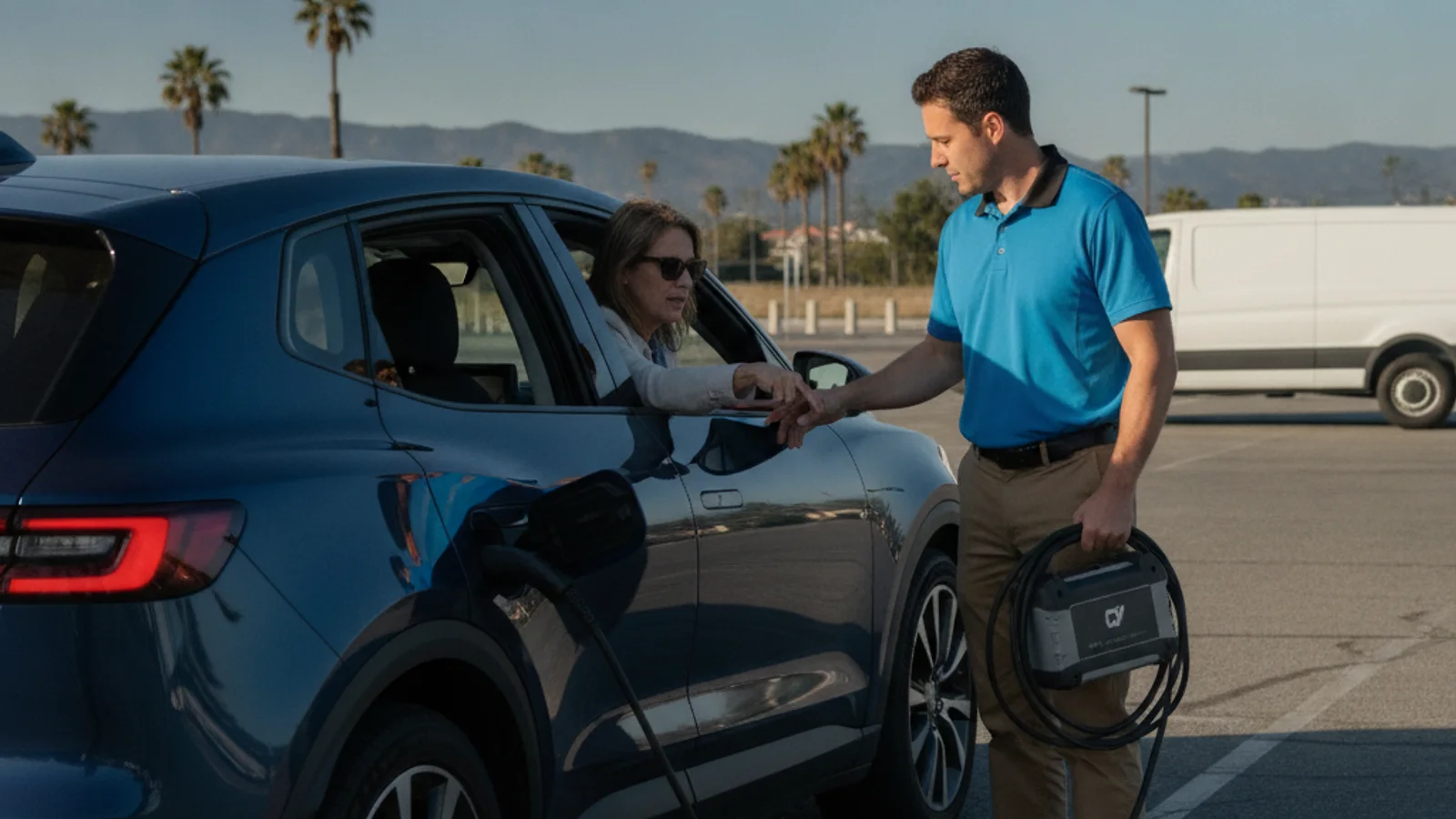
Inland Empire miles produce both kinds of stall
The Inland Empire isn’t one kind of drive. The Cajon climb on I-15 toward Victorville asks the pack for energy. The I-10 rise toward Beaumont and Banning does the same. Temecula grades and Ortega Highway near Wildomar ask the pack too. Warehouse lots in Fontana and Ontario add long sits after short miles.
A dead pack on those climbs is an energy problem. The car still talks to you, and the screen stays on. Range reads zero, or very close to it. You just can’t add miles without a charge or a ride.
A dead 12-volt looks like a different failure. The dash stays dark, and handles may not present. The traction pack can still hold a full charge. The small battery that runs computers and contactors has failed. Nothing will close the high-voltage loop until that system wakes.
Both stalls show up on these inland roads. Heat, long sits after a shift, and mountain runs all stress the car. This post can’t quote how often each mode hits. Charge Pro IE has no verified counts for those failures. Your dash and what still works are the evidence you have.
The traction pack is the one that moves you
Drivers say “EV battery” and mean the traction pack. It stores the energy that turns the motors. You fill it at home or at a public stall. A mobile Level 2 source can fill it on the shoulder too. When it’s empty, the car may still boot. It simply has nowhere to pull drive energy from.
That’s an out-of-charge problem, not a 12-volt one. Independent operators Charge Pro IE refers can bring a 240-volt Level 2 source. Tesla owners get a native NACS plug on that visit. Other brands use a CCS or J1772 adapter. Charging time is typically 15 to 30 minutes. That window is for adding about 10 to 20 miles of range. That figure is charging time, never an arrival promise. The matched operator quotes you before any cable goes on. You pay that operator directly for the work.
A Level 2 visit doesn’t refill a whole road trip. It’s enough to reach a destination charger or a safer lot. That’s only true if the car will take a charge. If the pack isn’t the problem, more energy won’t wake a dark 12-volt system. For the empty-pack path, see mobile EV charging.
The 12-volt battery is the one that wakes the car
Every EV still carries a small 12-volt battery. It doesn’t drive the wheels, and it doesn’t store trip range. It powers computers, locks, lights, and the screen. It also runs the relays that connect the traction pack. Fail that battery, and a healthy pack sits unused.
Tesla, Rivian, Hyundai, Ford, and Chevy all use a low-voltage system. Some model years use a lead-acid 12-volt battery. Newer Tesla Model 3 and Y cars can use a lithium 12-volt unit. Charge Pro IE has no verified voltage, capacity, or chemistry figures for any model. Your current owner’s manual is the source for those numbers.
A jump or an on-site 12-volt replacement can fit when the maker allows it. That step isn’t universal across brands or years. Don’t copy a video filmed on a different make. Confirm the procedure with the operator and the manual first. Tesla owners have a longer guide for this fork. See Dead Tesla: how to tell 12V failure from a dead pack. See when the 12-volt dies on the road for the wider stall.
Chemistry is a buying question, not a shoulder question
Forums argue pack chemistry, nickel content, and which supplier built which cells. None of that changes the call you make tonight. An operator isn’t testing cell chemistry on I-215 through Moreno Valley. They ask what the dash says and what still powers on.
Save chemistry for when you compare cars to buy. On the shoulder, the useful types are traction versus 12-volt. Pack chemistry doesn’t tell you if an Ioniq 5 needs energy or a jump. This site doesn’t publish unverified pack sizes or cell recipes. If a number matters, pull it from the manufacturer. The U.S. Department of Energy’s electric vehicle overview is general background. It won’t replace your manual for a model-specific step.
Read the car before you describe the stall
Two facts do more than any chemistry thread. Give the exact make, model, and model year. Then give the dashboard wording, word for word.
The model matters because jump points and service steps aren’t shared. A Tesla frunk post isn’t a Rivian layout. A Hyundai Ioniq 5 isn’t a Mustang Mach-E. Non-Tesla EVs have their own ports and rules. That’s why non-Tesla EV rescue is its own path.
The message matters because it’s the closest diagnosis you have. Range at zero, or a charge bar at empty, points at the traction pack. A black screen or handles that won’t present point at low voltage. Saying “it just died” helps almost nobody on the call. “The screen went dark and the handle stayed flush” does.
Note what still works on the car before you call. Interior lights, the phone app, and the key fob run on 12-volt power. The charge-port door usually runs on that same system. If some of those still answer while the car won’t drive, say so. If nothing answers at all, say that too.
Charge, jump, or a ride to a shop
Most Inland Empire stalls fall into three buckets. The right one depends on what you confirmed, not on a guess.
Charging fits when the traction pack is empty. The car also has to take a 240-volt feed. That’s a mobile charge, not a 12-volt fix.
A jump fits when the 12-volt has failed. The maker also has to support a roadside jump for that year. Some cars have posts behind a cover, in the frunk, or not at all. Tesla 12-volt jumps are common enough to have their own page. See Tesla 12V battery jump for that path. If a jump isn’t approved, don’t force one.
Transport fits when the cause is still unclear. It also fits when the car sits where equipment can’t reach it safely. Ask the operator straight if they aren’t sure. A match built on a guess is worse than “I don’t know yet.” If the fork is still muddy, use this walkthrough. Electric car died: charge it, jump the 12V, or tow it.
Charge Pro IE matches you with independent local operators. The brand doesn’t own trucks, employ technicians, or set prices. The operator on scene quotes, then bills you.
Your house utility doesn’t pick the fork
Inland Empire electric service isn’t one single company. Southern California Edison covers most cities, including Fontana, Ontario, Corona, and Temecula. Riverside Public Utilities serves the city of Riverside. Colton Electric Utility owns the grid inside Colton. The City of Banning Electric Utility serves Banning. Bear Valley Electric Service covers Big Bear Lake and Big Bear City. Lake Arrowhead and Crestline sit on SCE, not Bear Valley. Rancho Cucamonga is split: SCE plus Rancho Cucamonga Municipal Utility in a southeast pocket. Moreno Valley is split too, with SCE plus Moreno Valley Utility in newer development. None of that tells you which battery failed on the shoulder. Don’t wait on a utility truck for a stalled EV. Once you’re moving, the Inland Empire EV charging hub has local charging context.
Confirm details in the manual, not a forum
A general article can’t tell you where your jump posts sit. It can’t decode every warning string or promise a roadside 12-volt jump. Those details change by make, model, and year. Open the current owner’s manual for your exact vehicle first. Tesla’s owner resources and Rivian’s owner guides are the next stop. Each maker’s support line is next if the book is silent. If you can’t tell pack from 12-volt, say that on the call. An honest “I don’t know which battery this is” is better than a wrong diagnosis.
Call when you can’t classify the stall
Call when the EV won’t power on or won’t charge. Call if it shows a warning you can’t sort. The matched operator uses your model and the exact message. They sort charging, a 12-volt jump, or a tow from there. Charge Pro IE is a referral line, not a shop. It doesn’t hold a license, and it performs no work. If you need a match, call (909) 250-2881. We’ll connect you with a local EV rescue operator.